Category: Uncategorized

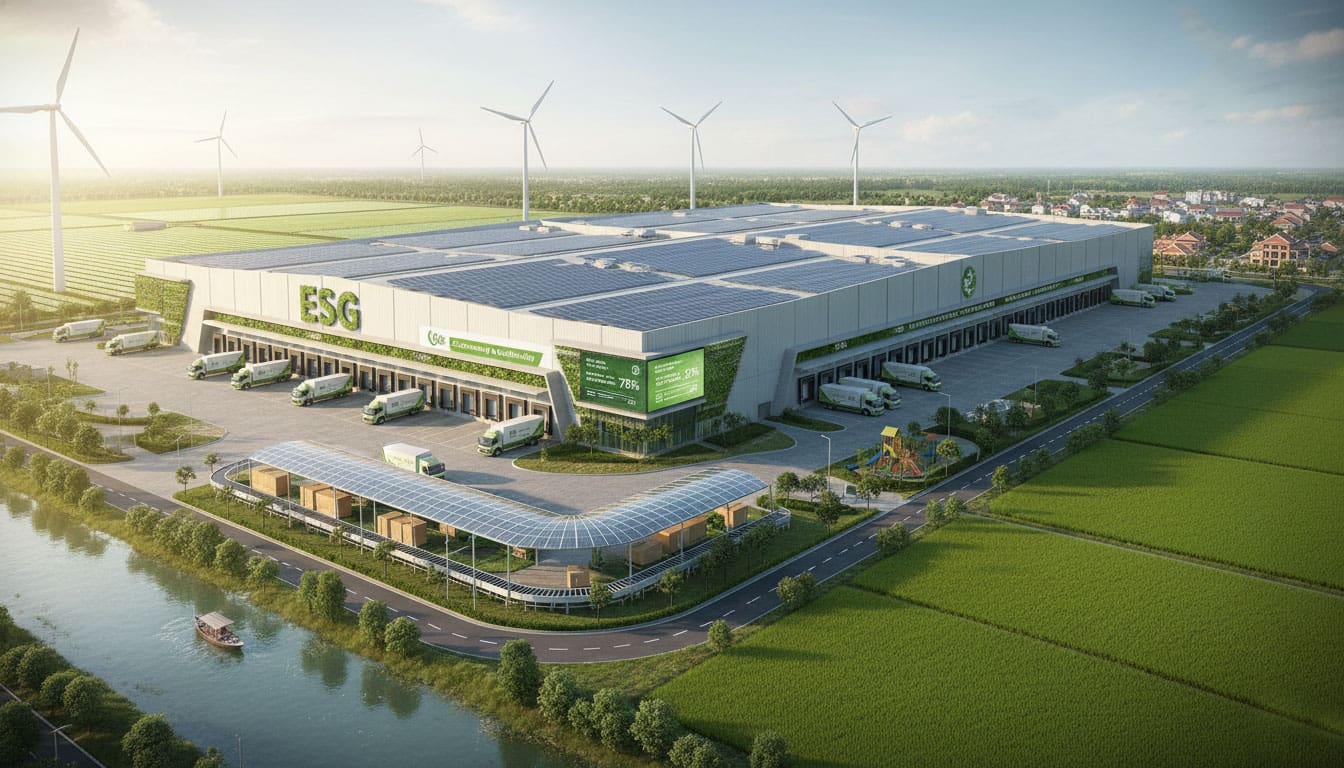
  • ISO Standard and Green Certification Warehouses: What Logistics Businesses Need to Know?

    ISO Standard and Green Certification Warehouses: What Logistics Businesses Need to Know?

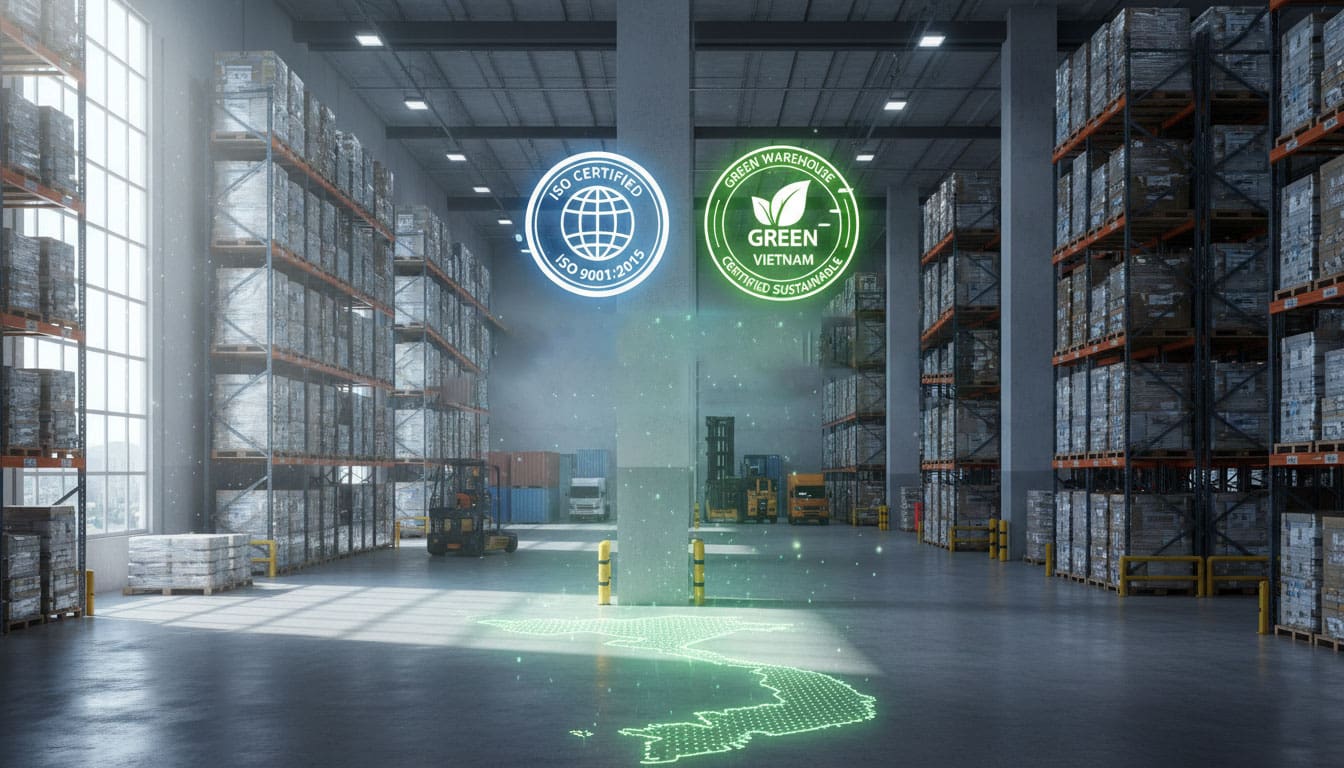
    International standard warehouses are facilities that have received independent verification from reputable accreditation bodies, confirming that their operational processes, storage environment, and infrastructure meet specific requirements. The two most crucial certification groups for businesses renting warehouses in Vietnam are: ISO (9001, 14001, 45001) – which assesses the quality of operational processes; and green certifications (LEED, EDGE) – which evaluate the energy efficiency and environmental performance of the facility. Warehouses meeting both sets of standards are currently leased at 10–25% higher rates but help tenant businesses save 15–30% in operating costs and meet ESG audit requirements from international partners (Savills Vietnam, 2024).

    ISO 9001, 14001, 45001 – What Do They Practically Mean for Warehouse Tenants?

    For businesses renting warehouses, ISO 9001 ensures that goods receipt/dispatch, inventory control, and incident handling processes are standardized and independently audited, minimizing risks of loss and misplacement of goods.

    ISO 14001 ensures the warehouse has a proper waste, emission, and energy management system – a mandatory condition if the tenant business needs to report ESG to its parent company. ISO 45001 guarantees a safe working environment for your warehouse operations team. In Vietnam, only about 30% of active logistics warehouses hold at least one ISO certification.

    A common reality in the Vietnamese warehouse market: many warehouse owners display “ISO certified” logos on their websites, but when logistics managers ask to see the original certificate, they receive vague answers like “it’s being renewed,” “that’s last year’s certificate,” or simply silence. This raises a more important question than just knowing what ISO is: you need to understand how ISO truly protects you, so you know what you’re losing when you rent a warehouse without it.

    ISO 9001 — “A Warehouse with a System, Not a Warehouse with a Talented Person”

    The biggest mistake warehouse tenants make is relying on an experienced “warehouse manager.” What happens if they leave? With ISO 9001, everything is run by processes, not individuals.

    • Practical meaning: Inbound, outbound, inventory counting, and defective goods handling processes are all documented. If goods are lost, you have evidence to investigate. If goods are incorrect, you know which stage the error occurred.
    • Telling numbers: ISO 9001 certified warehouses typically maintain an Inventory Discrepancy rate below 0.5%. In contrast, in “instinctively operated” warehouses, this figure can soar to 2–5%.
    • Tip for you: When visiting a warehouse, don’t just look at the shelves; ask: “Could you show me your process for handling damaged goods and your latest audit report?” If they hesitate, their system only exists on paper.

    ISO 14001 — Your “Passport” for ESG Reporting

    By 2026, if you want to export to the EU or work with multinational corporations, ESG (Environmental – Social – Governance) will be the biggest hurdle.

    What is Scope 3? Parent companies require you to report indirect emissions from outsourced services, including warehousing. An ISO 14001 certified warehouse will provide you with accurate electricity, water consumption, and CO2 emission data to complete your ESG report.

    • Risk of ignoring: You could be removed from a major client’s supplier list simply because your rented warehouse facility… lacks environmental data.
    • Benefits: Energy savings at the warehouse help reduce operating costs, indirectly keeping your warehouse rental prices more stable amidst energy price fluctuations.

    ISO 45001 — Safety is a Shared Responsibility

    Don’t assume you’re exempt if an accident occurs at a rented warehouse. According to Vietnam’s Labor Code, legal liability can sometimes be extremely complex if your employees are working on-site.

    • Safety standardization: An ISO 45001 certified warehouse ensures forklifts are maintained on schedule, signage is clear, and most importantly, the warehouse fire prevention and fighting system is always ready.
    • Prevention is better than cure: Renting an ISO 45001 certified warehouse helps you minimize the risk of supply chain disruptions due to fires or occupational accidents, which could lead to your goods being impounded for months for investigation.
    Standard Focus Direct Benefits for Tenants
    ISO 9001 Process quality Reduces loss, misplacement of goods.
    ISO 14001 Environment Provides data for ESG reports, “greenifies” image.
    ISO 45001 Occupational safety Reduces legal risks and disruptions due to incidents.

    According to the Vietnam Logistics Association (VLA), businesses renting warehouses that meet all three standards report an average 40–55% reduction in incident handling costs (damaged, lost, incorrect orders). Don’t just look at the rental price per square meter; look at the total cost of risk!

    Map of the Most Popular Green Certifications & Standards in the Warehousing Industry

    The warehousing industry features three main groups of certifications: (1) Green building certifications — LEED (US), EDGE (IFC), BREEAM (UK) — which assess a building’s energy and environmental performance; (2) Management system certifications — ISO 9001 (quality), ISO 14001 (environment), ISO 45001 (occupational safety) — which evaluate operational processes; and (3) Specialized certifications — HACCP, BRC, GDP — mandatory for cold storage, pharmaceutical, and food warehouses.

    Below is a comprehensive map of the standards every warehouse owner and logistics provider needs to master:

    1. Group 1 — Green Building Certifications

    This group evaluates the warehouse’s “hardware” — from construction materials to its ability to save electricity and water.

    Certification Origin Scope of Assessment Popularity in Vietnam Estimated Cost
    LEED US (USGBC) Comprehensive: Energy, water, materials, IEQ Very High (Gold Standard) 50,000 – 150,000 USD
    EDGE IFC (World Bank) Focuses on 3 indicators: Energy, Water, Materials Medium (Easier to achieve) 5,000 – 20,000 USD
    BREEAM UK (BRE) Very strict with 9 assessment criteria Low (Mainly EU projects) 30,000 – 100,000 USD
    LOTUS Vietnam (VGBC) Suitable for Vietnam’s specific climate and standards Rapidly growing 10,000 – 40,000 USD
    1. Group 2 — ISO Management System Certifications

    If Group 1 is the “body,” then Group 2 is the “soul.” These are operational process standards that ensure smooth warehouse operations.

    • ISO 9001:2015 (Quality): The “backbone” of every warehouse. It ensures that inbound/outbound/inventory processes do not rely on individual “memory” but on a documented system.
    • ISO 14001:2015 (Environment): Demonstrates that your warehouse has a systematic waste management and energy consumption system, a prerequisite for ESG reporting.
    • ISO 45001:2018 (Safety): Protects a company’s greatest asset — its people — while mitigating legal risks from forklift accidents or fires.
    • ISO 28000 (Supply Chain Security): Especially crucial for warehouses storing high-value goods (electronic components, pharmaceuticals) to prevent loss and unauthorized access.
    1. Group 3 — Specialized Certifications

    This group is not for the general public; it’s a “license to operate” for specific types of goods:

    Food & Consumer Goods Warehouses

    • HACCP: Controls critical points to prevent cross-contamination and mold in goods.
    • BRC Storage & Distribution: A global UK standard, it’s your “passport” if you want to store goods for major supermarkets like AEON, Walmart, or WinMart.
    • FSSC 22000: The highest level of food safety, integrating both ISO 22000 and stringent additional requirements.

    Pharmaceutical Warehouses (Must comply with Ministry of Health regulations)

    • GDP (Good Distribution Practice): Good practices for pharmaceutical distribution. Without this, you cannot legally store any medication in your warehouse.

    Choosing the right certification is like selecting an outfit for a party:

    • If you aim to raise capital or work with American/European clients: Prioritize LEED Gold and the ISO trio (9001, 14001, 45001).
    • If you want to optimize operational costs immediately: Start with EDGE to reduce electricity and water bills by 20%.
    • If you operate a cold storage warehouse: HACCP and ISO 22000 are mandatory to “survive” inter-agency inspections.

    A green-certified warehouse not only helps protect the planet but also tells your customers: “Your goods are cared for by the smartest, most sustainable, and safest system.”

    LEED, EDGE & LOTUS – The 3 Most Suitable Green Certifications for the Vietnamese Market

    In Vietnam, LEED is the most popular green certification for warehouses (accounting for ~60% of certified projects), but it comes with high costs (50,000–150,000 USD) and a complex process. EDGE, developed by IFC, is growing rapidly due to its lower costs (5,000–20,000 USD) and a minimum requirement of 20% savings in energy, water, and materials compared to the baseline. LOTUS is a local standard developed by VGBC, best suited to Vietnam’s climate conditions and building regulations.

    Below is a detailed comparison between LEED, EDGE, and LOTUS – the three most popular green building rating systems currently in Vietnam, to help you make the optimal choice:

    1. LEED (Leadership in Energy and Environmental Design) — The International “Gold” Standard

    Developed by the U.S. Green Building Council (USGBC), LEED is the most “powerful” certification globally, highly prioritized by multinational corporations (MNCs) when seeking warehouses.

    • Levels: Certified (40–49 points), Silver (50–59), Gold (60–79), Platinum (80+).
    • Advantages: Extremely high international recognition; significantly increases transfer value and rental prices (often 15-20% higher than conventional warehouses).
    • Disadvantages: High consulting and application fees (50,000 – 150,000 USD); assessment process takes 12–24 months.
    • Suitable for: Large-scale logistics warehouse projects (>20,000 m²), developers targeting Fortune 500 corporations as tenants.
    1. EDGE (Excellence in Design for Greater Efficiencies) — The Economical “Green” Solution

    This certification is developed by IFC (a member of the World Bank), focusing on practicality and immediate operational cost savings.

    • Minimum Requirements: Must achieve at least 20% savings in three indicators: Energy, Water, and Embodied Energy in materials compared to a conventional building.
    • Advantages: Quick process (3–6 months); low cost (5,000 – 20,000 USD). Businesses can conduct preliminary self-assessments using the free EDGE App software.
    • Financial Support: EDGE-certified projects often have easier access to preferential “Green Credit” packages from international banks like ADB or IFC.
    • Suitable for: Small and medium-sized warehouses (5,000 – 20,000 m²) looking to quickly “green” their operations to meet supply chain requirements with a reasonable budget.
    1. LOTUS — The “Local” Standard Optimized for Vietnam’s Climate

    Developed by the Vietnam Green Building Council (VGBC), LOTUS is a certification system specifically designed to suit Vietnam’s tropical climate characteristics and national building codes.

    • Structure: 8 assessment criteria groups, including aspects of Indoor Environment, Ecology, and Management.
    • Advantages: “Tropicalized,” effectively addressing specific humidity and temperature issues in Vietnam. Lower cost than LEED and easier access to government incentives for green buildings.
    • Disadvantages: Recognition among foreign partners (who have not worked in Vietnam) may be more limited compared to LEED or EDGE.
    • Suitable for: Domestic businesses looking to build a sustainable green management foundation, prioritizing high compatibility with Vietnamese legal regulations.

    Comparative Overview Table

    Criteria LEED EDGE LOTUS
    Origin USA IFC (World Bank) Vietnam (VGBC)
    Focus Comprehensive (Environment & People) Resource Efficiency (Electricity, Water) Tropical Climate & Vietnamese Standards
    Cost High (Very expensive) Low (Economical) Medium
    Time 1 – 2 years 3 – 6 months 6 – 12 months
    Popularity in VN ~60% of certified projects Fastest growing Stable in the domestic group
    • Choose LEED: If you are a developer of high-end warehouse projects in key economic regions (Binh Duong, Bac Ninh) and aim to attract tenants like Samsung, Apple, Shopee…
    • Choose EDGE: If your primary goal is to quickly reduce electricity and water costs by 20% each month and you need a swift international certification for ESG reporting.
    • Choose LOTUS: If you want to optimize warehouse design according to local weather conditions and wish to benefit from domestic investment incentives.

    By 2026, logistics businesses in Vietnam that achieve one of the above certifications are projected to experience 30% faster warehouse occupancy rates and more stable rental prices compared to the general market.

    Actual Process & Costs for Green Certification of Warehouses in Vietnam

    The process of achieving green certification for warehouses in Vietnam typically involves 5 steps: (1) Preliminary assessment & selection of suitable certification (1–2 months); (2) Integrated green design from the technical design phase (3–6 months); (3) Construction & collection of supporting documents (6–18 months); (4) Submission of documents & appraisal by the certification body (2–6 months); (5) Receipt of certificate & periodic maintenance. The total additional cost compared to conventional construction: 3–8% of construction value.

    In the context of 2026, when “Net Zero” is no longer just a slogan but a prerequisite for retaining major FDI players, transforming a conventional warehouse into a “green masterpiece” is a strategic move.

    However, “green” is not just about repainting walls. It’s a technical and financial journey that demands precise calculations. Below is the roadmap and actual “price list” for your reference:

    5 Implementation Steps — From Idea to Certification

    To achieve prestigious certifications like LEED (USA), EDGE (IFC), or LOTUS (Vietnam), you need to navigate the following “obstacle course”:

    • Step 1: Pre-Assessment [1–2 months]: Experts will scrutinize the “gap” between the current design and green standards. This is when you choose your “challenge”: Do you want quick electricity savings (EDGE) or a globally renowned certification (LEED)?
    • Step 2: Integrated Green Design (3–6 months): The technical team will “operate” on the blueprints. Commonly modified items include: Sensor-controlled LED lighting systems (reducing electricity by 40–60%), heat-reflective roofing, and especially rainwater harvesting systems for irrigation/cleaning.
    • Step 3: Collection of Supporting Documents (6–18 months): This is the most “diligent” phase. You must gather sufficient invoices for environmentally friendly materials, air quality measurement reports, and actual energy consumption data.
    • Step 4: Document Appraisal (2–6 months): Documents are sent to the USA (LEED) or the IFC organization (EDGE). This is when you await the “nod” from international experts.
    • Step 5: Maintenance and Recertification: A green certificate is not eternally valid if you “neglect” it. You need to monitor performance periodically to ensure the warehouse continues to operate according to the committed green standards.

    Comparison Table of Costs & Benefits (Estimated 2026)

    Don’t view costs as a loss; see them as an “insurance premium” for long-term asset value.

    Cost Category EDGE (Basic) LEED Silver LEED Gold
    Certification Consulting Fee 5,000 – 10,000 USD 20,000 – 50,000 USD 40,000 – 80,000 USD
    Application Fee 2,000 – 5,000 USD 5,000 – 15,000 USD 5,000 – 15,000 USD
    Additional Construction Cost 2 – 4% 5 – 8% 8 – 12%
    Payback Period 4 – 6 years 6 – 10 years 8 – 12 years
    Asset Value Increase +8 – 12% +15 – 20% +20 – 30%

    Strategic Perspective: Investment or Cost?

    Many warehouse owners often “feel the pinch” when construction costs increase by nearly 10%. However, actual market data (Savills, 2024) reveals a very sweet reality:

    “A LEED Gold certified warehouse in industrial hubs like Binh Duong or Bac Ninh commands 18–22% higher rental prices compared to conventional warehouses. Notably, the vacancy fill rate is 30% faster because multinational corporations always prioritize green warehouses to fulfill their ESG reporting requirements.”

    In other words: You spend more money today to ensure your warehouse isn’t “left empty” and maintains good value for the next 10-20 years.

    If you’re just starting out with a moderate budget, EDGE is the most “cost-effective and beneficial” option for quick green certification. If you’re targeting Fortune 500 corporations as clients, LEED Gold is the heavy-duty “weapon” you need.

    The cost of greening warehouses should not be seen as a “cost” but rather as an insurance premium for long-term asset value. A LEED Gold certified warehouse in Binh Duong can command 18–22% higher rent than a conventional warehouse in the same area, with a 30% faster fill rate.

    Current Status & Green Logistics Roadmap in Vietnam Until 2030

    As of 2024, only about 8% of the total logistics warehouse area in Vietnam meets international green standards — significantly lower than Singapore (45%) and Thailand (22%). However, the growth rate is accelerating: the number of new green warehouse projects registered for certification increased by 35% in 2023. The Vietnamese government aims for 25% of new constructions to meet green standards by 2025 and 50% by 2030, in line with the National Green Growth Strategy.

    1. Current Landscape: Gaps & Opportunities

    Despite being one of the fastest-growing logistics markets, Vietnam’s warehouse “greenness” still lags considerably behind its neighbors.

    • Coverage Rate: As of 2024, only about 8% of warehouse area meets green standards. Compared to Singapore (45%) and Thailand (22%), we are still in the early stages.
    • Geographic Density: 70% of green warehouses are concentrated in industrial hubs such as Binh Duong, Long An, Hanoi, and Hai Phong. These are areas with a strong presence of “big players” like LOGOS, GLP, and BW Industrial.
    • Key Drivers: FDI enterprises (Samsung, Apple, LEGO) are the “locomotives” driving this trend, as they require logistics providers to green their operations to meet global ESG reporting.
    1. Government & International Support Policies

    To achieve the Net Zero target, the Government has been rolling out attractive support packages:

    Support Source Incentive Type Benefits for Businesses
    National Strategy Tax incentives, reduced land rent Reduces initial CAPEX costs for green projects.
    IFC EDGE Program Free technical assistance Helps standardize energy/water-saving designs quickly.
    ADB Green Finance Preferential interest rates (0.5–1% reduction) Access to affordable capital for green cold chains.
    Decree 98/2020 Legal framework for green buildings Creates a legal basis for businesses to bid internationally.
    1. Green Logistics Roadmap Until 2030

    The journey from now until 2030 is divided into 3 key phases:

    Phase 2024 – 2025: Building the Foundation

    • Objective: 25% of new warehouse constructions meet green standards.
    • Focus: Digitizing energy consumption data and beginning to integrate Rooftop Solar.

    Phase 2026 – 2028: Accelerating & Carbon Market Operation

    • Objective: Official operation of the Carbon credit exchange (2028).
    • Focus: Green warehouses can start selling Carbon credits, creating new revenue streams. Electric trucks and electric forklifts become standard in major industrial parks.

    Phase 2029 – 2030: Widespread Standardization

    • Objective: 50% of new constructions meet green standards.
    • Focus: “Green Lease” becomes mandatory in major B2B transactions. Warehouses not meeting green standards will face high domestic Carbon taxes.
    1. Warehouse Trends in 2026

    If you are investing in or managing warehouses, pay attention to these 3 trends:

    • Green Lease: More than just renting space, contracts will clearly define emission reduction levels and share energy saving costs between warehouse owners and tenants.
    • Solar Warehouse: Installing solar power will no longer be an “option” but a mandatory item from the moment new warehouse construction permits are applied for.
    • Reverse Logistics: Warehouse systems will be designed to automatically handle the collection and recycling of packaging, reducing environmental waste.

    The current 8% may seem modest, but with the demand for green warehouses growing at approximately 25–30% annually, this is a “blue ocean” for investors. Those who own LEED or EDGE certified warehouses now will hold the most valuable assets by 2030.

    FAQ

    What is green certification for warehouses and why is it necessary?

    Green certification for warehouses is an independent confirmation from an international organization (USGBC, IFC, BRE) that a building meets standards for energy efficiency, water use, building materials, and workplace environmental quality. Green certification helps warehouses increase asset value by 15–30%, attract international tenants, and access preferential green credit—increasingly becoming a requirement in global supply chains.


    How do LEED, EDGE, and LOTUS differ? Which one should you choose for your warehouse in Vietnam?

    LEED (USA) is the most widely recognized global standard, suitable for large-scale warehouses with multinational tenants, costing $50,000–$150,000. EDGE (IFC) is more cost-effective ($5,000–$20,000), requiring energy/water/material savings of ≥20%, ideal for small and medium-sized warehouses. LOTUS is a Vietnamese standard suitable for the local climate and building regulations, with lower costs but limited internationalization.


    What ISO standards are necessary for a warehouse to operate professionally?

    The ISO standards required for a professional warehouse include: ISO 9001:2015 (quality management of warehousing processes), ISO 14001:2015 (environmental management, emission and waste control), ISO 45001:2018 (occupational safety, accident prevention), and ISO 28000 (supply chain security). Many international tenants require warehouses to have at least ISO 9001 and 14001 before signing long-term contracts.

    What specialized certifications are required for cold storage and pharmaceutical warehouses?

    Food cold storage warehouses are required to have HACCP certification, and BRC Storage & Distribution certification is recommended if serving international retail chains (Walmart, AEON, Tesco). Pharmaceutical warehouses must meet GDP (Good Distribution Practice) standards as regulated by the Vietnamese Ministry of Health and WHO-GDP if serving exports. Large-scale freezer warehouses must also have FSSC 22000 certification to meet integrated food safety standards.

    What are the costs to obtain LEED certification for warehouses in Vietnam?

    The total cost to obtain LEED certification for warehouses in Vietnam ranges from US$25,000–US$150,000 depending on the level (Certified to Platinum), including consulting fees (US$20,000–US$80,000) and USGBC filing fees (US$5,000–US$15,000). In addition, construction costs increase by 5–12% compared to a standard warehouse. However, LEED Gold warehouses can command 18–22% higher rental rates and increase asset value by 20–30% within 5 years.


    Can existing warehouses (not new constructions) achieve green certification?

    Yes. Both LEED and EDGE have certification categories specifically for existing buildings: LEED O+M (Operations + Maintenance) and EDGE Existing Buildings. The process focuses on optimizing operations: replacing lighting systems with LEDs, installing solar power, upgrading insulation systems, and implementing smart energy management. Renovation costs are typically 30–50% lower than new construction, but the scores achieved are also lower.


    Does green certification really lead to higher rental prices for warehouses?

    Market data confirms this. LEED-certified warehouses in Binh Duong and Long An are being leased at 10–25% higher rates than comparable uncertified warehouses in the same area (Savills Vietnam, 2024). Beyond the rental price difference, green warehouses also have 15–20% higher occupancy rates, shorter vacancy times when tenants change, and better tenant credit profiles—all of these factors combined create superior long-term profitability.


    What incentives does the Vietnamese government offer for warehouses that achieve green certification?

    According to the National Green Growth Strategy 2021–2030, green building projects receive incentives such as reduced land lease fees, preferential corporate income tax rates during the initial operating phase, and priority in construction permit procedures. In addition, the IFC and ADB provide green credit packages with interest rates 0.5–1% lower per year for logistics warehouse projects that achieve EDGE or LEED certification in Vietnam.


    How long does it take to obtain EDGE certification for a warehouse in Vietnam?

    The EDGE certification process typically takes 4–8 months in total: 1–2 months for preliminary assessment and design adjustments, 1–2 months for documentation preparation, and 2–4 months for verification and certification from IFC. This is the shortest timeframe among international green certifications, which is why EDGE is being chosen by many small and medium-sized developers in Vietnam as the first step in their greening journey.


    Where will green warehouse certification trends in Southeast Asia go in the next 5 years?

    By 2030, it is projected that more than 30% of newly built logistics warehouses in Southeast Asia will have at least one international green certification (JLL, 2024). In Vietnam, three trends will shape the market: (1) Green lease becoming a standard clause in warehouse lease contracts; (2) Carbon credit from green warehouses becoming an additional revenue source when the Vietnamese carbon credit market operates from 2028; (3) AI-driven energy management integrated into certified warehouses, automatically optimizing electricity consumption and reporting ESG in real time.
  • What are Industrial Outdoor Storage? Trends, Data & Potential in Vietnam

    What are Industrial Outdoor Storage? Trends, Data & Potential in Vietnam

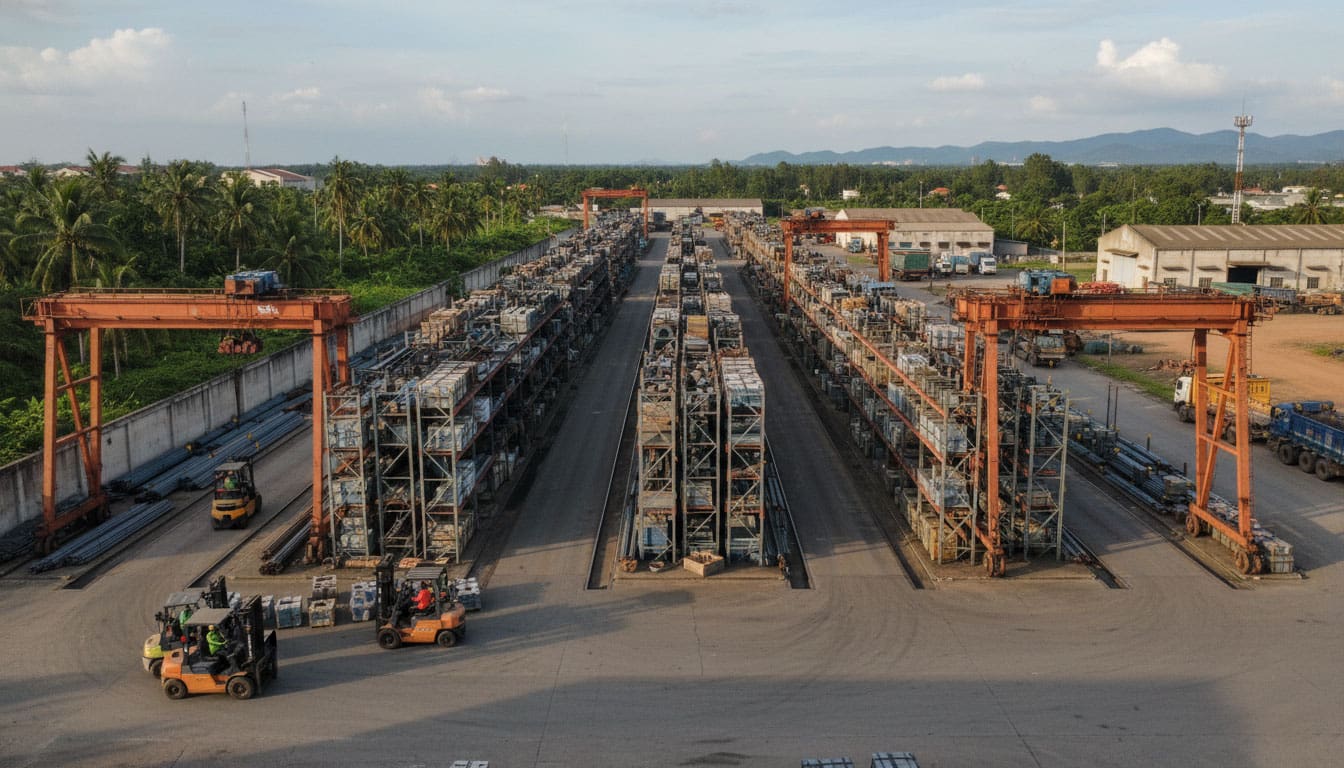
    Industrial Outdoor Storage (IOS) is a type of industrial real estate that utilizes outdoor space for storing heavy equipment, containers, machinery, trucks, and construction materials. Unlike traditional warehouses, IOS does not require a roof structure, which helps reduce initial investment costs by 40–60% compared to conventional warehouses.

    What is Industrial Outdoor Storage (IOS)?

    Industrial Outdoor Storage (IOS) is a type of industrial real estate that uses outdoor space, either uncovered or partially covered, for storing containers, semi-trucks, heavy machinery, and construction materials. IOS offers 40–60% lower investment costs compared to traditional covered warehouses, making it ideal for logistics, transportation, and construction businesses.

    Unlike conventional warehouses that demand complex roof structures, fire suppression systems, and temperature control, IOS optimizes land utility by maximizing the use of vacant ground space – a crucial factor many logistics and transportation businesses urgently need but lack flexible, cost-effective solutions for.

    How Does IOS Differ from Other Types of Industrial Real Estate?

    Many people confuse IOS with ordinary vacant lots or categorize it with warehouses. In reality, IOS holds a distinct position within the industrial real estate sector, boasting clear characteristics.

    Criterion IOS Warehouse Logistics Center Open Yard
    Roofing None or partial Full Full None
    Storage Items Vehicles, containers, heavy machinery Packaged goods, pallets Diverse goods, cross-dock Raw materials, scrap
    Infrastructure Requirements Medium High Very High Low
    Investment Cost/m² Low (5–15 USD/sqft) Medium (80–130 USD/sqft) High (130–200 USD/sqft) Very Low
    Legal Status & Standardization Emerging Mature Mature Unclear
    Cap Rate 5.5–7.5% (increasing) 4–6% 3.5–5% Low

    Key difference: IOS is not a “vacant lot”; it’s a professionally invested asset featuring load-bearing foundations, security systems, and technical infrastructure designed to meet businesses’ actual operational needs.

    What Types of Goods & Assets Are Typically Stored at IOS?

    IOS serves a diverse range of industries, from logistics and construction to renewable energy. Below are the most common asset groups:

    • Transportation & Logistics Industry: This is the largest global tenant group for IOS. Companies like Amazon, FedEx, and DHL utilize IOS to park semi-trucks, empty containers, and semi-trailers between shipments. According to Savills (2024), IOS demand from this sector increased by 30% in the US market during 2020–2023.
    • Construction & Infrastructure Industry: Excavators, cranes, road rollers, scaffolding, and pre-fabricated steel components all require spacious outdoor storage with high ground bearing capacity. IOS is the optimal choice as it avoids wasted roofing costs for assets inherently designed for outdoor operation.
    • Renewable Energy Industry: Solar panels, wind turbines, and Battery Energy Storage Systems (BESS) are large-sized assets that cannot be stored in conventional warehouses. IOS demand from this industry is rapidly growing in line with global renewable energy deployment.
    • Automotive & Commercial Vehicles Industry: Storage lots for imported vehicles, long-term rental cars, commercial vehicles awaiting maintenance, or storage for automotive and motorcycle spare parts.

    All of these represent ideal clients for IOS, requiring large areas and long-term leases.

    Identifying a Standard-Compliant IOS Location

    Not every vacant plot can be classified as IOS. A professional IOS location typically possesses the following characteristics:

    • Scale & Location: IOS operates effectively on areas ranging from 0.5 hectares to 50+ hectares, strategically located within a 15–20 km radius of seaports, cargo airports, or industrial beltways – areas where heavy trucks can easily access without violating urban traffic regulations.
    • Technical Infrastructure: The yard surface is paved with concrete or asphalt, ensuring a minimum load capacity of 5–10 tons/m² to withstand fully loaded container trucks. Surface drainage systems are designed to prevent flooding that could affect stored assets.
    • Security & Operations: 24/7 CCTV surveillance, robust fencing, access control gates, and full site lighting are minimum requirements. Many modern IOS facilities also integrate IoT sensors for real-time asset tracking.

    According to JLL (2023), the US IOS market boasts over 15,000 active locations with a total value of $200 billion, indicating a highly standardized segment in developed markets and an emerging phase in Vietnam.

    Industrial Outdoor Storage (IOS) Là Gì?

    Why Industrial Outdoor Storage (IOS) is Becoming the Most Attractive Industrial Real Estate Segment

    IOS appeals to investors due to its low construction costs, ranging from just 5–15 USD/sqft (compared to 80–200 USD/sqft for covered warehouses). Meanwhile, cap rates reach 5.5–7.5%, and occupancy rates in major markets are as high as 96–98%. Demand for IOS in the US surged by 30% between 2020–2023, driven by the e-commerce boom and the rise of last-mile delivery (Savills, 2024).

    While many commercial real estate segments face pressure from high interest rates and weakening demand, IOS is bucking the trend with increasing occupancy rates, escalating rental prices, and a growing influx of institutional capital. What’s truly fueling this upward trajectory?

    Scarce Supply Amidst Exploding Demand

    The biggest paradox in the IOS market is this: it’s one of the simplest real estate types to operate, yet finding the best locations is incredibly challenging. The reason lies in the fact that IOS properties only realize their full value when situated near ports, major transportation arteries, or large urban peripheries – precisely where land is rapidly depleting due to urbanization.

    Consequently, the IOS vacancy rate in the 10 largest US markets is only 3–5% (CBRE, 2023), a figure even cold storage or data centers struggle to achieve. In gateway markets like Los Angeles, New Jersey, and Chicago, this rate drops to below 2%, pushing rental prices up by 15–25% in just two years.

    On the demand side, three key drivers are simultaneously boosting the need for IOS:

    • E-commerce & last-mile delivery: Giants like Amazon, FedEx, and UPS require hundreds of distributed truck parking lots around urban areas to shorten delivery times to 2–4 hours.
    • Growth in international trade: Global container throughput at ports increased by an average of 4.5% annually from 2021–2023 (UNCTAD, 2024), leading to a corresponding rise in demand for temporary container yards.
    • Infrastructure construction: Large-scale public investment packages in the US (such as the Infrastructure Investment and Jobs Act – 1.2 trillion USD) are driving demand for construction equipment storage yards to record levels.

    Stable Cash Flow — An Advantage Few Segments Possess

    One of the reasons institutional investors are increasingly drawn to IOS is its incredibly lean cost structure. Without complex HVAC systems, freight elevators, or elaborate fire suppression systems, operating and maintenance costs for IOS are significantly lower than traditional warehouses.

    As a result, professional IOS operators can achieve EBITDA margins of 60–70%, substantially higher than the 35–45% seen in traditional warehouses. Combined with the common 3–7 year long-term leases in the industry, cash flow from IOS is highly predictable and less volatile with economic cycles.

    Comparing cap rates: IOS cap rates reached 5.5–7.5% (JLL, Q4 2023), outperforming Class A offices (3.5–5%) and retail centers (5–6.5%), all while boasting significantly lower operational risk.

    Thuật ngữ Xuất Nhập Khẩu, Logistics & Kho Bãi – Từ vựng tiếng Anh chuyên ngành 3

    Institutional Capital Flow – A Confirmation Signal from “Smart Money”

    The quickest way to identify a maturing real estate segment is to observe who is allocating capital. For IOS (Industrial Outdoor Storage), that list is growing longer and more impressive by the day.

    Blackstone, the world’s largest real estate fund with over $300 billion in assets under management, publicly announced its strategy to expand its IOS portfolio in 2022. Brookfield Asset Management and EQT Exeter have, in turn, established specialized funds for this segment. The total value of IOS M&A transactions in North America in 2023 exceeded $8 billion, doubling from 2021.

    This not only reflects confidence in short-term cash flow but also a long-term bet on the irreversible scarcity of suburban industrial land.

    China+1 Trend – A Special Opportunity for Southeast Asia

    Amidst a complex global geopolitical landscape, numerous multinational corporations are diversifying their supply chains under the China+1 strategy, maintaining manufacturing bases in China while simultaneously expanding into Vietnam, Indonesia, Thailand, and Malaysia.

    Each wave of manufacturing relocation brings an immediate demand for container yards, equipment storage, and transshipment areas – precisely the “address” for IOS. Vietnam is embracing this wave with FDI into the manufacturing sector increasing by 8–10% annually, while professional IOS infrastructure is almost non-existent, creating a significant market gap for both domestic and international investors.

    JLL’s Perspective: “IOS is following in the footsteps of cold storage a decade ago, evolving from a niche segment that few noticed into a highly sought-after asset with increasingly high valuations.” – Analysis from JLL Industrial Outlook 2024.

    The IOS Market in Vietnam: Current State & Opportunities

    In Vietnam, IOS is not yet officially classified within the industrial real estate legal framework, but actual demand is rapidly increasing in major port clusters like Cai Mep – Thi Vai and the Hanoi – Hai Phong corridor. Occupancy rates in Southern industrial parks reached ~93%, with industrial land lease prices increasing by 10–15% compared to 2022, averaging 160–200 USD/m²/lease cycle (Savills Vietnam, 2024).

    The paradox of Vietnam’s IOS market lies in this: real demand exists, but professional supply is almost non-existent. Thousands of logistics, transportation, and construction businesses are forced to self-manage with spontaneously leased land, unstandardized container yards, or pay significantly higher costs to lease standard industrial park land, even though they only need a well-managed outdoor space. This is precisely the gap that IOS can fill.

    3 Key Areas with the Highest IOS Potential

    Cai Mep – Thi Vai Port Cluster (Ba Ria – Vung Tau)

    Cai Mep – Thi Vai is currently Vietnam’s largest deep-water port cluster, capable of accommodating super-large container vessels with a deadweight tonnage of up to 200,000 DWT – something that Cat Lai Port (Ho Chi Minh City) cannot do. Container throughput through this cluster reached 7.2 million TEU in 2023, an 18% increase compared to 2022 (Vietnam Maritime Administration).

    This enormous volume of container movement creates an urgent demand for empty container yards, truck parking, and container cleaning and repair areas – all typical use-cases for IOS. Currently, most of this demand is met by unstandardized, self-managed yards, posing potential legal and safety risks.

    Hanoi – Hai Phong Corridor

    This is the vital logistics artery of the North with the 105 km Hanoi – Hai Phong expressway, directly connecting the capital with Lach Huyen Port, the largest deep-water port in the North, which is currently in its second phase of expansion.

    Along this corridor, provinces like Hung Yen, Hai Duong, and Hai Phong are attracting a strong wave of FDI from Samsung, LG, Foxconn, and numerous Tier 1–2 suppliers in the global electronics supply chain.

    Every new factory that comes into operation generates demand for storage yards for equipment, forklifts, bulky components, and export containers awaiting customs clearance – a demand that IOS serves better than any other type of real estate.

    Occupancy rates in industrial parks in Hai Phong and Hung Yen reached 85–92% in Q1 2024, with industrial land lease prices increasing by an average of 12% compared to Q1 2023 (CBRE Vietnam, 2024). Pressure on industrial land is pushing businesses to seek IOS solutions as a more cost-effective option.

    Da Nang — An Emerging Central Vietnam Gateway

    Less noticed than the Northern and Southern regions, Da Nang is quietly becoming a logistics hotspot thanks to its central location on the East-West Economic Corridor (EWEC) – a road connecting Myanmar, Thailand, Laos, and Vietnam to seaports.

    Tien Sa Port is being upgraded to accommodate larger vessels, while Da Nang High-Tech Park and Hoa Khanh, Lien Chieu Industrial Parks continue to expand. Demand for commercial vehicle parking, construction equipment, and transit goods is rapidly increasing, but no systematic IOS solutions have been implemented yet.

    Growth Drivers: 3 Concurrent Waves

    1. Wave 1 — Shifting Manufacturing FDI: Vietnam attracted $39.4 billion in registered FDI capital in 2023 (Ministry of Planning and Investment), with the processing and manufacturing sector accounting for over 65%. Each large-scale FDI project that becomes operational brings with it an ecosystem of suppliers, transportation units, and logistics services – all potential customers for IOS.
    2. Wave 2 — Accelerating China+1: US-China trade tensions and tariff policies are making Vietnam a priority destination in global supply chain diversification strategies. According to Cushman & Wakefield (2024), Vietnam is among the top 3 countries benefiting most from the China+1 trend in Southeast Asia, alongside Indonesia and Thailand.
    3. Wave 3 — Booming Domestic E-commerce: Vietnam’s e-commerce market reached $20.5 billion in 2023, a 25% increase compared to 2022 (VECOM, 2024), placing Vietnam among the top 3 fastest-growing e-commerce markets in Southeast Asia. Shopee, Lazada, and TikTok Shop are heavily investing in fulfillment infrastructure and last-mile delivery – creating new demand for delivery vehicle parking, transshipment warehouses, and suburban outdoor goods collection points.

    Challenges to Overcome Before IOS Breaks Through

    Despite its clear potential, the IOS market in Vietnam faces three main barriers that investors need to understand before participating:

    1. Barrier 1 — Regulatory Gap: The Land Law 2024 and current industrial real estate regulations do not yet have a specific definition or classification for IOS. This makes permitting, valuation, and asset transfer for IOS more complex compared to traditional warehouses or industrial parks. Investors must work on a case-by-case basis with local authorities, leading to lengthy approval times and unpredictable outcomes.
    2. Barrier 2 — Lack of Uniform Technical Standards: There are no national standards for IOS yard floor load capacity, surface drainage systems, or environmental requirements for outdoor storage activities. Each locality applies different standards, making it difficult to standardize products and compare quality across locations.
    3. Barrier 3 — Planning Risks: Some areas with high IOS potential (suburban, near ports) are located within zones planned for land use conversion within the next 5–10 years. Investors need to conduct thorough due diligence on local 1/2000 and 1/500 planning before committing to long-term investment.

    These barriers do not negate the potential; they actually create an advantage for early movers. Investors with strong legal capabilities and local relationships will be able to establish a dominant position before the Vietnamese IOS market becomes standardized and more competitive – just as happened with the cold storage and logistics segments in Vietnam during 2015–2020.

    Criteria for Evaluating a Standard IOS Location

    A standard Industrial Outdoor Storage location must meet three groups of criteria:

    1. Location – within 15 km of a port or national highway, and within a 30-minute radius of a major industrial park;
    2. Technical specifications – minimum ground bearing capacity of 5–10 tons/m², an environmentally compliant drainage system, and an access road clearance height of ≥ 5.5m;
    3. Legal compliance – correct industrial land use purpose, and full warehouse fire prevention & fighting and environmental permits for warehousing.

    The most common mistake when evaluating an IOS is focusing solely on rental prices while overlooking hidden costs arising from an inconvenient location, insufficient ground bearing capacity, or unresolved legal risks. An IOS location that is 20% cheaper but far from major transport routes could increase transportation costs by up to 40% — completely negating the initial rental price advantage.

    Criterion Group 1 — Location & Accessibility

    Location is the only factor that cannot be changed after investment, making it the first and most stringent filter in the IOS due diligence process.

    Location Criteria Minimum Threshold Ideal Threshold
    Distance to Port/ICD ≤ 20 km ≤ 10 km
    Distance to National Highway/Expressway ≤ 5 km ≤ 2 km
    Radius to Nearest Major Industrial Park ≤ 30 minutes ≤ 15 minutes
    Access Road Clearance Height ≥ 5.5 m ≥ 6.0 m
    Access Road Load Capacity ≥ 30 tons/axle ≥ 40 tons/axle

    Beyond distance, it’s crucial to check truck traffic regulations: some routes prohibit heavy vehicles during peak hours or at night, directly impacting the operational efficiency of IOS tenants — especially for logistics businesses operating 24/7 shifts.

    Criterion Group 2 — Site Technical Specifications

    This group of criteria creates the biggest distinction between a professional IOS and an improvised yard. Technical infrastructure investment costs typically account for 60–70% of the total IOS development capital, but this investment directly determines rental rates, tenant quality, and asset lifespan.

    Ground & Site Structure:

    Ground bearing capacity is the most critical technical parameter. A fully loaded 40-foot container can weigh up to 30 tons, and when placed by a reach stacker, it exerts immense point pressure on the yard’s surface. The minimum standard for container IOS is 5 tons/m², but IOS facilities serving heavy trucks and machinery need to achieve 8–10 tons/m². A reinforced concrete slab, at least 20–25 cm thick, over a compacted sand layer is the most common solution.

    Drainage System:

    IOS in Vietnam often falls short in this criterion, yet it’s a weakness that causes the most significant damage during the rainy season. The surface drainage system must be designed to handle extreme rainfall (≥ 100 mm/hour in Ho Chi Minh City and southern provinces), ensuring the site remains flood-free after 30 minutes of heavy rain. Wastewater from car washes and container maintenance areas must be collected and treated according to QCVN 40:2011/BTNMT before discharge.

    Security & Operations:

    Minimum security checklist for an internationally standard IOS:

    • High-resolution surveillance cameras, covering 100% of the area, with a minimum 30-day storage capacity
    • Robust fencing ≥ 2.4 m high with intrusion detection systems
    • Controlled gate with Automatic License Plate Recognition (ALPR) system
    • Minimum 50 lux illumination across the entire premises at night
    • 24/7 security guard presence at the main gate

    Criterion Group 3 — Legal & Planning

    This group of criteria presents the most hidden risks in the Vietnamese market, especially as the legal framework for IOS is not yet standardized.

    Land Use Purpose

    IOS land must be classified as non-agricultural production and business land (SKC or TMD purpose according to the 2024 Land Law). Absolutely avoid developing IOS on agricultural land that has not completed conversion procedures or on disputed land, as the risk of operational suspension or revocation is very high.

    Long-term Planning

    Consult the district-level land use plan for the 2021–2030 period and the 1/2000 scale zoning plan for the area to confirm that the land is not designated for conversion to urban, transportation, or public works purposes within the next 10 years.

    Operating Permits

    List of required permits before operating an IOS in Vietnam:

    • Land Use Rights Certificate (red/pink book) with the correct purpose
    • Construction permit for auxiliary structures (if there are offices, weighbridges)
    • Certificate of completion for environmental protection works (as per Decree 08/2022/NĐ-CP)
    • Fire Prevention & Fighting (PCCC) acceptance report from the local Fire Police

    Practical note for the Vietnamese market: Prioritize selecting land within the boundaries of industrial parks with Prime Minister-approved planning. Although rental prices may be 15–25% higher than land outside industrial parks, investors benefit from synchronized technical infrastructure, a single legal point of contact (Industrial Park Management Board), and virtually eliminate planning risks throughout the project’s lifespan.

    Kho Công Nghiệp Ngoài Trời Là Gì? Xu Hướng, Số Liệu & Tiềm Năng Tại Việt Nam

    Global IOS Trends & Forecast to 2030

    The global Industrial Outdoor Storage (IOS) market is projected to reach 500 billion USD by 2030 (Grand View Research, 2024), with Southeast Asia experiencing a 15–18% CAGR from 2024–2029. Key trends include: integrating solar power on IOS sites, developing commercial electric vehicle (EV) depots, and implementing marketplace platforms for hourly/daily IOS rentals, similar to the Airbnb model.

    If the 2010s were the era of smart warehouses with robots and automated conveyor belts, then the 2020–2030 decade is shaping IOS into a next-generation physical infrastructure platform – where green energy, digital technology, and logistics converge on a single outdoor footprint.

    Trend 1 — Green IOS: From Parking Lots to Power Plants

    The vast outdoor space of IOS, once considered an aesthetic drawback, is rapidly becoming a competitive advantage in the ESG era. The “Solar Canopy IOS” trend – installing solar panels on a framework covering the entire parking area – is booming in Europe and beginning to spread to North America and Southeast Asia.

    A 5-hectare IOS site equipped with a solar canopy can generate 4–6 MW of electricity, sufficient to power its entire operations and sell surplus back to the grid, transforming IOS from a mere land rental asset into a multi-revenue generating property. The average investment cost for a solar canopy is 150–200 USD/m², with a payback period of 7–10 years in Vietnam due to preferential rooftop solar electricity prices under Net Metering policies.

    Beyond solar power, some advanced IOS sites also integrate:

    • Commercial EV charging hubs for tractor-trailers and delivery trucks
    • Rainwater harvesting and reuse systems for vehicle washing and landscaping
    • LEED or EDGE green certifications to attract multinational tenants committed to ESG goals

    Trend 2 — Digitalization of IOS Management

    Traditional IOS management relies on security guards, manual ledgers, and phone calls – a model that cannot scale when property areas span tens of hectares with hundreds of vehicles and containers requiring simultaneous tracking.

    • IoT & GPS Asset Tracking IoT sensors attached to containers, machinery, and vehicles allow site owners and tenants to monitor real-time location, operational status, and movement history. This technology minimizes asset loss, resolves parking disputes, and optimizes site utilization rates – factors directly impacting an IOS operator’s revenue.
    • Drone Inspection Instead of deploying foot patrols, large-scale IOS sites are transitioning to automated drones that fly on a scheduled basis to inspect perimeter security, detect unauthorized intrusions, and record visual evidence. Drone operating costs are 60–70% lower than traditional security models for the same surveillance area.
    • Flexible Rental Marketplace Platforms This is the most disruptive trend: startups like Chunker (US) and Stowga (UK) are building platforms that connect IOS owners with businesses needing flexible rentals by the day, week, or month – similar to Airbnb in the accommodation sector. This model helps smaller IOS sites (under 1 hectare), which often struggle to attract long-term tenants, optimize capacity and generate revenue in unprecedented ways.

    Trend 3 — Special Opportunities for Vietnam by 2030

    Commercial EV Depots VinFast is implementing plans to electrify its truck and bus fleets in Vietnam, while Grab, Be, and other delivery platforms are transitioning to two- and three-wheeled electric vehicles. All these commercial EVs require outdoor charging and maintenance depots – a use case perfectly suited for IOS models integrated with charging stations. This segment has virtually no competitors in Vietnam as of early 2024.

    ASEAN Cross-border Logistics The RCEP Agreement, effective from 2022, and bilateral FTAs are boosting cross-border trade in the region. Road transport routes connecting Vietnam – Laos – Thailand and Vietnam – China (Lang Son, Lao Cai, Mong Cai) increasingly need IOS sites to serve as transit points, cargo inspection areas, and parking zones awaiting customs clearance. According to VLA (2023), cross-border logistics turnover through Vietnam is projected to grow by 20–25% annually from 2024–2028.

    IOS is no longer a “niche” segment for specialized investors. By 2030, IOS integrated with renewable energy, digital technology, and EV infrastructure will become one of the most multifunctional and sustainable types of industrial real estate, especially given the increasing scarcity of peri-urban land and the rising costs of traditional warehouse construction. Vietnam, with its geostrategic location and top-tier logistics growth rate in the region, stands before a rare opportunity to shape the IOS market before it fully matures.

    FAQ

    What is Industrial Outdoor Storage (IOS) and how does it differ from a traditional warehouse?

    Industrial Outdoor Storage (IOS) is a type of industrial real estate that uses open-air land — fully or partially uncovered — to store containers, semi-trailers, heavy machinery, and construction materials. Unlike traditional warehouses with roofing, fire suppression systems, and climate control, IOS maximizes usable land area at 40–60% lower capital costs, making it ideal for logistics, transportation, and construction companies.

    How much does it cost to rent IOS space in Vietnam?

    Vietnam’s IOS market is not yet standardized with unified pricing. However, industrial land rental rates in key IOS-potential areas such as Ba Ria – Vung Tau, Hai Phong, and Binh Duong range from USD 160–200/m²/lease term (Savills Vietnam, 2024). Informal yards near seaports may be 30–40% cheaper but carry significant legal risks.

    What types of businesses are best suited for IOS?

    IOS is most suitable for five business segments: (1) Logistics & transportation companies needing truck and container parking; (2) Construction contractors storing heavy equipment and machinery; (3) Import/export companies requiring temporary container yards; (4) Renewable energy firms storing solar panels and wind turbine components; (5) E-commerce platforms needing suburban staging areas for last-mile delivery operations.

    What is the return on investment (ROI) for IOS properties?

    IOS cap rates at mature markets reach 5.5–7.5% (JLL, Q4 2023), outperforming Grade-A offices (3.5–5%) and retail centers (5–6.5%). Professional IOS operators achieve EBITDA margins of 60–70% due to low operating costs. In Vietnam, given the nascent market stage, early-mover investors may expect above-average returns compared to global benchmarks during 2024–2028.

    Which regions in Vietnam have the highest IOS development potential?

    The three highest-potential IOS regions in Vietnam are: (1) Cai Mep – Thi Vai Port Cluster (Ba Ria – Vung Tau) — the largest deep-water port complex in southern Vietnam with 7.2 million TEUs in 2023; (2) Hanoi – Hai Phong Corridor — the North’s leading FDI electronics logistics axis; (3) Da Nang — the eastern gateway of the East-West Economic Corridor connecting mainland ASEAN to the sea.

    What technical standards must an IOS site meet?

    Minimum technical standards for a qualified IOS site include: concrete/asphalt flooring with 5–10 ton/m² load capacity; minimum 5.5m clearance height at entry roads; drainage system handling rainfall ≥ 100mm/hour; CCTV coverage of 100% of the site with 30-day storage; perimeter fencing ≥ 2.4m high; minimum 50 lux lighting across the entire yard at night; and 24/7 on-site security personnel.

    What legal risks should investors be aware of when developing IOS in Vietnam?

    Three key legal risks for IOS investment in Vietnam: (1) Regulatory gap — the 2024 Land Law has no specific classification for IOS, complicating permitting and asset valuation; (2) Zoning risk — land near ports and urban fringes may be rezoned for urban, transportation, or public-use purposes within 5–10 years; (3) Environmental compliance — outdoor storage operations must comply with QCVN 40:2011/BTNMT wastewater standards and local fire safety regulations.

    What is Green IOS and is it viable in Vietnam?

    Green IOS integrates renewable energy and sustainability solutions into outdoor yard operations, most commonly through solar canopy installations covering the entire yard surface. A 5-hectare IOS can generate 4–6 MW of power, enabling self-sufficiency and grid export. Vietnam is well-positioned for this model given its high solar irradiance (4.5–5.5 kWh/m²/day) and rooftop solar incentive policies, with an estimated payback period of 7–10 years.

    How is the global IOS market projected to grow through 2030?

    The global IOS market is forecast to reach USD 500 billion by 2030 (Grand View Research, 2024), growing at a compound annual growth rate (CAGR) of approximately 10–12%. Southeast Asia is expected to outpace the global average, achieving 15–18% CAGR from 2024–2029, driven by manufacturing FDI inflows, e-commerce expansion, and the modernization of regional logistics infrastructure.

    Should SMEs consider renting IOS, or is it only suitable for large corporations?

    IOS is suitable for both SMEs and large corporations, depending on the leasing model. SMEs can lease smaller plots from 500 m² to 1 hectare on flexible monthly terms through emerging IOS marketplace platforms — at 50–60% lower cost than traditional industrial park land. Large corporations typically sign long-term leases of 3–7 years for 5–50 hectare sites. The key takeaway: SMEs should prioritize IOS sites with clear legal standing and good location over cheaper informal yards that risk operational disruption.

  • What is E-Logistics & Trends in E-Logistics Development in Vietnam

    What is E-Logistics & Trends in E-Logistics Development in Vietnam

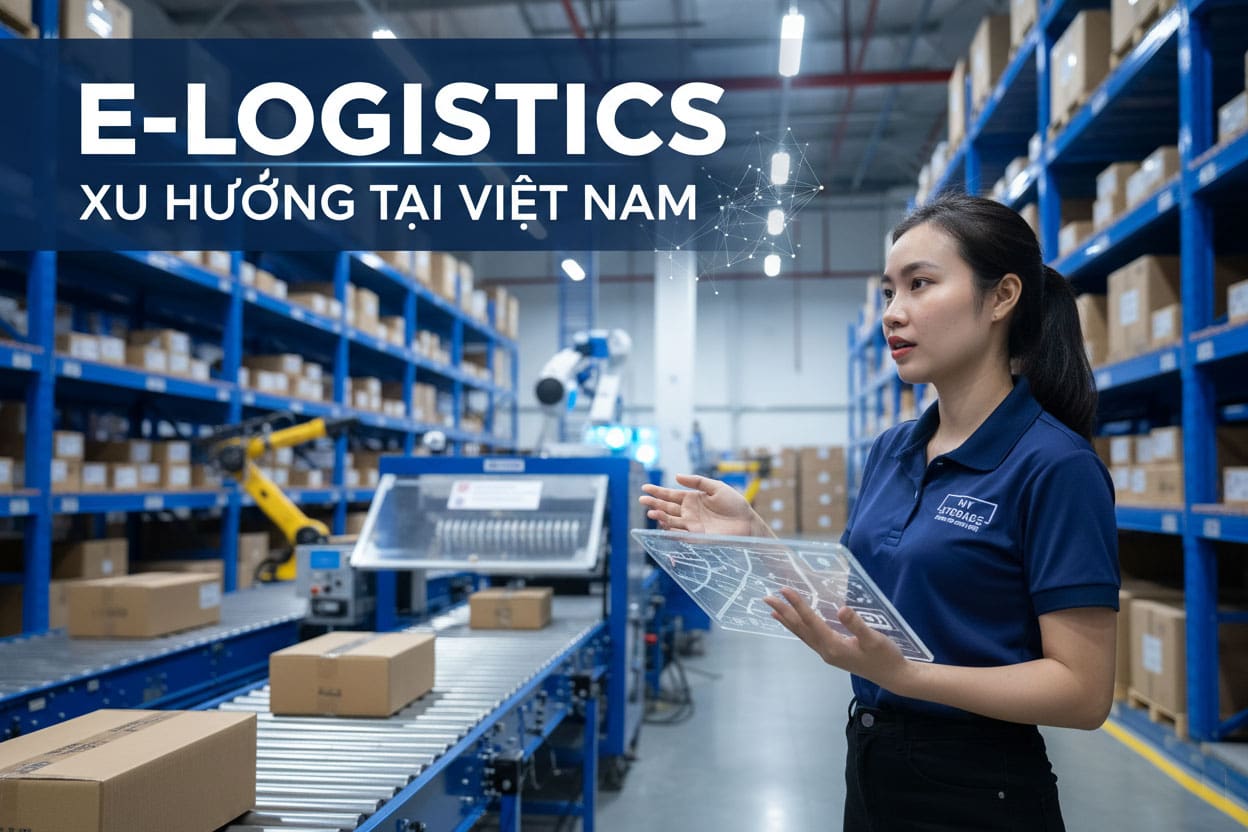
    E-Logistics is a digitally integrated logistics model designed to handle order processing, transportation, and distribution of goods in e-commerce. It optimizes supply chain efficiency and meets the ever-increasing demand for rapid delivery in Vietnam.

    What is E-Logistics? Characteristics & Role in E-commerce

    E-Logistics utilizes digital technology and the internet to optimize operations, from order reception to “last-mile” delivery. It is perfectly suited for the unique characteristics of small, high-volume orders and the fast delivery requirements of e-commerce.

    1. What is E-Logistics?

    E-Logistics (Electronic Logistics) is the process of managing the flow of goods by applying digital technology and the Internet. It encompasses all activities from order processing, warehouse management, and packaging to delivery and returns, all facilitated through online platforms.

    While traditional logistics typically handles large shipments (B2B), E-Logistics was created to solve the challenge of “Millions of individual orders to millions of destinations.”

    2. Core Characteristics of E-Logistics

    Compared to traditional logistics, E-Logistics possesses distinct features:

    • Speed is a critical factor: Customers in 2026 no longer want to wait. The concept of “Instant delivery” within 30 minutes to 2 hours has become the new standard.
    • Small, fragmented, and numerous” orders: Instead of transporting a single container of goods, E-Logistics handles millions of small packages to millions of different individual addresses.
    • Real-time Tracking System: Buyers need to know exactly where their package is (being picked up, at a transit warehouse, or 500m from their doorstep).
    • Reverse Logistics: The return rate in e-commerce is very high (approximately 15-30%). E-Logistics must have a fast and cost-effective returns process.
    • Last-mile delivery: This is the most complex and costly stage (accounting for up to 53% of total shipping costs), requiring the involvement of elite delivery teams and autonomous delivery robots.

    The Difference: Traditional Logistics vs. E-Logistics

    Criterion Traditional Logistics E-Logistics
    Target Audience Businesses (B2B) End Consumers (B2C/D2C)
    Type of Goods Large shipments, pallets, containers Small packages, individual items
    Destination Fixed (dealers, stores) Variable (homes, offices)
    Flow of Goods Primarily one-way Two-way (strong return flow)
    Technology Supportive (Excel, ledgers) Mandatory (AI, API, Big Data)

    3. The “Backbone” Role of E-Logistics in E-commerce

    By 2026, E-Logistics is no longer just a supporting service but a top competitive weapon for e-commerce platforms:

    • Enhancing Customer Experience: Fast and accurate delivery is the biggest reason customers return for future purchases.
    • Optimizing Operational Costs: Through AI algorithms to consolidate orders and optimize routes, businesses can minimize shipping costs.
    • Smart Inventory Management: E-Logistics allows businesses to know exactly which items are “hot” in which areas, enabling them to distribute goods to the nearest micro-fulfillment centers.
    • Expanding Borderless Markets: Thanks to cross-border E-Logistics, a craftsman in Hoi An can deliver a leather bag to a customer in New York within 3-5 days.

    According to reports from VECOM and market research organizations, the volume of e-commerce orders has maintained rapid growth momentum since the explosive 47% surge in 2020. By 2026, delivery density in major cities has reached a level where “one order is successfully delivered every 10 seconds.”

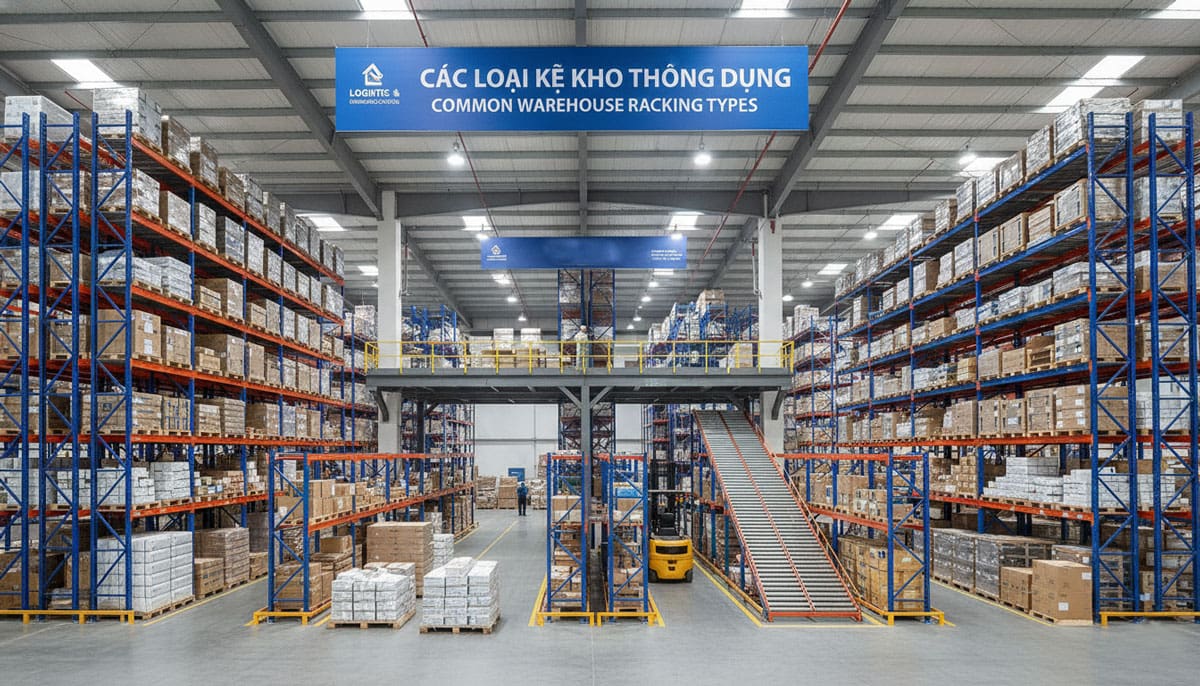
    Các loại kệ kho thông dụng trong kho chứa hàng

    E-Logistics Scale & Trends in Vietnam

    E-Logistics in Vietnam is experiencing rapid growth, fueled by a booming e-commerce market that handles millions of orders monthly and attracts dozens of logistics service providers expanding their networks.

    Vietnam is currently one of the brightest stars on Southeast Asia’s e-commerce (EC) map. By 2026, E-Logistics will no longer be a race for order volume but will have shifted to a competition for technological efficiency and ultimate user experience.

    1. Market Scale: The “Juggernaut” Shows No Signs of Stopping

    The E-Logistics market in Vietnam has made astonishing leaps, driven by online shopping habits that have become deeply ingrained in people’s lives.

    • GMV Growth: According to reports from Google & Temasek, Vietnam’s e-commerce Gross Merchandise Value (GMV) is projected to reach tens of billions of USD by 2026.
    • User Habits: Approximately 86% of online consumers maintain and even increase their shopping frequency post-pandemic.
    • Order Volume: Leading logistics providers currently process an average of 2 to 4 million orders daily during peak seasons (Mega Sales).

    2. Competitive Landscape: The Battle of 50+ “Titans”

    The market is witnessing a clear differentiation among three main groups of players:

    Provider Group Key Representatives Strengths
    Traditional Postal Services VN Post, Viettel Post Extensive network covering all 63 provinces, reaching remote areas.
    Tech Logistics (Startups) Giao Hàng Tiết Kiệm (GHTK), Giao Hàng Nhanh (GHN), Ninja Van Flexible, strong technology, extremely fast intra-city delivery speed.
    In-house Systems Shopee Express, SPX, TikTok Shop Logistics Controls the entire process from platform to customer, optimizing shipping costs for the platform.

    3. Top 4 Dominant E-Logistics Trends for 2026

    If you’re doing business online, here’s what you’ll see (and need to adapt to) right now:

    Ultra-fast Delivery

    The concept of “same-day delivery” is outdated. Now, it’s a race for Instant Delivery (30 minutes – 2 hours). “Micro-fulfillment centers” are appearing densely within residential areas to shorten the last-mile distance.

    Automation and Smart Warehouses

    Sorting Centers for GHN and Shopee currently boast over 90% automation rates. The use of robotic arms and smart conveyor belts helps reduce error rates to below 0.1% and shortens sorting time from several hours to just a few minutes.

    Green E-Logistics

    This is no longer just a slogan. The use of electric motorbikes for shippers and biodegradable packaging is becoming a standard for logistics providers to win over Gen Z customers and meet investors’ sustainability criteria.

    Cross-border E-commerce

    Purchasing goods from China, South Korea, or the US to Vietnam is now as seamless as domestic purchases. Electronic customs clearance systems and bonded warehouses help reduce waiting times from 2 weeks to 3-5 days.

    By 2026, Big Data will be the “fuel” for E-Logistics operations. Logistics providers can now predict which areas will see high order volumes during upcoming Flash Sales, allowing them to pre-position goods there before customers even click “Buy.”

    Growth Opportunities & Investment Appeal

    Vietnam is among the top 10 fastest-growing e-logistics markets globally, presenting significant opportunities for logistics businesses, 3PL/4PL providers, and investors, driven by a robust e-commerce foundation and increasing delivery demand.

    By 2026, Vietnam’s E-Logistics market will no longer be just a “rising star” but will have truly transformed into a “goldmine” for both domestic and international investors. Having entered the Top 10 fastest-growing emerging E-Logistics markets worldwide, Vietnam is currently experiencing a massive influx of capital.

    1. Growth Engine: The E-commerce Scale Boost

    Investment appeal stems from the impressive growth figures of the total Gross Merchandise Value (GMV) across the entire E-commerce sector.

    • Market Value: By 2026, Vietnam’s E-commerce is projected to reach approximately 32 – 35 billion USD. To manage this enormous volume of goods, the logistics system must expand accordingly.
    • Compound Annual Growth Rate (CAGR): Maintained at 20 – 25% per year.

    2. The Dedicated Logistics Real Estate Boom

    The E-Logistics explosion has led to an urgent demand for smart warehousing infrastructure, which is currently a prime target for “giants” like BW Industrial, Logos, and GLP.

    • Fulfillment Centers (Order Fulfillment Centers): Massive warehouses (over 10,000m² in area) integrating high automation are being rapidly constructed at the gateways of Hanoi and Ho Chi Minh City.
    • Micro-fulfillment Centers (Urban Satellite Warehouses): This presents an opportunity for smaller investors. Transforming old urban premises into ultra-small warehouses to facilitate 1-hour express deliveries is a lucrative trend.
    • Cold Storage for Food E-commerce: With the rise of online groceries (e-grocery), the cold storage segment is severely undersupplied, driving up rental prices and offering extremely attractive profit margins.

    3. The “Playground” for Logistics Tech Startups

    Beyond “bricks and mortar,” E-Logistics 2026 is a game of artificial intelligence. Tech startups have a once-in-a-lifetime opportunity to raise capital:

    • AI Route Optimization: Solutions that optimize routes to reduce fuel costs by 15-20%.
    • Smart Lockers: Addressing contactless delivery challenges and optimizing “last-mile” costs as shippers no longer need to wait for customers.
    • Green Logistics: Solutions for carbon footprint management and electric vehicle conversion are being actively sought after by ESG investment funds.

    4. Why Do Foreign Investors Choose Vietnam?

    Attraction Factor Details
    Golden Population Structure Over 70% of the population uses smartphones and has extremely high online shopping habits.
    Accelerating Infrastructure The North-South expressways and Long Thanh International Airport are nearing completion, shortening nationwide transportation times.
    Supply Chain Shift The “China + 1” trend is positioning Vietnam as a new manufacturing and distribution hub in the region.
    Supportive Policies The government prioritizes digital transformation and promotes the development of Logistics services as a crucial infrastructure sector.

    The “battle” for E-Logistics in Vietnam has now shifted from price competition to technological depth. Investors who master data and more effectively solve the last-mile delivery challenge will capture 80% of the market share.

    Quy trình vận hành nhà kho cho doanh nghiệp

    Major Challenges for E-Logistics in Vietnam

    The primary challenges for E-Logistics include limited infrastructure, high operating costs, inefficient operational management, and uneven technological capabilities among businesses.

    Despite its “breakneck” growth, the development path for E-Logistics in Vietnam by 2026 is not entirely rosy. Infrastructure and cost “bottlenecks” present a formidable challenge that any business must confront to thrive in this competitive landscape.

    Below are the 5 biggest challenges hindering the progress of E-Logistics in Vietnam:

    1. High Transportation Infrastructure and Logistics Costs

    This is a systemic challenge. Despite numerous improvements, logistics costs in Vietnam still account for approximately 16–20% of GDP — significantly higher than the global average and neighboring countries like Thailand or Singapore.

    • Urban Congestion: In Hanoi and Ho Chi Minh City, hourly load restrictions and traffic jams make express deliveries a real challenge in terms of time and fuel.
    • Dispersed Warehousing System: Many warehouses are still located far from major arterial roads, leading to increased middle-mile transit costs.

    2. Last-Mile Challenges in Rural Areas

    While delivery in major cities has become highly optimized, remote and rural areas remain a “difficult terrain” full of challenges.

    • Unclear Addresses: The system of house numbers and alleys in rural areas is often imprecise, making GPS navigation difficult and causing shippers to spend significant time searching for routes.
    • Low Order Density: Transporting a long distance just to deliver a small package dramatically increases the operating cost per order, making it difficult to achieve economies of scale.

    3. Shortage of Digital Logistics Workforce

    Technology can be acquired, but the skilled personnel to operate it are severely lacking.

    • Lack of Specialized Personnel: The industry is in dire need of experts who not only understand transportation operations but also possess capabilities in data analysis (Big Data), AI management, and operating automated warehouse systems.
    • Uneven Technological Capabilities: While “big players” are already utilizing robots, many small and medium-sized enterprises still manage warehouses with Excel and manual operations, creating disruptions throughout the entire supply chain.

    4. Pressure from COD Habits and Return Rates

    Vietnamese consumers still maintain the habit of “seeing the goods before paying” (COD – Cash on Delivery).

    • Cash Flow and Security Risks: Shippers often carry large amounts of cash, posing potential risks of loss. Businesses also incur additional costs for cash management and reconciliation.
    • High Cancellation Rates: Post-payment makes it easier for customers to refuse to accept goods (‘bombing’ orders). E-commerce return rates typically range from 15–20%, causing double losses in two-way shipping costs.

    5. Price War and “Paper-Thin” Profit Margins

    With over 50 entities vying for a slice of the E-Logistics pie, the race to cut prices and capture market share is fiercely competitive.

    • Record-Low Shipping Fees: To retain e-commerce platforms and large shops, many logistics providers must accept prices that yield little to no profit, or even losses, just to maintain volume.
    • Costly Technology Investment: Businesses are simultaneously forced to reduce shipping fees and invest millions of USD in automated sorting systems to increase speed, creating immense financial pressure on Logistics Start-ups.
    Challenge Direct Consequence Desired Solution
    High Logistics Costs Reduced competitiveness of goods Invest in synchronized, multimodal infrastructure
    COD Habit Increased risk, high management costs Promote cashless payments
    Shortage of digital workforce Hinders digital transformation speed Specialized training in Log-Tech
    Rural Infrastructure Long delivery times, high fees Develop franchised post offices, satellite warehouses

    Challenges are precisely opportunities for those who can solve them. By 2026, entities that master predictive AI technology to reduce return rates and optimize order density in rural areas will hold the “key” to victory.

    Kho kệ chung tại Đồng Nai

    Effective E-Logistics Solutions for 2026

    Key solutions include investing in warehouse & transport infrastructure, implementing TMS/WMS technology, offering risk-covering insurance, and building an optimized distribution system to boost e-logistics efficiency.

    By 2026, E-Logistics will no longer be a race of “who delivers cheaper” but rather “who masters data and smarter infrastructure.” As operating costs soar and customer expectations reach an “instant” level, businesses need groundbreaking and practical solutions.

    1. Smart Warehouse Ecosystem & Satellite Distribution Centers

    To solve the last-mile delivery challenge in congested megacities, warehouse structures need to evolve:

    • Micro-fulfillment Centers (Satellite Warehouses): Instead of a massive central warehouse on the outskirts, establish smaller facilities (50-200m²) right within residential areas. This shortens delivery distances to under 3-5km, supporting 30-60 minute delivery targets.
    • AS/RS Systems (Automated Storage and Retrieval Systems): Utilize robots and automated conveyors for order picking. By 2026, these systems have become more cost-accessible, accelerating order processing speeds by 3-4 times compared to manual methods.
    • IoT-based Environmental Control: For sensitive goods (cosmetics, functional foods), 24/7 IoT sensor monitoring of temperature/humidity is a mandatory requirement to reduce spoilage rates.

    2. Comprehensive Digitalization with AI and Cloud-based TMS/WMS

    Software is no longer just a supporting tool; it’s a “prerequisite” for survival.

    • AI Route Optimization: AI algorithms help drivers avoid real-time traffic hotspots and intelligently consolidate orders. This solution saves 10-15% on fuel costs — a significant figure amidst fluctuating energy prices.
    • Demand Forecasting: Leverage Big Data to predict which areas will experience “Flash Sale” order surges, thereby pre-positioning inventory at satellite warehouses before customers even click “Buy.”
    • Multi-channel Data Synchronization: Ensure seamless API connectivity between e-commerce platforms (TikTok Shop, Shopee) and warehouse systems to maintain accurate inventory, preventing “bait-and-switch” scenarios that lead to order cancellations.

    3. Risk Management & Transparent Order Insurance

    2026 sees an increase in fraud and lost goods. Having an “insurance safety net” is crucial:

    • Online Cargo Insurance: Directly integrate insurance fees into shipping costs. Providers like Bao Viet and various Insurtech companies are offering automated compensation processes via unboxing photos/videos, resolving claims within 24 hours instead of weeks.
    • Shift from COD to Digital Payments: Promote e-wallets and Apple Pay/Google Pay to reduce cash risks for shippers and decrease “return-to-sender” rates. When customers pay upfront, their responsibility to receive the goods is significantly higher.

    4. Public-Private Partnership (PPP) Model in Logistics Infrastructure

    Leverage major government infrastructure projects to optimize goods flow:

    • Utilize New Mega-ports & Airports: Connect warehouses with North-South expressways and Long Thanh Airport (currently in completion/partial operation phase) to boost cross-border E-Logistics.
    • M&A Wave: Domestic enterprises (like Viettel Post) are significantly increasing capital to partner with international corporations, aiming to inherit advanced management technology and expand their franchised post office network.
    Solution Main Objective Key Performance Indicator (KPI)
    Micro-fulfillment Hyper-speed delivery Delivery time < 2 hours
    AI Route Optimization Cost savings 15% reduction in fuel costs
    Smart Insurance Risk mitigation Claims processing time < 24 hours
    AS/RS Warehouse Increased productivity Picking speed +300%

    By 2026, “Green” and “Digital” must go hand-in-hand. An optimized E-Logistics process not only delivers fast but also needs to demonstrate low carbon emissions to retain demanding Gen Z customers.

    The Role of Warehousing & Fulfillment in E-Logistics

    Modern warehousing and integrated fulfillment systems reduce delivery times, optimize inventory, and create a superior customer experience in e-commerce.

    Within the 2026 E-Logistics ecosystem, warehouses and fulfillment services are no longer “static storage facilities.” They have evolved into “physical data processing centers” – where every second saved in the warehouse directly translates into a competitive advantage on customers’ shopping apps.

    Below are the “backbone” roles of warehousing and fulfillment in shaping the modern e-commerce experience:

    1. The Location Battle: Central Warehouses vs. Satellite Warehouses

    Current warehouse network design combines scale and speed to optimize last-mile costs.

    • Central Warehouses: Typically located on the outskirts with vast areas, serving as “master warehouses” for storing large quantities of goods, handling B2B shipments, and distributing inventory to smaller facilities.
    • Micro-fulfillment Centers (MFCs): These are the “weapons” of 2026. These warehouses are situated right within urban areas (sometimes utilizing old supermarket or store premises) to facilitate 30–60 minute deliveries.
    • Role: MFCs help minimize last-mile delivery distances – the most costly segment of the supply chain.

    2. Automation & Robotics Applications

    The speed of E-Logistics has surpassed human manual processing limits. Modern fulfillment relies on:

    • Autonomous Mobile Robots (AMRs): These robots navigate warehouses independently to bring shelves of goods to pickers (Goods-to-Person model), increasing picking productivity by 3–4 times.
    • Robotic Arms: Integrate AI and computer vision to accurately identify and pick thousands of different SKUs from cartons, reducing error rates to near zero.
    • Automated Sorting Systems: Capable of processing tens of thousands of parcels per hour, directing them to the correct postal routes in mere seconds.

    3. WMS/TMS Data Integration: The Synergy

    A fulfillment center operates efficiently only when information flows seamlessly.

    • WMS (Warehouse Management System): Precisely manages each shelf location, controls expiry dates (FEFO – First-Expired, First-Out), and coordinates robots within the warehouse.
    • TMS (Transport Management System): Manages vehicle fleets, optimizes delivery routes, and updates order statuses in real-time.
    • The Synergy: When WMS “reports” that goods are packed, TMS immediately “calls” the nearest driver for pickup. Data integration via API allows customers on Shopee or TikTok Shop to see the status: “Goods being sorted at warehouse” just minutes after clicking “buy.”

    By 2026, Fulfillment is truly the “face” of a brand. Customers don’t remember how large your warehouse is; they only remember how quickly their package appeared at their doorstep after a single click.

    E-Logistics is a crucial factor helping Vietnam solve the “fast delivery & low cost” challenge, while also unlocking breakthrough potential in the regional logistics market over the next decade.

    FAQ

    What is the most cost-effective way to transition to green logistics?

    Start with AI route optimization. Before investing in expensive electric vehicles, using software to reduce “empty mileage” and waiting time can cut fuel costs and emissions by 15% immediately with a low initial investment.

    How does e-logistics differ from traditional warehousing?

    Traditional logistics focuses on the movement of large shipments (B2B), while e-logistics is built for “large volume – small packages.” It requires real-time tracking, integration with e-commerce platforms, and robust reverse logistics processes to handle returns.

    Why is “Last-mile delivery” the most expensive part of E-Logistics?

    Last-mile delivery accounts for up to 53% of total shipping costs. Challenges such as urban traffic congestion, incorrect addresses, and multiple deliveries (especially for COD orders) make this stage inefficient and costly.

    What is a Medium-Scale Warehouse (MFC) and why do I need one?

    MFCs are small, highly automated warehouses located right in the heart of the city. By 2026, they will be a key component for express delivery (30-60 minutes), allowing you to store goods closer to customers and significantly reduce last-mile transit time.

    How does AI help reduce the rate of “bomb orders” (returns)?

    AI uses predictive analytics to analyze customer history and tag “high-risk” profiles. It can suggest prepayment for certain orders or optimize delivery times when customers are most likely to be home, reducing the rate of failed deliveries.

    How to transition to green e-logistics without impacting profitability?

    Start by optimizing packaging sizes to fit products perfectly, increasing stack density and reducing the number of trips. Switching to electric motorcycles for last-mile deliveries also helps reduce fuel and maintenance costs in the long term.

    What impact does cross-border logistics have on Vietnamese SMEs?

    It creates a level playing field. With integrated cross-border e-logistics, a small Vietnamese brand can deliver goods to global markets (US, EU) in just 3-5 days, bypassing traditional distributors and directly reaching global customers (D2C).

    Why is “Data Integration” More Important Than Warehouse Size in E-Logistics?

    A huge warehouse is useless if it’s not synchronized with the sales floor. Real-time data integration ensures you never oversell (run out of stock) and allows for flexible inventory allocation, moving goods to where demand is high.

    What is the standard “order cycle time” for E-Logistics in 2026?

    In 2026, the standard for “Click-to-Ship” (from order placement to warehouse departure) is under 2 hours. The total “Click-to-Door” cycle time for urban areas is currently expected to be within a day or under 24 hours.

    What is the impact of CBAM on Vietnam’s logistics industry?

    The Carbon Border Adjustment Mechanism (CBAM) means that exporters must report their carbon footprint in their logistics. If the supply chain is not “Green,” your products will face higher tariffs when entering the EU market.

  • What is Green Logistics? Why Should Businesses Care?

    What is Green Logistics? Why Should Businesses Care?

    Green Logistics is a model for managing transportation, warehousing, and supply chains with the aim of reducing CO₂ emissions, saving energy, and optimizing resources. Businesses adopting green logistics not only cut long-term costs but also meet ESG requirements, export standards, and global sustainable consumption trends. According to the World Economic Forum, the logistics sector accounts for approximately 8–10% of total global CO₂ emissions.

    What is Green Logistics?

    Green logistics is an environmentally friendly supply chain operation system focused on reducing emissions, optimizing transportation, utilizing renewable energy, and managing waste effectively.

    In the context of 2026, when Carbon tax regulations and ESG (Environmental – Social – Governance) standards become the “passport” for businesses to reach the global market, Green Logistics is no longer a mere formality but a vital strategy for optimizing costs and retaining customers.

    Below is a detailed analysis of this concept:

    Green Logistics (also known as Eco-logistics) is the process of planning, controlling, and operating the supply chain with the goal of minimizing negative environmental impacts (emissions, waste, noise) while ensuring economic efficiency and timeliness.

    Simply put: If traditional Logistics focuses solely on “Fast – Cheap – Good,” Green Logistics adds a crucial variable: “Sustainable.”

    1. Core Pillars of Green Logistics

    To implement green logistics, businesses need to focus on 4 key “green areas”:

    • Green Transportation: Utilizing electric vehicles (EVs), natural gas vehicles, or biofuel vehicles. Optimizing routes to reduce empty miles and CO2 emissions.
    • Green Warehousing: Designing warehouses that maximize natural light, using rooftop solar energy, LED sensor lights, and a Warehouse Management System (WMS) to reduce electricity waste.
    • Green Packaging: Shifting from single-use plastics to biodegradable materials, recycled packaging, or designing smart packaging to reduce size, thereby increasing loading density on vehicles.
    • Reverse Logistics: Establishing processes for collecting and recycling old products and packaging from customers to reintroduce them into the production cycle (Circular Economy).

    2. Traditional Logistics vs. Green Logistics Comparison

    Criteria Traditional Logistics Green Logistics
    Primary Goal Speed and Lowest Cost Economic Efficiency + Environmental Protection
    Energy Fossil Fuels (Gasoline, Diesel) Renewable Energy, Electricity, Hydrogen
    Packaging Prioritizes convenience, low cost Prioritizes recycling, sustainability
    Routes Optimized by time Optimized to reduce Carbon Footprint (CO2)

    3. “Golden” Concepts to Remember in 2026

    When discussing green logistics, you will frequently encounter the following strategic terms:

    • Net Zero: The goal of reducing greenhouse gas emissions to as close to zero as possible.
    • Carbon Footprint: The total amount of greenhouse gases emitted directly or indirectly from a business’s operations.
    • ESG Integration: The incorporation of environmental standards into financial reporting to attract investors.

    According to a report from the IEA (International Energy Agency), transportation accounts for approximately 24% of global CO2 emissions. This means that every time you transport goods more intelligently, you are directly contributing to saving the Earth’s climate.

    Vì sao logistic xanh trở thành xu hướng tất yếu năm 2026?

    Why Green Logistics is an Inevitable Trend in 2026

    Green Logistics is becoming a mandatory trend due to pressure from environmental regulations, international export requirements, and the Net Zero strategies of many nations.

    In 2026, we will no longer discuss Green Logistics as an “optional extra” to enhance a company’s profile. It has become a mandatory “passport.” If your business isn’t “green,” the doors to major markets like the EU, US, or Japan will slam shut immediately.

    Below are three key drivers transforming Green Logistics into an irreversible trend:

    1. Policy ‘Barrier’ and Carbon Tax

    2026 marks a turning point as international regulations enter a phase of strict enforcement.

    • CBAM (Carbon Border Adjustment Mechanism): The European Union (EU) has begun imposing carbon taxes on imported goods based on emissions generated during production and transportation. Without greening your supply chain, your products will become expensive and completely lose their competitive advantage.
    • Net Zero 2050 Commitment: The Vietnamese government and over 140 other countries are tightening their emissions reduction roadmaps. Regulations on truck emission standards and carbon quotas for warehouses are gradually being legislated.

    Logistics businesses that cannot demonstrate a low “carbon footprint” will face border taxes that could increase product costs by up to 15-20% when entering the EU market.

    2. Pressure from Investors and Customers

    Where the money flows, the trend goes.

    • ESG Standards (Environment – Social – Governance): Currently, 79% of global investors affirm that ESG is a top criterion when allocating capital. A polluting logistics company will be deemed “high risk” and will struggle to access low-interest green credit.
    • New Generation Consumers: Gen Z and Gen Alpha are dominating the market. They are willing to pay more for brands with sustainable packaging processes and electric vehicle transport. For them, “green” is a lifestyle, not just a product.

    3. Economic Benefits

    Don’t mistake green for expensive. In the long run, this is an incredibly smart cost optimization solution.

    • Energy Optimization: Installing solar power for warehouses can cut monthly electricity costs by up to 30-40%.
    • AI and Route Optimization: Using algorithms to reduce empty miles not only lowers CO2 emissions but also directly cuts fuel costs and vehicle depreciation.
    • Circular Packaging: Switching from single-use wooden pallets to recycled plastic or smart pallet systems can reduce material costs by up to 50% over multiple cycles.
    Criterion Traditional Logistics Businesses Green Logistics Businesses
    Market Limited to domestic/low-cost markets Expanding internationally (EU, US, Japan)
    Capital Costs High interest rates, difficult to raise capital Access to green credit, tax incentives
    Competitive Advantage Only compete on price (easily replaceable) Compete on sustainable value
    Operating Costs Increases with fossil fuel prices Stable due to renewable energy & AI

    To begin, you don’t need to replace your entire fleet with electric vehicles immediately. Start by digitizing warehouse data to accurately measure current emissions. You can’t improve what you can’t measure.

    Effective Solutions for Implementing Green Logistics

    Businesses can implement green logistics by optimizing transportation, applying technology, transitioning energy sources, and designing smart warehouses.

    To effectively implement Green Logistics by 2026, businesses need more than just changing their transport vehicles; they must undertake a comprehensive revolution in operational thinking – from packaging to the moment goods reach consumers and re-enter the recycling loop.

    Here are strategic solutions to help businesses “green” their supply chains practically and profitably:

    1. Green Transportation: Optimizing Every Kilometer

    Transportation is a major source of emissions. Optimizing this area will yield the most significant results in terms of both environmental impact and cost.

    • Fleet Transformation: Gradually replace diesel trucks with electric vehicles (EVs) or alternative fuel vehicles (LNG, Hydrogen) for last-mile deliveries.
    • AI-Powered Route Optimization: Utilize TMS software integrated with AI to calculate the shortest routes, avoid traffic congestion, and minimize “empty miles.”
      • McKinsey Data: Route optimization can reduce fuel costs and emissions by 10–15%.
    • Consolidate Shipments & Optimize Load Capacity: Employ algorithms to arrange goods so that each vehicle operates at maximum capacity, avoiding “shipping air.”

    Các giải pháp triển khai logistic xanh hiệu quả

    2. Green Warehousing – Energy Optimization

    A modern warehouse in 2026 must be a self-sufficient energy ecosystem.

    • Renewable Energy: Install rooftop solar power systems. This is an extremely effective solution in Vietnam for self-sufficient power supply for lighting, cooling, and electric forklift charging systems.
    • Smart Design: * Utilize motion-sensor LED lights (only illuminate when occupied).
    • Leverage natural light and ventilation to reduce electricity costs by 20-30%.
    • High-bay Racking Systems (AS/RS): Reduce ground footprint, optimize storage space, thereby decreasing the energy required for operation per product unit.

    3. Sustainable Packaging & Reverse Logistics

    “Green” starts from the packaging. Let’s eliminate the concept of waste from the supply chain.

    • Circular Materials: Use 100% recycled cardboard boxes or biodegradable packaging. Replace plastic shrink wrap with reusable materials.
    • Reverse Logistics: Design processes to retrieve packaging or old products from customers for recycling. This not only helps reduce waste but also fosters a strong connection with environmentally conscious customers.
    • Minimalist Packaging Design: Reduce packaging size to fit products snugly, increasing stacking density on pallets and consequently reducing the number of required trips.

    4. Measurement Technology & Data Management

    You cannot improve what you cannot measure.

    • Carbon Footprint Reporting (Carbon Tracking): Integrate CO2 emission calculation tools per order into management software. This is a mandatory requirement to meet ESG standards and report to international partners.
    • IoT & Big Data: IoT sensors monitor driving behavior (hard braking, speeding leading to fuel waste) to train drivers for more economical operation.
    Solution Investment Cost Return on Investment (ROI) Environmental Impact
    AI Route Optimization Low Very Fast (3-6 months) Reduce 10-15% emissions
    Warehouse Solar Power Medium – High Medium-term (3-5 years) Reduce 30-50% electricity consumption
    Recycled Packaging Low Immediate Reduce 80% plastic waste
    Electric Vehicle Conversion Very High Long-term (5-7 years) Reduce 100% direct emissions

    Green credit funds are currently offering significant interest rate incentives (2-3% lower than usual) for businesses with electric vehicle conversion or solar power installation projects. This presents a golden opportunity for businesses to leverage financial support for Green Logistics.

    Challenges & Future of Green Logistics in Vietnam

    Implementing green logistics in Vietnam faces barriers related to investment costs, infrastructure, and human resources, yet it simultaneously unlocks significant opportunities for exports, attracting FDI, and enhancing competitiveness amidst increasingly stringent ESG and Net Zero standards.

    Transitioning to a green model is a challenging “marathon” but also promises worthy rewards for persistent businesses. In Vietnam by 2026, this journey is entering a decisive phase where the line between risk and opportunity is clearer than ever.

    Thách thức & Tương lai của Logistic Xanh tại Việt Nam

    1. The “Cornerstones” on the Green Transformation Journey

    Despite understanding the benefits, businesses still face significant challenges:

    • Heavy initial investment costs (CAPEX): Transitioning to electric trucks or installing automated warehouse systems requires substantial capital. According to IEA data, the initial investment cost for electric trucks is typically 20-40% higher than traditional diesel vehicles.
    • Inconsistent technical infrastructure: The fast-charging station system for heavy-duty transport vehicles in Vietnam is still under construction and does not yet cover all major highways.
    • Scarcity of specialized human resources: Managing a green supply chain requires knowledge of ESG, carbon footprint measurement, and AI technology operation. This remains a “talent gap” in the Vietnamese market today.
    • Long Return on Investment (ROI) period: Green logistics is a long-term benefit equation, while many small and medium-sized enterprises (SMEs) are still struggling with short-term financial pressures.

    2. Future Vision: When “Green” is the #1 Competitive Advantage

    Despite the challenges, Vietnam possesses a “golden opportunity” to become the region’s green logistics hub:

    1. “Passport” to international markets (EVFTA): With new-generation free trade agreements, Vietnamese businesses with green transportation processes will be prioritized for access to demanding markets like the EU, significantly enhancing the value of exported goods.
    2. Wave of Green & Eco-Industrial Parks: Industrial parks (IPs) in Binh Duong, Bac Ninh, and Hai Phong are pioneering the installation of rooftop solar energy and smart wastewater treatment systems, creating a ready-made ecosystem for businesses to immediately lease “green” warehouses.
    3. Power from Digital Transformation: The explosion of 5G and AI in Vietnam is helping optimize supply chains at a lower cost. Technology enables even small businesses to participate in the “green” game by optimizing routes with software.
    4. Attracting “clean” FDI capital: Multinational corporations (such as LEGO, Samsung, Apple) investing in Vietnam require local logistics partners to meet sustainability standards, opening up huge cooperation opportunities for companies willing to change.

    Don’t view green logistics as an expense; see it as an insurance investment for the future. Businesses that start transforming now are the ones who will set the rules of the game for the market in the next 5 years.

    Green Logistics Transformation Roadmap for Businesses

    SMEs can start green logistics by optimizing operations before making large investments in green technology or vehicles.

    The green transformation roadmap for small and medium-sized enterprises (SMEs) doesn’t necessarily have to be an immediate “money-burning” venture into electric vehicles or robots. The secret lies in a “Low hanging fruit” strategy – prioritizing inexpensive changes that yield immediate results before moving on to larger investments.

    Below is a 5-stage roadmap designed specifically for SMEs in Vietnam in the context of 2026:

    Stage 1: Measurement & Digitization (January – April)

    You cannot improve what you cannot measure. The goal of this stage is to build a “data foundation.”

    • Emissions inventory: Use simple calculation tools to determine the CO2 emissions from the current fleet and warehouses.
    • Process digitization: Transition from manual/Excel management to basic warehouse management software (WMS) or transport management software (TMS) to track fuel consumption.
    • Establish green KPIs: Incorporate “Emissions per order” into operational goals alongside cost metrics.

    Hoạt động CSR cần thiết cho doanh nghiệp logistics

    Phase 2: “Low-Cost” Optimization (May – December)

    This is the “greening” phase driven by mindset, not money.

    • Route Optimization: Utilize route optimization software to reduce travel distance and avoid traffic jams. Simply cutting 10% of empty mileage can make you significantly “greener.”
    • Packaging Improvements: Switch to paper tape, recycled cardboard boxes, or minimalist packaging designs to increase loading density.
    • Driver Training: Instruct drivers on fuel-efficient driving techniques (e.g., reducing sudden braking, turning off engines during long stops).

    Phase 3: “Greening” Existing Infrastructure (Year 2)

    Start investing in areas with the quickest Return on Investment (ROI).

    • Energy-Efficient Warehouses: Replace the entire lighting system with sensor-controlled LEDs and repaint warehouse roofs with heat-reflective paint to reduce cooling costs.
    • Rooftop Solar Power: If the warehouse is owned by your company, installing solar panels is a long-term solution to reduce electricity costs.
    • Green Partnerships: Prioritize selecting 3PL (third-party logistics) partners who already have green certifications or use electric vehicles for last-mile deliveries.

    Phase 4: Vehicle & Technology Transformation (Year 3 Onwards)

    Once you’ve accumulated savings from energy efficiency in previous phases, you can then move towards investing in equipment.

    • Electric Vehicle (EV) Transition: Begin replacing old last-mile delivery vehicles with electric motorcycles or electric cargo vans.
    • Smart Automation: Install IoT sensors to automate warehouse environment adjustments, minimizing energy waste.

    Phase 5: ESG Reporting & International Certifications (Ongoing)

    Turn your green efforts into “currency” to attract funding and expand market reach.

    • Complete ESG Reporting: Utilize accumulated data to compile a comprehensive sustainability report.
    • Pursue Certifications: Apply for certifications like ISO 14001 (Environmental Management) or Green Logistics awards to boost credibility when bidding for international projects or exporting to the EU.

    Summary Table: Roadmap & Estimated Budget

    Phase Focus Investment Level Economic Impact
    Phase 1 Data & Digitalization Low Loss control achieved
    Phase 2 Operational Optimization Low 10-15% fuel savings
    Phase 3 Electricity & Warehousing Medium 30% reduction in electricity bills
    Phase 4 EVs & Robotics High 90% reduction in fossil fuel costs
    Phase 5 Certifications & ESG Medium Opens doors for export, easier fundraising

    Green logistics is no longer an option, but a long-term strategy that helps businesses optimize costs, enhance brand image, and meet global standards.

    FAQ

    What is the core goal of Green Logistics?

    The primary goal is to minimize the environmental impact of supply chain activities, such as CO2 emissions, waste, and noise, while maintaining economic efficiency.


    Why is Green Logistics a “must” in 2026?

    Due to strict international regulations like the EU’s Carbon Border Adjustment Mechanism (CBAM) and global Net Zero commitments, “green” is now a mandatory “passport” for businesses to export and join global supply chains.


    Does “Green” always mean “Expensive”?

    While initial investment (CAPEX) for EVs or solar panels can be high, Green Logistics reduces operational costs (OPEX) in the long run through energy savings, fuel optimization, and reduced waste.

    How can SMEs start with Green Logistics on a budget?

    SMEs should start with “Low-hanging fruit” solutions: optimizing transport routes using AI, improving packaging materials, and digitizing records to reduce paper waste.

    What are the key elements of a “Green Warehouse”?

    A green warehouse features rooftop solar energy, LED lighting with motion sensors, natural ventilation, and a Smart Warehouse Management System (WMS) to optimize space and energy.


    What is “Reverse Logistics” in a green context?

    It refers to the process of collecting used products or packaging from customers for recycling, refurbishing, or safe disposal, forming a “Circular Economy.”


    How does AI contribute to Green Logistics?

    AI helps calculate the shortest, most fuel-efficient routes, predicts demand to reduce overstocking, and monitors carbon footprints in real-time.


    What are the biggest challenges for Green Logistics in Vietnam?

    The main obstacles include limited EV charging infrastructure for heavy trucks, high initial costs, and a lack of specialized human resources for ESG management.


    What is the role of ESG in attracting investment?

    Investors in 2026 prioritize businesses with high ESG scores. Green Logistics practices directly improve the “E” (Environment) pillar, making the company more attractive for “Green Credit” with lower interest rates.


    How to measure the success of a Green Logistics strategy?

    Success is measured through specific KPIs: Carbon emissions per shipment, percentage of renewable energy used, waste recycling rate, and the Return on Investment (ROI) from energy-saving initiatives.

  • Guide to Designing Efficient Business Warehouses in 2026

    Guide to Designing Efficient Business Warehouses in 2026

    Effective enterprise warehouse design in 2026 demands a combination of optimized layout, standardized operational flow, management technology (WMS), environmental control, and smart storage classification to reduce operating costs and accelerate inbound and outbound operations.

    Why Effective Warehouse Design is a Vital Element for Businesses?

    A well-designed warehouse can reduce order processing time by 30–50%, lower labor costs, and optimize inventory storage, especially amidst the growth of e-commerce and complex supply chains in 2026.

    In the economic landscape of 2026, where e-commerce has become the market’s “lifeblood” and user expectations for delivery speed have reached record levels, a warehouse is no longer merely a storage facility. It has transformed into a “power station” that dictates a business’s speed and profitability.

    Here’s why an effective warehouse design is ‘vital’ for success:

    1. Speed: The Competitive “Weapon”

    In the era of express delivery, every wasted minute in the warehouse means a customer losing patience.

    • Optimizing Picking & Packing: Statistics show that picking accounts for 50-55% of total warehouse operating costs. A smart layout design can help reduce order processing time by 30–50%.
    • Real-world Data: A Statista 2025 report indicates that warehouses adopting a one-way flow design reduce average employee travel distance by 3km per shift.

    2. The Challenge of Hidden Costs and Efficiency

    Many businesses fail not due to a lack of orders, but because of excessively high operating costs.

    • Space Optimization (m³): Instead of focusing solely on floor area (m²), modern design emphasizes storage volume (m³). Utilizing high-rise shelving and narrow aisles can increase storage density by up to 40% without requiring additional floor space.
    • Reducing Errors: A disorganized warehouse leads to incorrect shipments and lost inventory. A Gartner 2025 report indicates that a lack of layout optimization can reduce overall efficiency by 20–40%, leading to skyrocketing return processing costs.

    3. Scalability and Adaptability

    The market in 2026 is highly volatile. A good warehouse must be able to expand or reconfigure its structure quickly.

    • Modularity: Design allows for repositioning shelves or integrating autonomous mobile robots (AMRs) without dismantling existing infrastructure.
    • Workplace Safety: A scientific layout minimizes collisions between forklifts and personnel, thereby reducing accident risks and legal compensation claims.

    Traditional Warehouse vs. Optimized Warehouse 2026 Comparison

    Criterion Traditional Warehouse (Old) Optimized & Efficient Warehouse (Modern)
    Space Utilization Primarily utilizes floor area Maximizes vertical space (m³)
    Goods Flow Intertwined, prone to congestion One-way flow (U-shape/I-shape)
    Data Management Manual or fragmented Excel Integrated WMS, AI for inventory forecasting
    Labor Costs High (due to extensive movement) Low (thanks to optimized routes)
    Order Processing Speed Slow, prone to errors 2-3 times faster

    Consider your warehouse a living entity. If its “bloodstream” (goods flow) becomes clogged, the entire business will stagnate. Investing in warehouse design isn’t an expense; it’s an investment in time and customer satisfaction.

    Cách Tính Kích Cỡ Lưu Kho Bằng AI - Giúp Chọn Kho Lưu Trữ Đúng Cách

    Effective Warehouse Design Principles

    An effective warehouse needs to be designed according to principles that optimize flow (inbound → storage → picking → outbound), ensure scientific zoning, fire safety, and easy scalability as needs change.

    1. Flow Principle – “One-Way Journey”

    This is the most crucial principle. The flow of goods from inbound to outbound must follow a consistent direction, preventing staff or forklifts from moving against the flow, which causes congestion.

    • U-shape layout: Inbound and outbound are on the same side. Suitable for smaller warehouses, it optimizes labor as staff can flexibly support both processes.
    • I-shape layout (Straight flow): Inbound at one end, outbound at the other. Often used for large warehouses with extremely high throughput to completely separate the two traffic flows.
    • L-shape layout: Suitable for warehouses with unique floor plans or for utilizing building corners.

    2. Accessibility & ABC Classification Principle

    Not all items are equally important. Effective design prioritizes “hot” items.

    • ABC Classification: * Group A (Fast-moving): Placed in low positions, near the packing area for the quickest retrieval.
    • Group C (Slow-moving): Placed in the highest or furthest positions.
    • 100% Accessibility: Ensure that every pallet or carton can be retrieved without needing to move other items around it.

    3. Space Optimization Principle

    Don’t just look at floor area; look at volume (m³).

    • Utilize height: Use high-bay racking systems. However, balance the rack height with forklift capabilities.
    • Aisle width: Aisles must be wide enough for forklifts to turn but not so wide as to waste space.
    • Tip: Using Very Narrow Aisle (VNA) forklifts can help you increase storage space by 20-30%.
    • Space utilization index: Fill rate = (Actual goods volume / Total usable warehouse volume) x 100%

    An ideal warehouse typically maintains this ratio at 80-85% to allow for operational space.

    4. Safety & Standards Principle

    No matter how good a design is, it’s meaningless if it poses hidden dangers.

    • Warehouse Fire Safety: Emergency exits must be clear of obstructions. Sprinkler heads must not be blocked by goods on top of racks.
    • Lighting and Ventilation: Ensure picking areas are well-lit to prevent SKU errors. Ventilation systems help preserve goods and protect employee health.
    • Traffic Lanes: Clearly marked lines for pedestrians and forklift operating areas to prevent collisions.

    5. Flexibility Principle

    Your warehouse in 2026 might be completely different in 2028.

    • Modular Design: Use racking systems where shelf heights can be adjusted or easily disassembled.
    • Automation Readiness: Even if you’re not using Robots (AMR) yet, the floor should be flat and well-finished to facilitate future technology upgrades.
    Principle Main Goal Mistakes to Avoid
    Flow Reduce travel time Cross-cutting flows causing collisions
    Accessibility Fast Picking Placing fast-moving items at the back of the warehouse
    Space Optimize warehouse rental costs Only storing goods on the floor, not using high racks
    Safety Protect people & goods Blocking emergency exits with pallets
    Flexibility Easy expansion/change Installing fixed racks, welded to the warehouse floor

    Before installing racks, use tape to mark out the flow paths on the warehouse floor and have staff simulate picking. You’ll discover countless “bottlenecks” that are never visible on a CAD drawing!

    Các Loại Hình Thuê Kho Phổ Biến Tại Quận Tân Bình

    Choosing the Right Area & Layout for Your Business Scale

    Warehouse space should be designed based on average inventory volume, number of SKUs, turnover rate, and storage cycle, typically calculated as TL* months of inventory × average orders/day.

    1. Choosing a Layout Based on Business Scale

    In modern logistics management, there’s no “one-size-fits-all” formula for every warehouse. An effective warehouse layout must strike a delicate balance between financial capability (CAPEX) – warehouse rental costs, product characteristics, and the business’s short-term growth objectives. Forcing a small business into an overly massive structure will lead to capital waste, but maintaining a rudimentary “storage shed” mindset when the business has grown will create “bottlenecks” that hinder delivery speed.

    To optimize every square meter of space and every second of picking, businesses need to choose a warehouse structure based on specific scale milestones and operational characteristics, as follows:

    A. Small Scale / Startup (Under 500 m²)

    • Characteristics: Limited budget, few SKUs but rapid fluctuations.
    • Preferred Layout: Selective Racking or medium-duty shelving.
    • Advantages: Low investment cost, 100% accessibility to goods. You can pick any carton without moving other items.

    B. Medium Scale / Growing (500 – 2,000 m²)

    • Characteristics: Rapid increase in SKUs, starting to experience space shortages.
    • Preferred Layout: Mezzanine (Mezzanine flooring).
    • Advantages: This is a “lifesaver” for warehouses with high ceilings. You can double the usable area by building additional mezzanine levels above to store light goods or create a packing area.

    C. Large Scale / Enterprise (Over 2,000 m²)

    • Characteristics: Extremely high goods throughput, prioritizing speed and density.
    • Preferred Layout: Drive-in Racking (for low SKU count but high volume goods) or VNA (Very Narrow Aisle).
    • Advantages: Maximizes space optimization (extremely narrow aisles). At this scale, integrating autonomous mobile robots (AMRs) for picking is a worthwhile investment.

    2. Comparison of Popular Storage Racks

    Rack Type Storage Density Accessibility Investment Cost Suitable for
    Selective Low 100% Low High SKU count, continuous inbound/outbound
    Double Deep Medium 50% Medium Space-saving aisles, standard goods
    Drive-in Very High Low High Homogeneous goods, long-term storage
    Mezzanine Extremely High Customizable High Height optimization, component warehouse

    3. The “85% Threshold” Principle

    Never design a warehouse to be 100% full. In warehouse management, the 85% threshold is known as the “productivity bottleneck.”

    If the warehouse is over 85% full, staff will spend too much time moving items to retrieve the necessary goods (the “traffic jam” effect in the warehouse).

    The remaining 15% space is “breathing room” to handle newly arrived shipments or unexpected returns.

    Always reserve space for the next two years of growth. If you plan to grow by 20% annually, don’t rent a warehouse that’s just enough for the present; you’ll incur relocation costs after just one year of operation.

    Tiêu chuẩn PCCC Nhà Kho Mới Nhất: Quy Định, Yêu Cầu

    Goods Classification & Modern Storage Methods

    Classifying goods (FIFO, LIFO, FEFO) and selecting the right racking system helps optimize space and processing time, especially for spare parts warehouses, FMCG, and pharmaceuticals.

    In the warehouse logistics 4.0 era of 2026, merely “having space” is no longer enough. A modern storage system must be a perfect blend of inventory rotation strategies and smart technical infrastructure.

    If you misclassify goods or choose the wrong racking system, operating costs can “devour” your profits. Here’s how the “big players” are running efficient warehouses:

    1. Classifying Inventory Flow

    Depending on product specifics (expiry date, physical properties), you must choose one of three “philosophies”:

    FIFO (First-In, First-Out):

    • Application: FMCG (Fast-Moving Consumer Goods) industry, food.
    • Benefit: Ensures older stock doesn’t remain stagnant for too long, reducing the risk of expiry.

    LIFO (Last-In, First-Out):

    • Application: Construction materials (bricks, stones, sand), items without expiry dates and with significant weight.
    • Benefit: Optimizes stacking, requiring fewer aisles between pallets.

    FEFO (First-Expired, First-Out):

    • Application: Pharmaceuticals, cosmetics, fresh food.
    • Benefit: This is the strictest standard to protect consumer safety and prevent losses due to spoiled goods.

    2. Modern Racking Systems: Choosing the Right “Backbone” for Your Warehouse

    In 2026, racks are no longer static metal frames; they are designed to optimize every second of picking:

    A. Selective Racking

    • Mechanism: Each pallet has its own dedicated location, with 100% direct forklift access.
    • Suitable for: Warehouses with many different SKUs (stock-keeping units), each with small quantities.

    B. Semi-Automated Racking

    • Mechanism: Uses a small robot (shuttle) running on rails to move pallets deep into the rack.
    • Suitable for: Warehouses with extremely high density, few SKUs but very large quantities of each. This is a booming trend this year due to minimizing forklift travel inside the racks.

    C. Gravity Flow Racking

    • Mechanism: Racks are designed with an incline, allowing pallets to slide automatically from the loading end to the unloading end by gravity.
    • Suitable for: Excellent for FIFO strategies. Staff only need to stand at one end to pick goods.

    3. Multi-Tier Warehouse Solutions – “Duplicating” Space

    If your warehouse ceiling is over 6m high, don’t let that overhead space go to waste.

    Mezzanine Flooring: Helps create new working levels without needing to build additional factory space.

    • Application: The lower level stores heavy goods on pallets, while the upper level is divided into smaller picking zones for e-commerce individual orders.
    Industry Preferred Method Recommended Racking Type
    Automotive Parts FIFO / ABC Selective + Longspan Shelving
    Food / FMCG FIFO Pallet Flow Rack / Radio Shuttle
    Pharmaceuticals FEFO Enclosed, Temperature-Controlled Racks (Cold Storage)
    E-commerce ABC (Fast-moving) Mezzanine + Automated Conveyor System

    Goods classification isn’t just about what’s on the shelves; it must be synchronized with a Warehouse Management System (WMS). If your racks are modern but your software is outdated, you’ll still spend hours searching for a “lost” pallet.

    Thuê nhà kho chứa hàng tại quận bình tân

    Leveraging Technology in Warehouse Design 2026

    Technologies like WMS, barcode/RFID, automation, and analytics enable real-time inventory tracking, minimize picking errors, and optimize warehouse operational costs.

    By 2026, the line between a warehouse and a data center is increasingly blurring. Adopting technology is no longer an “optional extra” but has become a prerequisite for businesses to thrive in a volatile global supply chain.

    Here are the technological pillars reshaping modern warehouse design and operations:

    1. WMS (Warehouse Management System) – The Central “Brain”

    By 2026, a warehouse management system is more than just a record-keeper for inbound and outbound goods. It’s a connected ecosystem:

    • Cloud & Real-time Integration: All data regarding pallet locations and order statuses are instantly updated across all devices (smartphones, tablets, AR glasses).
    • Route Optimization: AI within WMS automatically calculates the shortest picking route for staff, reducing unnecessary travel distances by 30-40%.

    2. Identification & Sensor Technology (The Senses)

    Forget manual notepads; 2026 is the era of “No-touch” operations:

    • RFID & Smart Identification Tags: Instead of manually scanning individual barcodes, RFID gates allow hundreds of products to be scanned in mere seconds as a forklift passes through.
    • IoT Sensors (Internet of Things): Sensors are deployed throughout the warehouse to monitor temperature and humidity (crucial for parts and pharmaceuticals), automatically adjusting ventilation systems or sending mobile alerts in case of anomalies.

    3. Autonomous Mobile Robots (AMR) & Automation (The Muscle)

    Manual labor is being replaced by powerful assistants:

    • AMR (Autonomous Mobile Robots): Unlike AGVs (which follow fixed paths), AMRs use laser sensors and AI to navigate independently, avoid obstacles, and transport goods to the correct packing areas.
    • Cobots (Collaborative Robots): Robots work alongside humans to assist with strenuous or repetitive tasks, such as stocking high shelves.

    4. Digital Twin – The “Digital Replica” and AI Analytics

    This represents the pinnacle of modern warehouse design:

    • Digital Twin: Businesses create an accurate 1:1 3D simulation of their warehouse on a computer. Before changing the layout or adding shelves, you can run simulations to predict efficiency without incurring any real-world costs.
    • Predictive AI: AI analyzes historical data to forecast order “waves” (e.g., promotional seasons), suggesting which SKUs should be moved from group C to group A before peak periods commence.

    KPIs & How to Measure Warehouse Design Effectiveness

    Measure effectiveness using KPIs such as: order processing time, picking accuracy, space utilization percentage, cost per order, and inventory accuracy.

    Designing an aesthetically pleasing warehouse on paper is just the first step. To determine if it truly “generates profit,” you need concrete figures. In 2026 logistics management, we don’t say “my warehouse runs pretty well”; we talk about Key Performance Indicators (KPIs) measured in real-time.

    Here are the vital KPI groups for evaluating your warehouse design effectiveness:

    1. Speed-related KPIs

    An effective warehouse design must shorten travel distances and eliminate “bottlenecks.”

    • Order Cycle Time: The total time from order receipt until goods are ready for dispatch.
      • Goal: For modern e-commerce warehouses, this figure should be under 30-60 minutes.
    • Picking Productivity: The number of lines or items an employee picks per hour.
      • Design Impact: If Group A items are stored too far away, this metric will plummet.

    2. Accuracy-related KPIs

    Smart warehouse design (with clear signage and location coding) will minimize human errors.

    • Picking Accuracy: Calculated using the formula:
      • A = (Number of Correctly Picked Orders / Total Number of Orders) x 100%
      • 2026 Benchmark: A standard warehouse should achieve > 99.8%.
    • Inventory Accuracy: The congruence between software data (WMS) and physical inventory counts.

    3. Space Utilization KPIs

    This is a direct measure of whether you are wasting rental space.

    • Space Utilization Rate:
      • U = (Actual Volume of Goods Stored / Maximum Storage Volume) x 100%
      • Note: If this metric is > 85%, your warehouse is experiencing congestion, leading to reduced picking speed. If < 70%, you are wasting space.

    4. Cost-related KPIs

    The ultimate goal of design optimization is to reduce costs per product.

    • Cost Per Order: Total warehouse operating costs (personnel, electricity, shelf depreciation, technology) divided by the total number of orders.
    • Warehouse Cost-to-Revenue Ratio: Helps businesses assess whether the warehousing department is consuming too much budget relative to business performance.
    KPI Metric Average Level Best-in-class Level
    Picking Accuracy 98.5% > 99.9%
    Inventory Accuracy 97.0% > 99.5%
    Space Utilization 75% 80% – 85%
    Dock-to-Stock Time 24 Hours < 4 Hours
    Picking Time/Order 5 – 10 Minutes < 2 Minutes

    Effective warehouse design in 2026 is not just about optimizing space; it’s about building an intelligent, flexible, and scalable operational system that helps businesses reduce costs by 15–30% and accelerate order processing amidst increasingly complex e-commerce and supply chains.

    In an era where logistics is rapidly shifting towards automation and data-driven processes, a well-designed warehouse from the outset will help businesses:

    • Increase picking and packing efficiency
    • Reduce outbound shipping errors
    • Optimize storage space
    • Enhance customer experience

    According to global logistics reports for 2024–2025 (Gartner, Deloitte Supply Chain Insights), businesses investing in standardized warehouse design combined with WMS can improve inventory accuracy by up to 99% and reduce order processing time by 20–40%. Therefore, warehouse design is no longer an expense – but a long-term strategic investment.

    FAQ

    What is the most critical principle in warehouse design?

    It is the “Flow” principle. A good design ensures a one-way, continuous movement of goods from Inbound (receiving) to Storage, then to Picking/Packing, and finally Outbound (shipping), minimizing backtracking and congestion.

    How can I maximize storage capacity without expanding the footprint?

    Think vertically m3 instead of horizontally m2. Use High-bay racking systems, Mezzanine floors, or Very Narrow Aisle (VNA) racking to utilize the full clear height of your warehouse.

    Why is ABC Analysis essential for picking efficiency?

     ABC Analysis categorizes items by frequency. Group A (fast-moving) items should be placed at the most accessible locations near the shipping area to reduce travel time, which can account for up to 50% of total picking costs.

    How does a Warehouse Management System (WMS) integrate with physical layout?

    In 2026, WMS acts as the “brain.” It maps the warehouse layout digitally to guide workers through the shortest picking routes and manages Bin Locations via Barcode/RFID to ensure 99.9% inventory accuracy.

    What are the mandatory safety standards for modern warehouses?

    Essential standards include fire safety (sprinklers, smoke detectors), clear emergency exit paths, adequate lighting (minimum 200 lux for picking zones), and designated pedestrian lanes to separate people from forklifts.

    When should I consider implementing Autonomous Mobile Robots (AMRs)?

    When your labor costs rise and order volume becomes high and complex. AMRs are ideal for repetitive transport tasks, allowing human workers to focus on high-value activities like quality control.

    How do I calculate the Return on Investment (ROI) for a warehouse redesign?

    Use the formula:

    ROI = ((Annual Operation Saving – Investment Cost)/Investment Cost) x 100%

    Savings usually come from reduced labor hours, lower error rates, and optimized space.

    How can I design a “Green Warehouse” in 2026?

     Incorporate Solar panels on the roof, use LED lighting with motion sensors, and implement paperless operations through digital tablets and WMS to minimize environmental impact.

    What is the “85% Rule” in warehouse capacity?

    It states that once a warehouse exceeds 85% occupancy, operational efficiency drops significantly due to congestion. You should always aim for a 15% “buffer space” to maintain smooth flow.

    How do I future-proof my warehouse design?

    Focus on Modularity. Use adjustable racking systems and leave space for future automation integration. Designing with scalability in mind ensures you won’t have to relocate when your SKU count grows.

  • Why Do We Need Specialized Warehouses for Auto and Motorcycle Parts?

    Why Do We Need Specialized Warehouses for Auto and Motorcycle Parts?

    Automotive and motorcycle spare parts come in various types, sizes, and require different storage conditions, especially needing humidity control and organization by SKUs to accelerate order fulfillment. Specialized spare parts warehouses can reduce part wear and tear by up to 40% compared to non-standard storage. An EFRA Logistics 2024 study indicates that mechanical equipment suffers losses due to poor storage, ranging from 15–40% of inventory annually.

    Unique Characteristics of Automotive & Motorcycle Spare Parts

    Unlike consumer goods, spare parts differ due to their vast number of SKUs, variable sizes, and the presence of heavy & easily oxidizable components, thus requiring dedicated warehouse infrastructure (pallet systems, three-phase power bays, humidity control).

    1. A Massive and Complex SKU Matrix

    A modern car comprises approximately 30,000 large and small components. In the aftermarket industry, a mid-sized dealership might manage between 5,000 and 10,000 stock keeping units (SKUs).

    • Absolute Precision: A single incorrect character in the Vehicle Identification Number (VIN) or part code renders the item useless.
    • Consumer Goods: Typically have standard packaging sizes (boxes, pallets), making them easy to stack.
    • Spare Parts: Exhibit extreme diversity in shape – from tiny screws to bulky front bumpers or lengthy exhaust pipes.

    2. Stringent Material Storage Requirements

    Unlike consumer goods with clear expiry dates, spare parts have a “technical lifespan” that depends on the storage environment:

    • Anti-Oxidation (Rusting): Steel and aluminum components (such as brake discs, crankshafts) are extremely sensitive to humidity. If the warehouse lacks proper humidity control, items will rust even within their packaging.
    • Rubber Aging: O-rings, tires, and drive belts will become brittle and crack if stored in excessively hot environments or exposed to direct sunlight.
    • Electronic Components: Engine Control Units (ECUs) and sensors demand a dry and strictly anti-static environment.

    3. Load Capacity and Warehouse Infrastructure

    Consumer goods are typically lightweight and can be stacked high on standard pallet racks. Spare parts, however, are different:

    • Extremely High Local Loads: An engine block or gearbox can weigh hundreds of kilograms. Warehouses require heavy-duty racking systems and high load-bearing floors to prevent subsidence.
    • Specialized Racking Systems: Cantilever racks are needed for long bars, medium-duty racks for boxed spare parts, and open floor areas for engine blocks.

    4. Distinct Goods Flow

    In a spare parts warehouse, classifying goods by turnover rate is crucial:

    • Fast-moving: Oil filters, brake pads, spark plugs, etc., need to be placed in the most accessible locations.
    • Slow-moving: Body panels, rare engine parts, etc., can be stored for several years. If stored like consumer goods (which prioritize quick turnover), these “slow” items would soon be damaged or lost.

    Storage Characteristics Comparison

    Feature Consumer Goods (FMCG) Automotive & Motorcycle Spare Parts
    Packaging Uniform (Cardboard boxes) Diverse, irregular shapes
    Weight Light to medium From ultra-light to ultra-heavy
    Environment Ventilation is sufficient Humidity, temperature control
    Management By batch, expiry date (FEFO) By component code (SKU), vehicle model
    Risks Expiry Rusting, aging, obsolescence

    When storing spare parts, the factor of “Fixed Location” is extremely important. You cannot constantly change the position of items as in a consumer goods warehouse, because finding a washer among 10,000 SKUs without a standard layout is an “impossible mission”.

    Analyzing Spare Parts Storage Costs vs. Economic Benefits

    The cost of renting a spare parts warehouse, calculated per m³, is often lower than the cost of stockouts due to production interruptions, which can be 20–30% per delayed order – according to the Automotive Aftermarket Report 2025 survey.

    Kho chứa phụ tùng ô tô và xe máy nhiều kích cỡ, tiện lợi

    1. The Cost of “Stockouts”

    According to the Automotive Aftermarket Report 2025, the costs incurred from spare parts supply chain disruptions are often many times higher than inventory holding costs.

    • Revenue Loss: When a vehicle is waiting for parts (Vehicle Off Road – VOR), each day of delay can lead to a 15–25% loss of potential revenue for that period as customers switch to competitors.
    • Opportunity Cost: For garages, the absence of a small item (like a rubber gasket) can clog the entire repair process, leading to wasted labor and lift bay space.
    • Economic Benefits: Scientific inventory management helps reduce the order cancellation rate to below 2%, protecting a stable revenue stream.

    2. Specialized Warehouse vs. Standard Warehouse Costs

    Many businesses opt for low-cost warehouses to save money, but this often turns into a “cost trap.”

    • Standard (Low-cost) Warehouse: Saves 20-30% on rent but carries a risk of damage (rust, mold) up to 5-10% of the goods’ value annually.
    • Specialized Warehouse (Heavy-duty racking, humidity control): Although the initial investment cost is higher, it helps to:
    • Optimize Space (m³): Utilizing high-rise racking systems allows for storing 3 times the amount of goods in the same floor area.
    • Asset Protection: Reduces the rate of environmental damage to goods to nearly 0%.

    3. Benefits of Improved Fulfillment

    The greatest economic benefit of a well-organized parts warehouse lies in speed.

    • FIFO (First In, First Out) Classification: Ensures that components with a technical lifespan (such as batteries, tires) are always in optimal condition.
    • Reduced Picking Time: A warehouse arranged with logical SKUs helps staff find the correct item in < 2 minutes instead of 20 minutes.
    Category Investing in a Standard Warehouse Cutting Warehouse Costs
    Operating Costs High (electricity, systems, racking) Low
    Goods Damage Rate < 1% 5% – 15% (due to humidity, impact)
    Customer Loyalty High (always in stock) Low (frequent rescheduling)
    Brand Value Professional, reliable Less stable
    Cash Flow Efficiency Optimized due to fast turnover Slow due to manual management

    In 2026, leading automotive parts businesses will no longer compete on price; they will compete on “component availability speed.” A self-managed or specialized warehouse system is the “weapon” to achieve that speed without excessively increasing operating costs.

    How to Choose the Right Warehouse for Automotive & Motorcycle Parts?

    Choosing a parts warehouse should be based on 5 criteria: proximity to roads/dealerships, ISO-standard humidity control, heavy-duty pallet racking, ERP/WMS integration for SKUs, and standard picking/packing processes.

    1. Convenient Warehouse Location

    The location of the warehouse directly affects transportation costs and customer waiting times.

    • Traffic Connectivity: The warehouse should be located near main roads, avoiding routes prone to frequent traffic jams or time-restricted vehicle access.
    • Service Radius: An ideal warehouse should be within a 30-45 minute drive to dealerships or areas with a high concentration of repair garages.
    • Loading/Unloading Area: Must be spacious enough for trucks or containers to easily enter, exit, and turn around.

    2. Environmentally Controlled Warehouse

    As analyzed, humidity is the number one enemy of metal and rubber parts.

    • ISO-Standard Humidity Control: The warehouse needs to maintain stable humidity (typically below 60%) and have a good ventilation system.
    • Fine Dust Protection: Engine parts and electronic components are extremely sensitive to dust. Prioritize warehouses with anti-dust Epoxy coated floors and sealed door systems.
    • Separate Storage Regimes: Check if the warehouse has separate areas for chemicals (oils, coolants) to prevent odor contamination or fire hazards to other components.

    3. Specialized Technical Infrastructure

    Never stack heavy gearboxes weighing hundreds of kilograms on flimsy metal shelves.

    • Heavy-duty Racking System: Must ensure floor load capacity and shelf load capacity can accommodate heavy components like engine blocks and axles.
    • Lifting Equipment: The warehouse must have readily available forklifts or hand pallet trucks suitable for safely moving bulky parts pallets.
    • Lighting System: Sufficient lighting in aisles helps staff accurately read SKU codes, minimizing picking errors.

    4. The Management “Brain” – WMS System

    In the digital age, managing 10,000 SKUs with a notebook is self-sabotage.

    • Barcode/RFID Integration: The warehouse must support barcode scanning for real-time control of inbound, outbound, and inventory.
    • Bin Location Management System: The software must precisely indicate which aisle, shelf, and level an item is located on.
    • Smart Inventory Reports: Automatically alerts when stock falls below minimum levels or when “dormant” SKUs have been in the warehouse for too long.

    5. Standard Operating Procedures (SOPs)

    Picking & Packing Procedures: Do warehouse staff have a basic understanding of parts to avoid incorrect packaging or scratching component surfaces?

    Fire Safety: The warehouse’s fire protection system must be regularly inspected, as parts warehouses often contain many flammable materials (packaging, oil, rubber tires).

    Comparison: Self-Storage Mini Warehouse vs. Large Parts SKU Storage Warehouse

    A self-storage mini warehouse is suitable for garages/SMEs with <1,000 SKUs, while a large SKU warehouse requires a racking system, extensive floor space, and complex inventory processes.

    Criteria Self-Storage Mini Warehouse Large Parts SKU Storage Warehouse
    Definition Small, flexible space for individuals/SMEs to access their items Industrial or high-tech warehouse specializing in managing large quantities of SKUs
    Suitable for Small shops, small garages, individuals Aftermarket businesses, parts dealers, garage chains
    SKU Scale Limited (~<1,000 SKUs) Large (>1,000 SKUs – many thousands of codes)
    Suitable Item Types Small parts, few variations All SKUs: small – medium – large – bulky
    Environmental Control Usually basic, no temperature/humidity control Optional in-depth temperature & humidity control
    Infrastructure Low shelving, basic pallets Heavy-duty pallet racking, sorting areas, conveyor belts
    Sorting Process Manual, simple logic Batch sorting system (ERP/WMS)
    Inventory Metrics Support Small inventory, no strict FIFO needed FIFO, batch traceability, lot number
    Warehouse Management Software (WMS) Not mandatory, often Excel Mandatory (WMS – integrated ERP)
    Order Processing Speed Slow – medium Fast, can process hundreds of orders/day
    Operational Process Not standardized, little automation Standardized according to central warehouse processes, with automation
    Security & Fire Safety Basic Advanced, industrial standard
    Premises Cost (rental price) Low Higher (due to location & technical infrastructure)
    Monthly Operating Costs Low – moderate Moderate – high
    Initial Investment Cost (setup) Very low Moderate to high
    Software Costs Not needed Yes (WMS, scanner, label, automation)
    Space Optimization Potential Moderate Very high (optimized by row, level, zone)
    Operational Complexity Low High
    Scalability Limited High
    Risk of Operational Errors High if no SOP Low if SOP & WMS are in place
    Return on Investment (ROI) Short Longer but with more benefits
    Suitable for E-commerce? For few SKUs & small scale Very suitable for large e-commerce
    Suitable for Inner-city Distribution? Possible Very suitable
    3PL/4PL Service Integration Capability No Yes
    Ability to Reduce Shipping Errors Low – moderate High (thanks to WMS control)
    Professionalism for Customers Moderate Very high

    Auto & Motorcycle Parts Storage Rental Price List by Size in HCMC

    Prices are for market reference only for 2025–2026 (may vary depending on location, accompanying services, rental duration)

    Warehouse Size / Unit Reference Price (VNĐ/month) Suitable for Notes
    By Area (m²)      
    1–3 m² ~600,000 – 1,750,000 Storing small parts, components Small self-storage mini warehouse
    4–6 m² ~780,000 – 2,500,000 Parts boxes, components, loose items Mini warehouse
    7–10 m² ~1,000,000 – 3,840,000 Small e-commerce warehouse, few parts Self-storage mini warehouse
    11–20 m² ~1,250,000 – 5,640,000 SME warehouse, many parts codes Large mini warehouse
    >20 m² ~2,450,000 – 6,080,000+ Small/mid-sized business warehouse Large mini warehouse or shared warehouse
    By Volume (m³)      
    1 m³ ~200,000 – 400,000 Storing small, easily sorted components Calculated by volume
    3–5 m³ (≈ small parts for 1 vehicle) ~600,000 – 1,200,000 Storing parts by vehicle unit Calculated by volume
    Pallet/Shelf Location Storage      
    1 Pallet Position ~25,000 – 50,000 / pallet/day Heavy parts, large pallets Price per pallet/day
    Storage by m³ pallet ~65,000 – 130,000 / m³/month Shared racking warehouse storing many SKUs Shared warehouse price calculated by volume
    Large Warehouse for Businesses      
    Large industrial standard warehouse (area rental) ~100,000 – 160,000 / m²/month Storing large quantities of parts Warehouse/large racking facility

    Large industrial standard warehouses (large workshop warehouses) often have lower rental prices per m² but require long-term contracts and are more suitable for larger businesses.

    Factors affecting the final price: warehouse location in the city, environmental control (humidity control), security, pallet forklifts, smart WMS inventory management, short or long rental period.

    Checklist for Optimizing Parts Storage Implementation

    The checklist includes 7 steps: ABC classification of SKUs, calculating area based on ABC, setting up pallet racking, installing WMS, defining picking/packing procedures, checking security, and controlling humidity.

    Kho chứa phụ tùng ô tô và xe máy phù hợp

    1. Categorize SKUs Using the ABC Model

    Before moving any item into your warehouse, you need to identify which products are “hot sellers” and which are “shelf warmers.”

    • Group A (Fast-moving): These SKUs represent 20% of your items but account for 80% of outbound movements (e.g., oil filters, brake pads). Store them in low, easily accessible positions near the entrance.
    • Group B (Medium-moving): These items have an average outbound frequency. Store them on middle shelves.
    • Group C (Slow-moving): While making up the majority of your SKUs, these are rarely used (e.g., car bumpers, rare engine components). Store them on high shelves or at the furthest end of the warehouse.

    2. Infrastructure & Shelving System Design

    Avoid using a single type of shelving for everything. Auto parts often have “unusual” shapes, so diversify your storage solutions:

    • Heavy-duty Pallet Racking: Ideal for engines and gearboxes (Load capacity $>1000kg/pallet).
    • Cantilever Racking: Specifically designed for exhaust pipes, bumper bars, or windshields (long and bulky items).
    • Medium-duty Shelving with Dividers: Perfect for small parts boxes, screws, and bearings.
    • Warehouse Floor: Must be coated with Epoxy paint to resist water, dust, and withstand forklift loads.

    3. Environmental & Safety Control

    Auto parts are made of metal and rubber, and they “dislike” humidity and dust.

    • Humidity Control: Install hygrometers and maintain humidity at 60%. Use industrial dehumidifiers if necessary.
    • Fire Safety Planning: Emergency exits must always be clear. CO2 fire extinguishers (suitable for electronic components) should be placed in easily visible locations.
    • Rodent & Insect Control: These are the number one “enemies” of electrical wires and plastic parts. Design a sealed warehouse and schedule regular pest control spraying.

    4. Digitalization & Operational Procedures

    For smooth warehouse operations, you need a robust Warehouse Management System (WMS).

    • Bin Location Coding: Each shelf location must have a unique code (e.g., Aisle A – Rack 1 – Level 2 – Bin 3).
    • QR/Barcode Integration: 100% of incoming goods must be labeled with barcodes for scanning during inbound/outbound processes.

    Are you looking for a flexible & secure auto parts storage solution?

    If you need a clean, secure, and easily expandable storage space for car or motorcycle parts, MyStorage’s self-storage units are a worthwhile consideration.

    MyStorage self-storage is suitable for garages, auto parts stores, and online shops that require flexible storage areas (1–20m²+) with 24/7 security monitoring and flexible monthly rental terms.

    Why consider MyStorage?

    • 24/7 security, CCTV surveillance & access control
    • Diverse unit sizes from 1-23m³, easily expandable as your SKU count grows
    • Air-conditioned units with temperature and humidity control

    Kho tự quản có máy lạnh kiểm soát nhiệt độ và độ ẩm

    • Ideal for storing small parts, components, and e-commerce inventory.

    • Flexible monthly warehouse rental, with no long-term contracts required.

    • Convenient warehouse location, offering easy access to the city center.

    • AI-powered storage size calculator helps customers effortlessly determine the optimal storage unit size and cost.

    AI size estimator for warehouse storage

    Following the strong growth trend of the self-storage market in Vietnam (Urban Logistics Report 2024–2025), the self-storage model is increasingly being chosen by small garages and SMEs because it reduces rental costs by 30–40% compared to renting large traditional warehouses (see Urban Storage Industry Report).

    If you want to optimize your business space while effectively controlling inventory, consider exploring a self-storage facility that suits your current spare parts inventory.

    FAQ

    How much does it cost to rent an auto & motorbike parts warehouse per month?

    Rental prices range from $25–$120/month for small 3–10m² units, and $4–$7/m²/month for industrial warehouses, depending on location and services.


    How much auto parts inventory can a 5m² storage unit hold?

    A 5m² unit can typically store 150–300 small parts boxes, or parts inventory for around 15–30 motorbikes with proper shelving.


    Should I rent by square meter or cubic meter to save costs?

    If parts are stackable, renting by cubic meter (m³) is more cost-efficient. If you need access space, square meter (m²) rental is better.

    What storage size is suitable for a small garage?

    Small garages with under 1,000 SKUs usually need 3–7m² storage space.

    Do auto parts warehouses require humidity control?

    Yes. Metal and electronic parts can corrode; improper humidity may reduce product lifespan by 10–30%.


    Is self-storage suitable for online auto parts businesses?

    Yes, for small-scale operations under 50–100 daily orders. Larger businesses need structured warehouse systems.


    Is long-term rental cheaper than monthly rental?

    Most providers offer 5–15% discounts for 6–12 month contracts compared to monthly rental.


    How much warehouse space does a mid-size parts dealer need?

    Dealers with 2,000–5,000 SKUs typically require 15–30m² or pallet-based storage.


    Does rental price include electricity, security, and management?

    Basic security is usually included; electricity and handling services may be charged separately.


    How do I calculate the right warehouse size for my inventory?

    Multiply total cartons by average carton volume (m³), then add 20–30% extra space for access and workflow.

  • Storage for Items When Studying Abroad or Going Overseas for 6-24 Months

    Storage for Items When Studying Abroad or Going Overseas for 6-24 Months

    When traveling abroad for 6–24 months, the most optimal solution is to use self-storage combined with a standard moisture-proof packing process. This storage option for studying or working abroad for 6-24 months helps save 70–80% of costs compared to maintaining a rented room/apartment just to store belongings.

    Why is it necessary to store belongings when studying or living abroad long-term?

    When studying or working abroad for 6–24 months, professional storage of your belongings is not only a way to protect your assets but also a smart financial decision. This solution helps you cut up to 70% of costs compared to maintaining monthly rent, while also protecting your belongings from mold and damage caused by prolonged stagnant air in a closed house. This is the perfect “stepping stone” for you to confidently start your new life without worrying about urgently liquidating assets at a low price or bothering relatives.

    The Economic Question: Rent a house for “stuff” or rent a storage unit?

    Cost of renting a house: In major cities like Hanoi or Ho Chi Minh City in 2026, the average rent for an apartment/room ranges from 5–15 million VND/month. If you go for 1 year, you’ll lose 60–180 million VND just to hold a spot for your belongings.

    Cost of renting a storage unit: A mini self-storage unit only costs 1–2 million VND/month. You save a significant budget to cover the expensive living costs abroad.

    Protect belongings from the “silent killer” – Humidity

    A house left closed for a long time in Vietnam is an ideal environment for mold, termites, and musty odors to penetrate clothes, books, and leather goods.

    Professional storage facilities have humidity control and ventilation systems, ensuring your belongings remain “as good as new” on the day you return.

    Flexibility for “Trial” Trips

    Families trying out relocation: If life abroad isn’t as expected, you still have a “backup” of all your family’s belongings safely stored, allowing you to restart without the expense of buying new items.

    Students/Trainees: Avoid the nightmare of “fire-selling” cherished items at 1/10th of their actual value due to the pressure of an approaching flight date.

    Don’t Burden Relationships

    Asking relatives or friends to store items for 1–2 weeks is a favor, but storing them for 24 months is a burden. Self-storage helps you maintain relationships and not worry about the safety of your belongings if an unexpected event occurs at a relative’s home.

    The 6–24 month period is a psychological “gray area.” You’re not ready to get rid of everything, but you can’t take everything with you either. Smart storage is how you buy “peace of mind” for the journey ahead.

    Items to Store When Going Abroad

    Ideal items for storage are durable, timeless, or sentimental belongings that you’ll definitely need upon your return. This list often includes: kitchen appliances, disassembled furniture, off-season clothing, important documents, and valuable electronic devices. Keeping these items helps you seamlessly reintegrate into life in Vietnam without spending tens of millions of dong to repurchase everything from scratch.

    Priority Items for Storage

    Item Category Specific Examples Packing Notes
    Home Appliances & Furniture Air fryer, coffee maker, disassembled desk, swivel chair. Clean food crumbs thoroughly, wrap with shrink wrap (PE) to prevent scratches.
    Clothing & Footwear Heavy winter coats, office wear, branded shoes, spare luggage. Vacuum seal to save space and provide absolute moisture protection.
    Documents & Papers Storage Degrees, certificates, property contracts, specialized books. Store in hard, waterproof plastic boxes and add desiccant packets.
    Electronic Devices Storage Computer monitor, speaker system, gaming consoles (PS5, Switch). Absolutely remove batteries, wrap with bubble wrap, and place in a sealed box.
    Souvenirs & Collectibles Storage Photo albums, models, personal collections. These are “priceless” items, so they should be prioritized for the core area of the storage unit.

    Why should you keep these items?

    • Small Home Appliances & Furniture: Items like microwaves or blenders often have a lifespan of 5–10 years. Selling them off only recoups 20–30% of their value, but upon returning, you’d have to buy new ones at 100% of the price, which might be higher due to inflation.
    • Books and Documents: These are a source of accumulated knowledge over time. Many books may no longer be reprinted, or personal documents could be extremely troublesome if lost during travel.
    • Electronics: If you’re only gone for 6–24 months, electronic devices won’t be too outdated. A good graphics monitor will still serve you well upon your return.

    Risks of Leaving Items at Home or with Acquaintances

    Leaving items in an empty house or with acquaintances for 6–24 months carries risks of damage, mold, loss, and difficulty in control, especially in Vietnam’s hot and humid climate.

    1. Risks of Leaving Items in an Empty House

    When a house lacks human presence and isn’t regularly cleaned, natural factors will “attack” your belongings very quickly.

    • The Silent Killers – Humidity and Mold: With Vietnam’s tropical monsoon climate, humidity often exceeds 80%. In a closed environment with poor air circulation, mold will grow on wood and leather surfaces (sofas, handbags) and damage electronic circuit boards.
    • Insect Infestation: Termites, cockroaches, and rats are “uninvited guests.” Rats not only gnaw on clothes but also have a particular fondness for electrical wires, posing a risk of short circuits when you reuse appliances.
    • Security and Safety: An empty house left for a long time is an easy target for thieves. Furthermore, incidents like water leaks from an upper floor or electrical shorts won’t be addressed promptly, leading to cascading damage.

    Những món đồ bạn nên lưu kho cho nhà thêm rộng

    2. Risks of Storing Belongings at a Friend’s or Relative’s Home

    “Storing items means entrusting them,” but sometimes trust is inversely proportional to convenience and responsibility.

    • Inconvenience to their living space: Your belongings (especially bulky items) will occupy someone else’s living area. After 1-2 months, initial enthusiasm can quietly turn into an inconvenience.
    • Lack of legal responsibility: As it’s a personal relationship, there’s usually no contract or insurance. If loss, damage, or fire occurs at a friend’s or relative’s home, claiming compensation is extremely difficult and can easily strain the relationship.
    • Difficulty accessing your items: You’ll be entirely dependent on their schedule. It can be very awkward if you urgently need an item when they are busy or away.
    Criteria Leaving at an empty house Storing with friends/relatives
    Humidity control None (Prone to mold) Depends on their home environment
    Security Low (Prone to theft) Medium
    Cost 0 VND (but renovation costs) “Debt” of gratitude
    Access to items Free Dependent on homeowner
    Risk of damage Very high (Mice, cockroaches, termites) High (Accidental bumps, misuse)

    Why is self-storage suitable for students studying abroad for 6–24 months?

    1. Cost Optimization Compared to Renting a Room

    This is the most obvious economic advantage. Instead of maintaining a rented room for 5–7 million VND/month just to “store items,” you can rent a self-storage unit for only 1/4 or 1/5 of that cost.

    • Savings: The money saved in one year could be enough to cover a semester’s tuition or a short trip in your host country.
    • No large deposit: Most self-storage facilities do not require a 2-3 month rental deposit like traditional apartment rentals.

    2. Flexible Contracts – “Living” by the Semester

    Self-storage services typically allow monthly rentals. This is extremely convenient because:

    • Easy renewal: If you decide to stay for an extra summer term or pursue further studies, a simple phone call or email is all it takes to extend your contract.
    • Quick cancellation: Upon your return, you can terminate the contract immediately without being bound by 1-year terms like a typical rental agreement.

    3. Preserving the “Health” of Your Belongings

    Student belongings often include books, laptops, cameras, or winter clothes. These items are extremely sensitive to weather conditions.

    • Humidity control: Professional storage facilities always maintain ideal temperature and humidity, preventing mold from corroding garments or damaging electronic components.
    • 24/7 Security: Surveillance camera systems and individual locks provide significantly more peace of mind compared to leaving items at a friend’s house (where many people come and go).

    4. Easy Authorization for Relatives

    While you are abroad, if you need to retrieve an important document or an item you’ve stored, you can:

    • Authorize access: Grant permission to your parents or close friends to access the storage unit and retrieve items.
    • Support services: Some facilities even offer pick-up and delivery services upon request, meaning you might not even need to ask a relative.

    Quick Comparison: Renting a Room vs. Self-Storage

    Feature Renting a room for storage Self-storage
    Cost Very high Low, cost-effective
    Safety/Security Medium (prone to fire, theft) High (with guards, cameras, fire prevention)
    Preservation Dusty, moldy, cockroaches/mice Clean, humidity-controlled
    Space Fixed (often excess space) Flexible (from 1m² to 20m²)

    Before studying abroad, categorize your belongings into 3 groups: Keep (Store), Sell (Resell), and Discard. This helps you reduce the required storage space and save a significant amount of money!

    cơ sở kho tự quản mới tại An Phú Sports Park

    Summary of storage space and costs

    The ideal storage space depends on the number of rooms and types of items; on average, a 1-bedroom apartment only requires 2–4 m² of storage for 6–24 months. Storage costs for studying abroad for 6–24 months are often lower than renting an empty apartment, and are flexibly calculated by area, starting from just a few hundred thousand VND per month.

    Target User / Item Volume Type of Living Space Suggested Storage Area Common Stored Items Estimated Cost / Month Suitable for 6–24 Months Storage
    Students / Single Room Rented room, dormitory 1 – 2 m² Clothes, luggage, books, personal items From 300,000 – 600,000 VND ✔ Highly suitable
    Study Abroad / 1BR Apartment 1-bedroom apartment 2 – 4 m² Small furniture, electronics, off-season clothes From 600,000 – 1,200,000 VND ✔ Most popular
    Small Family / 2BR Apartment 2-bedroom apartment 4 – 6 m² Small sofa, wardrobe, household appliances, cartons From 1,200,000 – 2,000,000 VND ✔ Suitable for long-term
    Business Trip / Overseas assignment Short-term rental 2 – 3 m² Daily necessities, work equipment From 600,000 – 900,000 VND ✔ Flexible
    Minimalist Storage Only valuable items 1 m² Documents, souvenirs, small devices From 300,000 VND ✔ Most economical

    Key Criteria to Check When Choosing a Storage Facility

    When selecting a storage facility, prioritize 24/7 security, humidity control, flexible contracts, convenient location, and brand reputation.

    1. Security & Safety Systems

    Never compromise on the safety of your belongings. A reputable provider must meet the following:

    • 24/7 Surveillance: AI Camera systems capable of motion detection and storing data for at least 30 days.
    • Access Control: Utilizing fingerprint locks, key cards, or personal PINs. Only you (or an authorized person) can open your storage unit.
    • Standard Fire Protection System: Check if the facility has automatic sprinklers, fire extinguishers, and especially a standard smoke alarm system.

    2. Environmental Control

    This is the distinguishing factor between a “premium storage facility” and an “old warehouse.”

    • Humidity Control: Especially crucial if you’re storing wooden items, documents, or electronics. The facility should maintain stable humidity (typically below 60%) to prevent mold.
    • Cleanliness & Pest Control: The facility must be clean, free of strange odors, and have a regular schedule for termite, cockroach, and rodent extermination.

    3. Contract Flexibility

    Studying abroad or business trips often involve unexpected changes. Choose a place with a “flexible” policy:

    • Rental Period: Is monthly rental available? Is it easy to extend or terminate the contract early without incurring excessive penalties?
    • Space Adjustment: If you sell off some items after 3 months, do they allow you to switch to a smaller unit to save costs?
    • Property Insurance: An extremely important criterion. The contract must clearly state the compensation amount in case of fire or loss.

    4. Ancillary Services & Location

    • Convenient Location: Prioritize facilities near major roads, allowing easy access for trucks or pickup trucks.
    • Support Tools: Does the facility provide trolleys, ladders, or cargo lifts? These will save you a lot of effort when moving items.
    • 24/7 Access: Check if you can access your items on weekends or at night, or if you’re restricted to business hours.
    • An AI-powered storage size calculator helps customers easily determine the optimal storage unit size and cost.

    AI size estimator for warehouse storage

    Storing belongings when studying abroad or traveling overseas for 6–24 months is a smart way to protect your possessions, save money, and focus on your new journey with peace of mind.

    FAQ

    Should I rent a storage unit if I study abroad for 6–24 months?

    Yes. Renting a storage unit is often cheaper than keeping an empty apartment and ensures your belongings are stored safely while you are abroad.

    How much storage space do I need when studying abroad?

    Students usually need 1–2 m², while a one-bedroom apartment typically requires 2–4 m² for 6–12 months of storage.

    How much does storage cost for 6–24 months?

    Storage costs start from just a few hundred thousand VND per month, based on the space used, with no hidden fees.

    Do I need to pay upfront for long-term storage?

    No. You can pay monthly or choose long-term plans to receive better discounts.

    Will my belongings get moldy if stored for 6–24 months?

    No, as long as you choose a clean, dry, or climate-controlled storage unit suitable for long-term storage.

    Can I store suitcases, clothes, and books?

    Yes. These are among the most common items stored by students and people going abroad long-term.

    Can I end my storage rental early if I return sooner?

    Yes. You can end the rental early with prior notice, and fees are adjusted based on actual usage.

    Is renting a storage unit safer than leaving items with relatives?

    Yes. Professional storage facilities offer 24/7 security, private locks, and fire safety systems, reducing risks of loss or damage.

    What if I don’t know how much storage space I need?

    You can use an AI size estimator by selecting your items—no need to calculate square or cubic meters yourself.

    Is self-storage suitable for going abroad for one year?

    Absolutely. Self-storage is ideal for medium- to long-term needs, offering flexibility and cost efficiency.

  • Comprehensive Home Cleaning Checklist: 7 Steps to Free Up 30% of Your Living Space

    Comprehensive Home Cleaning Checklist: 7 Steps to Free Up 30% of Your Living Space

    A 7-step home decluttering checklist helps eliminate excess items, optimize storage, and move rarely used belongings out of primary living areas, thereby freeing up an average of 25–35% of living space. This is particularly effective for apartments under 90m² in major urban centers.

    Why can proper home decluttering free up to 30% of living space?

    Most of the occupied space is taken up by rarely used items, incorrectly stored belongings, and “undecided” items, accounting for 28–40% of space according to urban living behavior studies.

    Do you ever feel like your apartment is “shrinking” even though the number of occupants hasn’t changed? In reality, the space isn’t lost; it’s merely being “captured” by items we’ve inadvertently forgotten. According to urban living behavior studies from entities like Savills and CBRE, a significant 28–40% of space in modern apartments is occupied by items that don’t provide daily utility.

    “Proper” home decluttering isn’t just about cleaning; it’s a “revolution” in organizational thinking to reclaim that stolen 30% of space.

    1. Identify the “Space Thieves” in Your Apartment

    In a typical 65–85m² apartment, even if wardrobes seem full, we often only truly use a small fraction of their contents. Wasted space typically falls into 3 main categories:

    Item Category Characteristics “Static” Space Occupancy Rate
    Expired items Items untouched for > 12 months (old clothes, broken appliances). 15%
    Seasonal items Duvets, heavy winter coats, Tet/Christmas decorations stored incorrectly. 10%
    “Decide later” items Items whose fate (keep or discard) is undecided, often found in plastic bags or hidden corners. 5% – 10%

    2. Why Does “Doing It Right” Make a Difference?

    Many mistakenly believe decluttering means throwing everything away. In reality, proper decluttering is about optimizing the flow of items.

    • Transition from horizontal to vertical storage: Instead of stacking (which creates dead space underneath), using tall, ceiling-high shelves or smart storage boxes helps you maximize your home’s vertical space.
    • The “80/20 Visibility” Principle: 80% of items should be neatly stored in closed cabinets, leaving only 20% of frequently used or aesthetically pleasing items visible. This eliminates “visual clutter,” making the space feel significantly more expansive.
    • Decisive handling of “Grey Areas”: Areas like under beds or on top of cabinets are often where “undecided” items accumulate. By clearly categorizing them (Keep – Donate – Discard), you’ll be surprised how these square meters can transform into professional storage zones.

    Fun Fact: For a young family working in a hybrid model (combining home and office work), freeing up 30% of space isn’t just about having room to breathe; it’s equivalent to “adding” a professional workspace without spending a single penny on rent.

    3. Decluttering ≠ Discarding

    Don’t worry about becoming an extreme minimalist. Proper decluttering is about cherishing the items you keep even more. When every item has its own “home,” you’ll no longer have to repeatedly buy things you already own but can’t find.

    10 Cách Tối Ưu Không Gian Căn Hộ Nhỏ Mà Ai Cũng Làm Được

    7-Step Comprehensive Home Decluttering Process

    Area-based inventory helps accurately identify excess items, prevents impulsive decluttering, and forms the foundation for reducing your living space by at least 10% right from the start.

    Step 1: Inventory All Items by Area

    Don’t start decluttering immediately! Begin by grabbing a notebook (or your phone) and going through each area. An inventory helps you precisely identify the “culprits” taking up space, potentially reducing your footprint by at least 10% just through awareness.

    Decluttering Checklist:

    • Living Room: Old magazines, unidentified cables, dusty decorative items.
    • Bedroom: Unworn clothes, excessive spare bed sheets.
    • Kitchen: Expired spices, plastic containers missing lids, appliances used only once a year.
    • Shoe Cabinet & Under Bed: Shoes “waiting for repair,” empty cardboard boxes.
    • Balcony / Small Storage: Broken plant pots, old repair tools.

    Step 2: Categorize Items into 4 Quick Decision Groups

    To avoid getting bogged down in “reminiscing,” apply the 4-group rule. This method can cut your decluttering time by 40-50%.

    Group Action Description
    Used Frequently Keep Everyday items, placed in the most accessible locations.
    Seldom Used but Needed Deep Storage Sentimental items, important documents, backup supplies.
    Sell / Donate Declutter Items still in good condition but no longer fit your needs.
    Discard Dispose Damaged, expired, or no longer usable items.

    Step 3: Eliminate Items Not Used in the Last 12 Months

    This is a painful but necessary “reality check.” Statistics show that if an item hasn’t been touched in 12 months, the likelihood of needing it in the future is less than 20%.

    Priority Targets:

    • Old Clothes: Outfits “waiting for you to lose weight” or outdated styles.
    • Outdated Devices: Old phone chargers, broken music players, unused TV cables.
    • Trendy Decor: Decorative items that were once “hot” but now only collect dust.

    Step 4: Manage Seasonal & Bulky Items

    This group of items takes up a huge amount of space but is used very infrequently. If you keep them in your main living areas, you’re needlessly cluttering your home.

    • Sports Equipment: Skateboards, old weights, golf club bags.
    • Travel Gear: Huge suitcases (try nesting smaller suitcases inside larger ones to save space).
    • Seasonal Appliances: Fans in winter, heaters in summer, Christmas trees.

    Step 5: Optimize Your Home Storage Space

    After filtering out unnecessary items, rearrange what you’ve kept with an “architect’s mindset.”

    • Utilize Vertical Space: Use tall, ceiling-high shelves and uniform storage boxes.
    • Labeling: Don’t underestimate the power of labeling; it helps you find items in 5 seconds instead of 5 minutes.
    • “One In – One Out” Rule: When you buy a new item, be ready to let an old one go.

    Step 6: Move Seldom-Used Items Out of Your Living Space

    This is a breakthrough step to free up 20-30% of your space without discarding valuable items. In major cities by 2026, the trend of using Self-storage is becoming increasingly popular.

    • Self-Storage Units: Small, private, locker rooms you can access 24/7.
    • Ideal Environment: Storage facilities often have humidity control, which helps preserve electronics, books, or leather goods better than your home might.
    • Mental Freedom: A more spacious home leads to a lighter mind.

    Step 7: Maintain a Tidy Space After Decluttering

    Decluttering is a journey, not a destination. To prevent things from returning to “square one” after two weeks:

    • Regular Review: Conduct a “quick inventory” every 3-6 months.
    • Buffer Zone: Set up a “pending” basket. Newly purchased items or those without an assigned spot will stay here for a maximum of one week before finding their permanent home.
    • Stop Emotional Hoarding: Before buying an item, ask yourself: “Where will I put this?”

    Những món đồ gia đình nên gửi kho để nhà rộng gấp đôi

    Common Mistakes That Make Home Decluttering Ineffective

    Unsuccessful home decluttering often stems from poor categorization, emotional attachment to items, and a lack of external storage solutions.

    1. “Out of Sight, Out of Mind” – Shoving Items into Closets

    Many people view decluttering as making surfaces (floors, tabletops) completely clear by stuffing everything into closets, under beds, or in hidden corners.

    • Consequence: You’re not actually freeing up space; you’re merely “relocating” the clutter. Your closet will soon become a “ticking time bomb,” and you’ll spend twice as long trying to find what you need.
    • Advice: Confront the item. If it doesn’t have a place in plain sight, perhaps it shouldn’t be in your home at all.

    2. The Paradox of Boxes: Buying More Without Reducing Clutter

    A classic mistake is buying many plastic boxes and beautiful organizers before categorizing your belongings.

    • Consequence: You’re “organizing” waste. Having more boxes only creates a false sense that your home is tidy, but in reality, your living space is still occupied by the same amount of excess stuff.
    • Golden Rule: Declutter first, buy boxes later. Only purchase storage solutions when you know exactly how many items you need to store.

    3. Keeping Items Due to “Regret” and “What If I Need It Later?”

    This is the biggest psychological barrier. We often hold onto items linked to memories or broken appliances with the thought, “one day I’ll fix it.”

    • The Truth: According to 2026 consumer behavior statistics, 90% of “what if I need it” items will never be touched over the next two years.
    • Advice: Try the “90/90 rule”: Have you used it in the last 90 days? And do you plan to use it in the next 90 days? If not, be brave and let it go.

    Summary Table of Mistakes and Solutions

    Mistake Nature “Correct” Solution
    Shoving items into hidden corners Avoiding clutter Categorize and assign a specific place for each item.
    Buying storage boxes too early Storing unnecessary items Eliminate excess items before considering buying trays/boxes.
    Overlooking bulky items Letting large objects occupy “prime” space Move seasonal/rarely used items to external storage or the attic.
    Decluttering by room Easily leads to items being moved around Declutter by category (e.g., clear all books in the entire house at once).

    4. Not Dealing with Bulky “Odd Objects”

    Empty suitcases, exercise machines used as clothes racks, or electronic equipment cartons… these are the items that take up the most space but are often overlooked because we’ve become too accustomed to their presence.

    Small Tip: Try taking a photo of your room. When viewed through a picture, bulky, superfluous items will stand out more clearly than when you look at them directly with your naked eye.

    Effective home decluttering isn’t about making your house look like a spotless showroom, but about creating a space where every item serves your current life, not the person you were in the past or a vague future plan.

    7-Step Checklist to Declutter and Free Up 30% of Your Space

    A concise checklist to help you declutter in just 1–2 days without missing any crucial steps.

    Phase 1: Filter & Confront (Day 1)

    Goal: Completely eliminate items that don’t add value.

    Step 1: Quick Inventory (30-60 minutes)

    • Go through 5 areas: Living Room, Kitchen, Bedroom, Balcony, Shoe Cabinet.
    • Identify “hot spots” that are crammed with items.

    Step 2: Categorize into 4 Groups (3-Second Rule)

    Pick up an item and decide immediately: Use Now – Store – Donate/Sell – Trash.

    Step 3: Apply the 12-Month Rule

    Ruthlessly eliminate clothes not worn, broken appliances, and old decor that has been “dormant” for the past year.

    Những món đồ bạn nên lưu kho cho nhà thêm rộng

    Phase 2: Optimize & Organize (Day 2)

    Objective: Re-establish the flow of items to allow the space to “breathe.”

    Step 4: Handle Bulky & Seasonal Items

    • Nest smaller suitcases inside larger ones.
    • Vacuum-seal duvets and winter clothes to reduce their volume by 70%.

    Step 5: Implement a Smart Storage System

    • Utilize tall shelves up to the ceiling (maximizing vertical space).
    • Label every storage box to avoid rummaging when needed.

    Step 6: Reclaim “Prime Real Estate”

    • Move infrequently used items (souvenirs, seasonal equipment) out of main living areas.
    • Tip: Consider renting a self-storage unit if your home is too cramped.

    Phase 3: Sustainable Maintenance (Daily)

    Objective: Prevent clutter from returning.

    Step 7: Establish New Disciplines

    • Adopt the “1 in – 1 out” rule (Buy 1 new item, discard 1 old item).
    • Spend 5 minutes each evening returning items to their designated “home.”

    “Don’t declutter with memories; declutter with square footage.” If you feel sentimental, take a photo of the item as a keepsake before letting it go. A picture takes up 0 bytes on your floor but still preserves the memory!

    DIY Home Organization vs. Combining with Storage Units: Which Option is Right for You?

    DIY organization suits small homes with fewer possessions, while combining with storage units effectively handles infrequently used items, especially for family apartments and those moving homes.

    Criteria DIY Home Organization Off-site Storage Combination
    Cost Lowest: Only costs for boxes, shelves, and your effort. Moderate: Additional monthly storage rental fees (starting from a few hundred thousand VND).
    Effort Very High: Must find ways to “cram” or liquidate all excess items to create space. Lower: Simply pack and move infrequently used items to storage; your home is instantly cleared.
    Space Efficiency Low (5-10%): Merely reorganizing existing items for a tidier look. High (20-40%): Truly frees up actual space by removing physical objects from the home.
    Sustainability Difficult: Prone to becoming cluttered again if the number of items still exceeds the home’s capacity. Sustainable: Creates genuine empty space to maintain a tidy lifestyle long-term.

    When Should You Choose Which Option?

    Choose “DIY Home Organization” when:

    • You are single or live in a studio apartment with a minimal number of possessions.
    • You embrace Minimalism and are willing to donate/discard most infrequently used items.
    • Your budget for decluttering is limited.

    Choose “Combining with Storage Units” when:

    • Families with children: Need to keep old baby items for subsequent children (cribs, playpens, strollers…) but lack storage space at home.
    • Hybrid/Home Office workers: Need to free up 2–3m² for a desk and ergonomic chair without wanting to sell other belongings.
    • People with special hobbies: Have bulky sports equipment (SUP paddleboards, golf bags, bicycles), collectibles, or a large book library.
    • Seasonal items: Have too many bed linens, winter clothes, or event decorations that need to be stored in a dry environment (with humidity control).

    Don’t view renting a storage unit as “extra expense.” Consider it “buying more living space” at an affordable price. In major cities, the price per square meter of housing is very high. Instead of having to upgrade to a larger apartment (costing billions of VND), renting a 2m² mini-storage unit only costs a few hundred thousand VND/month but offers equivalent efficiency.

    FAQ

    Why does proper decluttering free up to 30% of living space?

    Because most space is occupied by unused items, seasonal goods, and “visual clutter.” By re-categorizing and moving stored items out of active living areas, you reclaim the physical square footage that was previously wasted.

    What is the 12-month rule in decluttering?

    If you haven’t touched an item in the past 12 months, chances are you’ll never need it again. It’s time to sell, donate, or discard it.

    Should I declutter by room or by category?

    You should declutter by category (e.g., gathering all clothes at once). This helps you see the total volume of what you own, making keep/toss decisions more accurate.

    How does vertical storage benefit small apartments?

    Vertical storage utilizes wall space and ceiling height, freeing up floor space – the essential area needed for movement and daily activities.

    How do I handle sentimental items?

    Take photos to preserve memories digitally and keep only 1-2 most representative pieces. Memories reside in your heart, not in dust-collecting objects.

    Is self-storage actually necessary?

    Absolutely necessary for urban dwellers with bulky or seasonal items. Renting a mini-storage unit is often much cheaper than upgrading to a larger apartment.

    What is the biggest mistake when decluttering?

    Buying storage bins before sorting your items. This often leads to “organizing trash” rather than actually eliminating it.

    How to maintain a tidy home in the long run?

    Apply the “one-in, one-out” rule. Every time you buy something new, discard an equivalent old item to maintain spatial balance.

    Does decluttering help reduce stress?

    Yes. A space with less “visual clutter” helps the brain relax, increases focus, and improves sleep quality.

    Where should I start decluttering to avoid feeling overwhelmed?

    Start with the smallest area or the one with the least sentimental value, like a shoe rack or a junk drawer. Small initial wins build momentum for larger areas.

  • Common Types of Warehouse Racking Used in Logistics & Warehousing

    Common Types of Warehouse Racking Used in Logistics & Warehousing

    Warehouse racking systems are core solutions that help optimize space, ensure safety, and enhance warehouse operational efficiency. Depending on the type of goods, load capacity, inventory turnover, and warehouse area, logistics and storage businesses will choose different types of racks such as selective racking, drive-in racking, medium-duty racking, or mezzanine flooring. Selecting the right type of racking helps reduce long-term costs, increases scalability, and meets modern operational standards.

    What are warehouse racking systems? Why are they crucial in warehouses?

    Warehouse racking systems are specialized shelving units (often made of powder-coated steel) used to store goods vertically, helping to optimize space, manage inventory efficiently, and ensure safety in logistics warehouses, production warehouses, and self-managed storage facilities.

    Real-world value:

    • Increase warehouse capacity by 30–60%: Maximize ceiling height utilization instead of just floor space.
    • Reduce risk of goods damage: Goods are layered, preventing direct stacking and protecting against moisture and mold from the ground.
    • Standardize fire prevention & occupational safety procedures: Create clear aisles, allowing fire sprinkler systems to reach every corner and minimizing forklift collisions.

    Why are warehouse racking systems “vital” for businesses?

    If a warehouse is likened to a giant library, then warehouse racks are the shelves that prevent you from having to rummage through the entire building to find an item.

    1. Optimize “Every Inch Counts”

    Instead of goods occupying the entire floor, racking systems allow you to stack items high (up to 12-15m). This is extremely important for storage or 3PL logistics businesses, where every square meter is measured in dollars.

    2. Smart Inventory Management (FIFO/LIFO)

    Racking systems help you easily apply modern inventory management principles:

    • FIFO (First In, First Out): Goods entered first are dispatched first, crucial for food and pharmaceuticals.
    • LIFO (Last In, First Out): Goods entered last are dispatched first, suitable for construction materials or large quantities of homogeneous goods.

    3. Protect Assets and People

    • Moisture protection: Goods are elevated from the ground, avoiding humidity and rodents.
    • Occupational safety: Racks are designed for precise load bearing (from a few hundred kg to several tons per level), preventing the risk of goods collapse that could endanger staff.

    Classifying Warehouse Racking Systems by Load Capacity

    Warehouse racking systems are typically classified based on their load-bearing capacity per shelf level. This classification helps businesses accurately determine the appropriate shelving type for their specific goods, from light document boxes to heavy industrial pallets weighing tons.

    Golden Rule: Always choose racking with a design load capacity at least 10-15% higher than the actual goods weight to account for errors and ensure long-term structural durability.

    Light-Duty Racking

    This is the most common type of racking in daily life and offices.

    • Load capacity: Typically under 200kg/level.
    • Characteristics: Simple structure, often versatile slotted angle steel shelving. Quick to install, easy to adjust shelf spacing.
    • Applications: Storing documents, books, household items, or small retail goods in self-managed warehouses.
    • Advantages: Lowest cost, absolute flexibility.

    Medium-Duty Racking

    The “national” racking system for commercial and distribution warehouses.

    • Load capacity: Ranges from 200kg – 500kg/level.
    • Characteristics: Uses stronger beams and deck panels (steel sheets or wood). Goods are usually loaded/unloaded manually or with specialized step ladders.
    • Applications: Warehouses storing auto/motorcycle parts, electronic components, pharmaceuticals, or FMCG (fast-moving consumer goods).
    • Advantages: Good load-bearing capacity, high durability (often over 10 years), professional aesthetic.

    Heavy-Duty Racking

    The backbone of modern logistics centers.

    • Load capacity: From 500kg to several tons/level.
    • Characteristics: Large upright steel structure, extremely high load-bearing beams. Requires forklifts for loading/unloading goods. Popular types include Selective, Double Deep, Drive-in racking.
    • Applications: Storing large palletized goods, industrial machinery, raw materials in logistics hubs or factories.
    • Advantages: Excellent vertical space optimization (up to 12m), durable in harsh operating environments.

    Quick Comparison Table of Racking Types by Load Capacity

    Criteria Light-Duty Racking Medium-Duty Racking Heavy-Duty Racking
    Max Load Capacity < 200kg/level 200kg – 500kg/level > 500kg/level (up to 3000kg)
    Loading Method Manual Manual / Step ladder Forklift
    Main Material Slotted angle steel, steel shelves Powder-coated steel High-strength cold-rolled steel
    Common Height 1m – 2.5m 1.5m – 4m 3m – 12m

    Note: Never “test” the limits of your racking: A common mistake is concentrating goods in the middle of a shelf level. Always distribute weight evenly across the entire shelf surface to prevent beam deflection or upright deformation.

    By 2026, many heavy-duty racking systems have integrated smart load sensors. If you overload, the system will send alerts directly to your phone or warehouse control center to prevent collapse.

    Most Common Warehouse Racking Systems Today

    Popular warehouse racking types are designed based on inventory retrieval methods (FIFO/LIFO) and storage density, meeting diverse needs from small warehouses to large logistics centers.

    Choosing the right warehouse racking system is like solving a spatial puzzle: How can you store the most goods while retrieving them the fastest? Below are the “backbone” racking systems of the logistics industry in 2026.

    Các Loại Hình Thuê Kho Phổ Biến Tại Quận Tân Bình

    Selective Pallet Rack

    This is the ‘national’ or most common type of racking, found in almost every warehouse in Vietnam.

    • Features: Each pallet occupies a separate, dedicated position on the rack. Forklifts can directly access any pallet without needing to move others.
    • Advantages: Offers 100% pallet accessibility and absolute flexibility, ideal for warehouses managing thousands of different SKUs (Stock Keeping Units).
    • Best suited for: B2C warehouses, e-commerce fulfillment centers, or facilities handling a wide variety of product types.

    Drive-In / Drive-Through Racking

    The ultimate solution for warehouses aiming to maximize space utilization.

    • Features: Forklifts drive directly into the racking lanes to store pallets. This system significantly reduces or eliminates most aisles between rows of racks.
    • Advantages: Achieves extremely high storage density (up to 70-80% of warehouse floor space).
    • Best suited for: Homogeneous goods (same SKU), and large-batch inbound/outbound operations (e.g., beverage warehouses, packaged food storage).

    Double Deep Racking

    A clever variation of Selective racking designed to boost storage capacity.

    • Features: Two rows of Selective racks are placed back-to-back, creating a two-pallet deep storage configuration.
    • Advantages: Reduces the number of aisles, increasing storage space by approximately 30% compared to standard Selective racking.
    • Note: Requires a specialized forklift with an extended reach (Deep Reach Forklift) to access pallets stored at the back.

    Push Back Racking

    Utilizes gravity to operate on a LIFO (Last-In, First-Out) principle.

    • Features: Pallets are placed on nested carts that slide along slightly inclined rails. When the front pallet is removed, the pallets behind it automatically glide forward to the picking position.
    • Advantages: Forklifts do not need to drive into the rack structure, unlike Drive-In systems, ensuring greater safety and faster retrieval speeds.

    Flow Rack (Pallet Flow Racking – FIFO)

    The ‘king’ of warehouses dealing with expiry dates or strict inventory rotation requirements.

    • Features: Employs a system of rollers and gravity. Goods are loaded from one end and retrieved from the other.
    • Advantages: Strictly adheres to the FIFO (First-In, First-Out) principle. Achieves extremely fast picking speeds thanks to gravity assistance.
    • Best suited for: Food warehouses, pharmaceutical storage, and high-standard cold storage facilities.
    Rack Type Accessibility Storage Density Picking Principle
    Selective 100% (Very High) Low Flexible
    Double Deep 50% (Medium) Medium – High LIFO
    Drive-In Low Very High LIFO
    Push Back Medium High LIFO
    Flow Rack High High FIFO

    Trend 2026: Many modern racking systems are now integrating IoT sensors at each pallet position. These sensors report real-time empty/full status directly to the Warehouse Management System (WMS), making inventory location as straightforward as finding a file on your computer.

    Tiêu chuẩn PCCC Nhà Kho Mới Nhất: Quy Định, Yêu Cầu

    Which Warehouse Racking System is Right for Your Business Model?

    Choosing the right warehouse racking isn’t just about purchasing storage equipment; it’s a strategic challenge to optimize profit per square meter of warehouse space. With land costs at logistics hubs projected to rise significantly by 2026, an incorrect racking choice could slow down your entire operational chain and escalate long-term expenses.

    To make the right choice, businesses should consider these four core factors:

    • Goods type: size, weight capacity, uniformity
    • Inbound/outbound frequency: fast or slow inventory turnover
    • Warehouse area: floor space and ceiling height
    • Investment budget: initial costs and long-term operating expenses

    Quick Reference Guide by Common Warehouse Models

    Business Model Suitable Racking Type Core Advantages
    General Logistics (3PL) Selective, Double Deep Flexible, 100% SKU accessibility, easily adaptable to contracts
    Manufacturing / Cold Storage Drive-In, Push Back, Radio Shuttle Optimized storage density, reduced aisle space
    Self-storage Medium-duty racking, Mezzanine flooring Divides space, flexible for manual handling
    E-commerce Flow Rack, Selective Accelerates picking, supports FIFO, reduces order processing time

    Detailed Analysis Based on Actual Needs General Logistics & Distribution Warehouses (3PL)

    3PL warehouses are characterized by diverse goods that constantly change according to each client – truly a mix of “everything under the sun.”

    Recommended Solutions:

    • Selective racking is an essential foundation
    • Combine with Double Deep for long-term storage areas

    Why It’s Effective:

    • Selective allows access to any pallet without moving others
    • Double Deep increases capacity by ~30% while maintaining operational control → Aligns with 3PL warehouse trends for 2026: flexible yet cost-optimized per m²

    Manufacturing & Cold Storage Warehouses

    Goods often have high volumes but few SKUs (e.g., beverages, frozen foods, raw materials for production).

    Recommended Solutions:

    • Drive-In / Push Back
    • For large, highly automated warehouses: Radio Shuttle (robot racking)

    Why It’s Effective:

    • Maximizes aisle space reduction → increases storage density
    • For cold storage, “compressing” goods reduces the volume requiring refrigeration → Saves significant electricity costs annually, aligning with ESG criteria

    Family Warehouse & Document Storage

    Target customers include individuals, households, and small offices, requiring easy access, flexibility, and security.

    Recommended Solutions:

    • Medium-duty racking for small to medium-sized items
    • Mezzanine flooring to maximize warehouse height utilization

    Why It’s Effective:

    • Mezzanine flooring doubles usable space without needing to build extra floors
    • Medium-duty racking allows for easy compartment division, offering flexible rental options based on m²/m³ needs → Highly suitable for urban self-storage models

    E-commerce Warehouses

    The greatest pressure lies in order processing speed (lead time) and picking accuracy.

    Recommended Solutions:

    • Flow Rack (gravity flow racking) for fast-moving items
    • Selective for slower-moving inventory areas

    Why It’s Effective:

    • Flow Rack operates on a FIFO basis, with goods automatically sliding towards the picker
    • Reduces warehouse staff travel time by approximately 40% → Increases order processing speed and reduces errors during peak seasons

    There’s no single “best” racking type for all warehouses. The most suitable racking system is one that helps you maximize capacity, reduce operating costs, and accelerate goods handling within your specific business model.

    Safety & Operational Standards for Warehouse Racking Installation

    Warehouse racking must strictly adhere to design load standards, floor anchoring techniques, fire safety distances, and emergency exits to ensure safe operation and meet cargo insurance requirements. Key considerations:

    • Load Signs: Clearly display the maximum load capacity for each rack level in an easily visible location.
    • Fire Safety Clearance: Ensure a minimum distance of 50cm from the top of the stored goods to the sprinkler heads.
    • Regular Inspections: Conduct structural rack inspections every 6-12 months to detect any early signs of deformation or rust.

    Detailed Technical Requirements:

    • Bolting: All heavy-duty rack uprights must be bolted to the concrete floor using expansion anchors to ensure stability and prevent tipping in case of minor impacts or seismic activity.
    • Floor Flatness: The warehouse floor must meet standard flatness requirements. If the floor is uneven, the racking will twist, reducing its load-bearing capacity by 20-30%.
    • Post Protectors: Install steel guards at rack corners to protect uprights from direct impact by forklifts – a leading cause of rack collapse.
    • “Heavy Below – Light Above” Rule: Always prioritize placing the heaviest pallets on the ground floor or the lowest levels to lower the overall system’s center of gravity.

    Các loại kệ kho thông dụng trong kho chứa hàng

    Modern Warehouse Racking Trends in Logistics & Self-Storage

    The warehousing industry is rapidly shifting towards flexible, modular racking solutions that are easily reconfigurable and optimized for automation. This move aims to meet ESG trends and significantly reduce long-term operational costs.

    Key Trends for 2026:

    • Reusable Modular Racking: Smart designs allow for quick assembly, disassembly, and relocation without damaging components.
    • Robot & AGV Optimized Racking: Features integrated rails and sensors for seamless coordination with Automated Guided Vehicles (AGVs).
    • Urban Warehouse Design (Micro-fulfillment): Maximizes vertical space in the confined areas of major city centers.

    In-depth Trend Analysis:

    • Mezzanine Floor Systems: Instead of costly reinforced concrete construction, modern warehouses are utilizing steel floor racking to double their usable area. This is also a ‘green’ solution, as it’s fully recyclable.
    • IoT-Integrated Smart Racking: Beams are equipped with vibration and load sensors. If excessive deflection or a strong impact is detected, the system automatically sends alerts to the warehouse manager’s phone.
    • “Net-Zero” Warehouse Racking: Utilizes steel produced with renewable energy and VOC-free (Volatile Organic Compound) powder coating, helping businesses achieve ESG certification faster.
    • High-Rise Urban Warehouses: In cities like Ho Chi Minh City and Hanoi, the trend of multi-story warehouses with specialized freight elevator systems is flourishing, employing flexible, medium-duty racking solutions.

    If you’re planning to install new warehouse racking, always request as-built drawings and load capacity certification from your contractor. These documents are your ‘safeguard,’ making interactions with insurance providers and fire safety authorities much smoother.

    FAQ

    What is a warehouse racking system?

    A warehouse racking system is a specialized steel framework designed to store goods vertically, optimizing floor space and enabling professional inventory management

    How many types of warehouse racks are there based on load capacity?

    Warehouse racks are typically divided into three types: Light-duty racks (under 200kg/level), Medium-duty racks (200kg – 500kg/level), and Heavy-duty racks (over 500kg/level).

    Why is Selective Racking the most popular?

    Selective Racking is popular due to its 100% direct access to every pallet, making it ideal for warehouses with high SKU counts and compatible with all forklift types.

    What are FIFO and LIFO principles in warehousing?

     FIFO (First-In, First-Out) is ideal for perishable goods. LIFO (Last-In, First-Out) is suitable for high-density storage of homogenous products.

    Do warehouse racks need to be bolted to the floor?

    Yes. All heavy-duty racking systems must be bolted to the floor using steel anchors to ensure stability and prevent collapse in case of accidental impact.

    What is the fire safety distance for warehouse racks?

    According to fire safety standards, there must be a minimum clearance of 50cm from the top of the goods to the fire sprinkler heads to ensure effective firefighting.

    How to increase warehouse capacity without expanding the floor area?

    You should use High-bay heavy-duty racks to utilize vertical space or install a Mezzanine floor to double your usable floor area.

    How often should warehouse racks be inspected?

    Businesses should perform weekly self-inspections and conduct deep technical audits every 12 months to detect structural deformations or corrosion.

    Which business models are medium-duty racks suitable for?

     Medium-duty racks are the perfect choice for retail stores, spare parts warehouses, pharmaceuticals, or self-storage service providers.

    What are the smart racking trends in 2026?

    The current trends are Radio Shuttle systems and IoT-integrated racks that provide real-time pallet location tracking and optimization for Autonomous Guided Vehicles (AGVs).

  • ESG & CSR in the Logistics and Warehousing Industry – Trends or Competitive Advantage?

    ESG & CSR in the Logistics and Warehousing Industry – Trends or Competitive Advantage?

    ESG and CSR in the logistics and warehousing industry are no longer merely formal activities but have become mandatory operational standards, especially for businesses serving B2B, FDI clients, and global supply chains. Adopting ESG helps logistics companies reduce energy costs, ensure legal compliance, enhance brand reputation, and increase their ability to secure long-term contracts with domestic and international partners.

    How do ESG and CSR differ in the logistics & warehousing industry?

    ESG is a set of criteria measuring performance in Environmental, Social, and Governance aspects, acting as a quantitative “metric” that helps investors and partners assess a business’s sustainability. Meanwhile, CSR (Corporate Social Responsibility) leans towards ethical values and voluntary activities aimed at building brand image.

    In the logistics and warehousing industry, ESG is mandatory and measurable (e.g., carbon emissions per package), while CSR typically plays a supportive role in building corporate image and culture through community activities.

    1. Definition of ESG (Environmental – Social – Governance)

    ESG is a governance framework that helps logistics businesses operate sustainably through 3 pillars:

    • Environmental: Focuses on reducing the carbon footprint. Example: Using electric vehicles (EVs), installing rooftop solar panels on warehouses, optimizing routes to reduce fuel consumption.
    • Social: Focuses on relationships with people. Example: Ensuring occupational safety for warehouse staff, providing welfare benefits for long-haul drivers, diversifying the workforce.
    • Governance: Focuses on transparency and business ethics. Example: Publishing regular emissions reports, combating corruption in customs clearance processes, strictly complying with international laws.

    2. Definition of CSR

    CSR is a business model that helps companies be self-aware of their impact on society. These are “inspiring” activities that build trust.

    Example in Logistics: Granting scholarships to drivers’ children, providing free relief goods to disaster-stricken areas, or organizing a “Green Transport” day to raise community awareness.

    3. Comparison Table: ESG vs CSR in Warehouse & Logistics Operations

    Criteria CSR (Corporate Social Responsibility) ESG (Environmental – Social – Governance)
    Nature Voluntary, ethical. Mandatory (by regulation/partner requirements).
    Measurement Difficult to quantify, often told through stories/images. Quantified by metrics (KPIs, sensor data, financial reports).
    Target Audience Community, employees, customers. Investors, regulatory bodies, supply chain partners.
    In Logistics Donating ambulances, planting trees at warehouses. Transitioning to LEED-certified warehouses, measuring CO2 emissions per km.
    Vision Building brand reputation and trust. Ensuring competitiveness and survival in the green supply chain.

    4. Why is ESG “replacing” traditional CSR?

    By 2026, CSR alone will no longer be sufficient to vouch for a reputable logistics company. ESG is becoming a top priority because:

    • International market requirements: Partners in the EU or US now require transport companies to have ESG certifications to sign long-term contracts.
    • Financial pressure: Banks prioritize low-interest loans for warehousing businesses with good ESG scores (Green Finance).
    • Technological support: The explosion of AI and IoT allows for precise measurement of indicators (warehouse temperature, energy consumption), transforming the “vague” commitments of CSR into the “speaking numbers” of ESG.

    If CSR is a company’s “promise” for a better world, then ESG is the “proof” that the company is truly acting and operating effectively.

    Why Has ESG Become a Mandatory Standard in the Logistics & Warehousing Industry?

    The logistics and warehousing sector is currently one of the industries facing the most significant ESG pressure. This is because it acts as a massive energy consumer, generates high CO₂ emissions, and carries numerous potential occupational safety risks.

    Today, multinational corporations (MNCs), major investment funds, and FDI clients no longer view ESG as merely a “bonus point.” They consider it a prerequisite: failing to meet ESG standards means being unable to enter their supply chains.

    Looking ahead to 2026, if you operate a warehouse without an ESG report, you’re not just being “outdated”; you’re effectively closing the door on participating in the global marketplace.

    1. Pressure from FDI Clients & Global Supply Chains

    Giants like Apple, Samsung, and Nike have all committed to achieving Net Zero (zero net emissions). However, the majority of their emissions fall under Scope 3 (indirect emissions from their supply chains and transportation).

    • Chain Reaction: To achieve their green goals, these corporations are compelled to “push” their logistics service providers (3PL/4PL) towards greening their operations.
    • Green Certifications: If your warehouse doesn’t meet LEED standards or lacks a smart energy management system, you’ll be disqualified from the partner list right from the “get-go.”

    Differences Between CSR and ESG: Meaning, Roles & Application Methods

    2. Stringent Requirements from Banks and Investment Funds

    Capital flow into the logistics sector is currently shifting strongly towards Green Credit.

    • Preferential interest rates: Banks are willing to reduce loan interest rates for projects building smart warehouses and automated warehouses that utilize renewable energy.
    • Investment barriers: International venture capital funds and pension funds now have strict regulations: They only invest in companies with an ESG score of “Good” or higher to mitigate future legal and reputational risks.

    3. Legal Regulations & International Standards

    Vietnamese and international governments have shifted from “encouraging” to “mandating”:

    • Carbon Border Adjustment Mechanism (CBAM): Goods exported to the EU must report emissions during transportation and storage.
    • Net Zero 2050 Roadmap: In Vietnam, regulations on greenhouse gas inventory are gradually being applied to large logistics enterprises. Compliance is no longer an option, but a legal responsibility.

    4. ESG: The “Supplier Shortlist” Condition

    In warehouse service bidding sessions for 2026, the scoring criteria have completely changed:

    Traditional Criteria Modern ESG Criteria (Shortlist)
    Cheapest rental price Optimal cost coupled with an emission reduction roadmap
    Large warehouse area Energy efficiency per m²
    Convenient location Integration of EV charging stations & Rooftop solar power
    Long-standing experience Transparent reporting on employee safety and welfare

    ESG acts like a “passport.” You might have the most modern warehouse facilities, but if you cannot demonstrate sustainability, you will lose contracts to smaller but “greener” competitors.

    ESG in Warehouse Operations: What Should Businesses Do?

    ESG in warehousing focuses on three pillars: Minimizing energy consumption (Environmental), enhancing occupational safety (Social), and transparent operational processes (Governance).

    To begin, businesses should focus on practical solutions such as: Installing rooftop solar power, using motion-sensor LED lighting, tightening warehouse fire prevention and fighting procedures, and digitizing operational reports to ensure accuracy and transparency.

    1. E – Environmental: Greening Warehouse Infrastructure

    The Environmental pillar often yields the most direct financial benefits through operational cost savings.

    • Rooftop Solar Power: Utilize large roof areas to install solar panels. In Vietnam in 2026, this not only helps reduce electricity bills but may also allow for selling surplus electricity (depending on the mechanism) or earning carbon credits.
    • Energy-saving equipment: Replace 100% of lighting with motion-sensor LED lights (only illuminate when occupied). Use electric forklifts instead of diesel forklifts to reduce noise and emissions in enclosed warehouses.
    • Packaging Waste Management: Implement a “Circular Logistics” model, encouraging the use of recycled plastic pallets, containers, and bio-based PE shrink wrap.

    2. S – Social: Focus on People and Safety

    In warehousing, people are the most valuable asset. A positive working environment will reduce staff turnover and errors.

    • Workplace safety is paramount: Ensure full provision of Personal Protective Equipment (PPE) and conduct regular training sessions on forklift operation and goods arrangement. Install natural ventilation systems or smart cooling solutions to maintain a comfortable temperature for warehouse staff.
    • Standardized Fire Protection System: Invest in modern automatic fire alarm and suppression systems. This is a “make-or-break” standard for gaining trust from insurance companies and clients storing high-value goods.
    • Protecting Customer Assets: Utilize 24/7 AI-powered camera surveillance systems and biometric access control to ensure goods are not lost or damaged.

    3. G – Governance: Transparent and Standardized Management

    Effective governance helps businesses mitigate legal risks and build absolute trust with partners.

    • Standard Operating Procedures (SOPs): Every operation, from inbound receiving and packaging to outbound shipping, must follow clear procedures and be recorded in the Warehouse Management System (WMS).
    • Contract & Cost Transparency: Implement Blockchain technology or automated invoicing software so customers can track storage costs in real-time, with no hidden fees.
    • Internal ESG Audits and Reporting: Establish specific Key Performance Indicators (KPIs) (e.g., electricity consumption per m², number of workplace accidents per year) and publish these reports for stakeholders.

    Don’t try to do everything at once. Start by digitizing processes (G) to gather data, then optimize energy (E) to see immediate economic benefits, and finally, perfect the working environment (S).

    Hoạt động CSR cần thiết cho doanh nghiệp logistics

    ESG in Logistics, Transportation, and Supply Chains

    In transportation logistics, ESG focuses on optimizing resource efficiency (fuel, time), minimizing carbon footprints, and ensuring humane operations.

    Businesses that successfully implement ESG often integrate AI technology to manage fleets, calculate warehouse sizes, monitor real-time emissions, and build a strict safety culture to protect both drivers and goods.

    Practical Implementation Content:

    • Optimizing Transportation & Routes: Utilizing AI algorithms to plan deliveries, reduce deadhead miles, and optimize vehicle load capacity.
    • Reducing CO₂ Emissions: Gradually transitioning to electric vehicle (EV) fleets or using biofuels. Installing sensor systems to monitor fuel consumption per kilometer.
    • Traffic Safety & Human Well-being: Implementing journey monitoring systems and collision warning systems (ADAS) to protect drivers. Strictly regulating rest periods to prevent fatigue.
    • Tracking & Reporting Technology: Using digital platforms to automate the collection of emission data (Scope 1, 2, 3), making ESG reports transparent and ready for international audits.

    CSR in the Logistics & Warehousing Industry: What is its role?

    CSR still serves as the “soul” of a business, helping to build internal cohesion and trust with local communities.

    However, by 2026, CSR will no longer be about isolated charitable activities. It will only be truly effective when it acts as a “satellite” supporting the core ESG system, shifting from “giving what you have” to “being responsible for what you do.”

    Practical Implementation Content:

    • Internal CSR: Beyond just salaries and bonuses, this includes career development paths, digital skills training for warehouse staff so they aren’t replaced by robots. Providing mental health care for long-haul drivers.
    • Community CSR: Supporting local transportation infrastructure where warehouses are located, providing free transportation services for disaster relief or medical campaigns.
    • CSR vs ESG – Avoiding “Greenwashing”: Businesses need to avoid using small charitable activities (CSR) to mask environmental issues or poor governance (ESG). A tree-planting campaign becomes meaningless if the vehicle fleet still emits black smoke beyond regulated limits.

    Below is a comparison and combination table to give you an overall perspective for applying it to your business:

    Pillar ESG Factors (System & Standards) CSR Activities (People & Community) Value Delivered
    Environment (E) Investing in EVs, optimizing routes with AI, installing solar panels on warehouse roofs. Organizing “Green Transport” day, launching a plastic reduction movement in packaging. Reduced fuel costs, achieving international green certifications.
    Social (S) ISO-certified occupational safety systems, comprehensive professional insurance. Supporting education for employees’ children, emergency relief using the company’s transport network. Increased employee retention, building a reputable brand.
    Governance (G) Transparent supply chains with Blockchain, anti-corruption in customs clearance. Business ethics training, building a culture of integrity internally. Reduced legal risks, easier access to preferential loans.
    Measurement By specific data (Liters of fuel/km, tons of CO₂, accident rate). By employee satisfaction, feedback from the community and society. Sustainable development and long-term prosperity.

    Real Benefits for Logistics & Warehousing Businesses Adopting ESG

    Adopting ESG helps logistics businesses not only optimize profits by reducing operational costs but also opens up opportunities to win multi-million dollar contracts from multinational corporations.

    In reality, companies that meet ESG standards have a distinct advantage in accessing low-interest loans, securing favorable insurance rates, and becoming the top preferred partners for FDI clients seeking sustainable supply chains.

    1. Long-term Cost Savings

    ESG encourages businesses to find smarter ways of working, thereby cutting intangible waste:

    • Energy Optimization: Switching to sensor-controlled LED lighting systems and rooftop solar power can reduce monthly electricity costs by 20-40%.
    • Reduced Fuel Costs: Using AI to optimize transportation routes not only reduces emissions but also saves significant amounts of fuel and minimizes vehicle wear and tear.
    • Automation Systems: Reduces human errors, thereby lowering costs associated with handling returns or compensating for damages.

    2. Increased Likelihood of Winning B2B Tenders

    In 2026 tender processes, major corporations (such as Apple, Samsung, Unilever) often allocate 15-30% of the total score to sustainability criteria.

    • Making the Shortlist: Without a carbon emission report or a commitment to labor safety, your business might be eliminated immediately during the application stage.
    • Long-term Contracts: Partners prioritize long-term agreements with logistics service providers that have a clear ESG roadmap to ensure stability for their entire supply chain.

    3. Easier International Expansion and Access to Capital

    ESG is the common language of the global financial market:

    • Green Finance: Banks now offer preferential loan packages with interest rates 1-2% lower for businesses with green-certified warehousing/transportation projects.
    • Overcoming Legal Barriers: Meeting ESG standards helps businesses easily comply with stringent regulations when expanding into EU or US markets (such as the CBAM mechanism – carbon tax).

    4. Enhanced Business Value and Brand Reputation

    • Attracting Talent: Gen Z and Alpha generations prioritize working for companies with social responsibility and a safe, transparent work environment.
    • Risk Mitigation: A robust governance (G) process helps businesses avoid legal troubles, corruption, and media incidents, thereby maintaining stock value or company valuation.

    Many businesses worry about high initial ESG investment costs. However, considering current energy cost charts and stringent demands from FDI clients, not adopting ESG is, in fact, the most expensive “cost” a business will have to bear.

    ESG & Green Warehousing: The Future Trend in Vietnam and the Region

    Green warehousing and sustainable logistics are now the “dual standards” for Vietnamese businesses to retain foreign capital. Areas such as Ho Chi Minh City, Binh Duong, Long An, Dong Nai, and in the North, Hai Phong, Bac Ninh, are leading this race.

    In the near future, ESG will create a significant divide: on one side, leading businesses with smart, energy-efficient warehouse ecosystems; on the other, outdated traditional warehouses gradually being phased out of the global supply chain.

    1. “Greening” Warehousing Trends in Vietnam 2026

    The market is shifting from “storage warehouses” to “smart logistics centers” with the following characteristics:

    • Green Certification is Mandatory: Standards like LEED (US) or LOTUS (Vietnam) are becoming primary requirements in long-term warehouse lease contracts.
    • Rooftop Solar Power: Nearly 100% of new warehouses built from 2024-2025 will integrate solar power systems to self-supply operational energy and reduce Scope 2 emissions.
    • Digital Twin Technology: Helps simulate warehouse operations to optimize forklift travel distances, thereby reducing electricity consumption and increasing labor safety.

    2. Most Rapidly Developing Regions

    FDI capital flowing into Vietnam is prioritizing localities with synchronized green logistics infrastructure:

    Region Trend Characteristics Typical Centers
    Southern Vietnam Focus on green e-commerce warehouses, energy-efficient cold storage for agricultural exports. Binh Duong (Bau Bang), Long An (Can Giuoc), Ho Chi Minh City (Cu Chi).
    Northern Vietnam Warehouses serving electronic component and electric vehicle supply chains, with stringent governance (G) requirements. Hai Phong (Dinh Vu), Bac Ninh (Yen Phong), Quang Ninh.
    Central Vietnam Logistics warehouses serving green seaports and renewable energy. Da Nang (Lien Chieu), Binh Thuan.

    3. Role of Investors and Tenants

    This transformation doesn’t stem from mere voluntarism but from “pincer” pressure:

    • Investors: Investment funds like Warburg Pincus, GLP, or BW Industrial now only inject capital into green-certified projects to meet requirements from international financial institutions.
    • Tenants: “Giants” like Apple, Lego, or Samsung only lease warehouses from providers capable of reporting monthly emission metrics. If your warehouse isn’t “green,” you simply won’t have clients.
    • Government: Vietnam’s regulations on greenhouse gas inventory and carbon emission reduction roadmap are creating a legal framework that compels businesses to transform if they want to avoid environmental taxes/fees.

    Don’t wait until you’re “forced” to implement ESG. In Vietnam today, investing in green warehouses is like buying a business class ticket for the future: initial costs might be higher, but you’ll be “prioritized” to move faster and further in the global value chain.

    FAQ

    What is ESG in logistics?

    ESG in logistics is a framework used to measure the sustainability and ethical impact of transportation and supply chain companies across three pillars: Environmental, Social, and Governance. It quantifies sustainability performance beyond traditional financial metrics.

    How does ESG differ from CSR in the logistics industry?

    While CSR in the logistics industry often refers to voluntary philanthropic activities to build brand image, ESG is a mandatory, measurable framework (e.g., CO2 emission metrics) used for reporting to investors and partners.

    Why is green warehousing in Vietnam becoming a trend?

    Green warehousing in Vietnam is surging due to pressure from FDI corporations and the Government’s Net Zero 2050 commitment. These facilities help reduce energy costs, optimize operations, and serve as a prerequisite for international contracts.

    What are the benefits of sustainable logistics for businesses?

    Sustainable logistics helps businesses save fuel costs, enhance competitive positioning in B2B bidding, and gain easier access to “green credit” with preferential interest rates.

    What does ESG warehousing focus on?

    ESG warehousing focuses on installing rooftop solar panels, using energy-efficient automation (E), ensuring occupational safety (S), and transparentizing management data via WMS software (G).

    What are common certifications for green warehouses?

    In Vietnam, the two most popular certifications for green warehouses are LEED (USA) and LOTUS (Vietnam). These standards strictly evaluate energy, water efficiency, and construction materials.

    Can SMEs implement ESG in logistics?

    Absolutely. Small businesses can start by optimizing routes to reduce fuel, using recycled packaging, and digitizing documents to reduce paper waste—fundamental yet effective steps of ESG in logistics.

    What is Scope 3 in sustainable logistics?

    Scope 3 refers to indirect emissions occurring in a company’s value chain, including outsourced transportation. It is the most challenging to control but often represents the largest portion of a sustainable logistics strategy.

    How to reduce the carbon footprint in warehousing?

    Businesses can upgrade to sensor-based LED lighting, use electric forklifts, and utilize natural ventilation. These are key solutions for realizing the green warehousing Vietnam model.

    How does ESG affect fundraising for logistics firms?

    Investors now prioritize funding companies with strong ESG warehousing metrics to mitigate risk. A transparent ESG profile helps businesses enhance their valuation and credibility in the financial market.