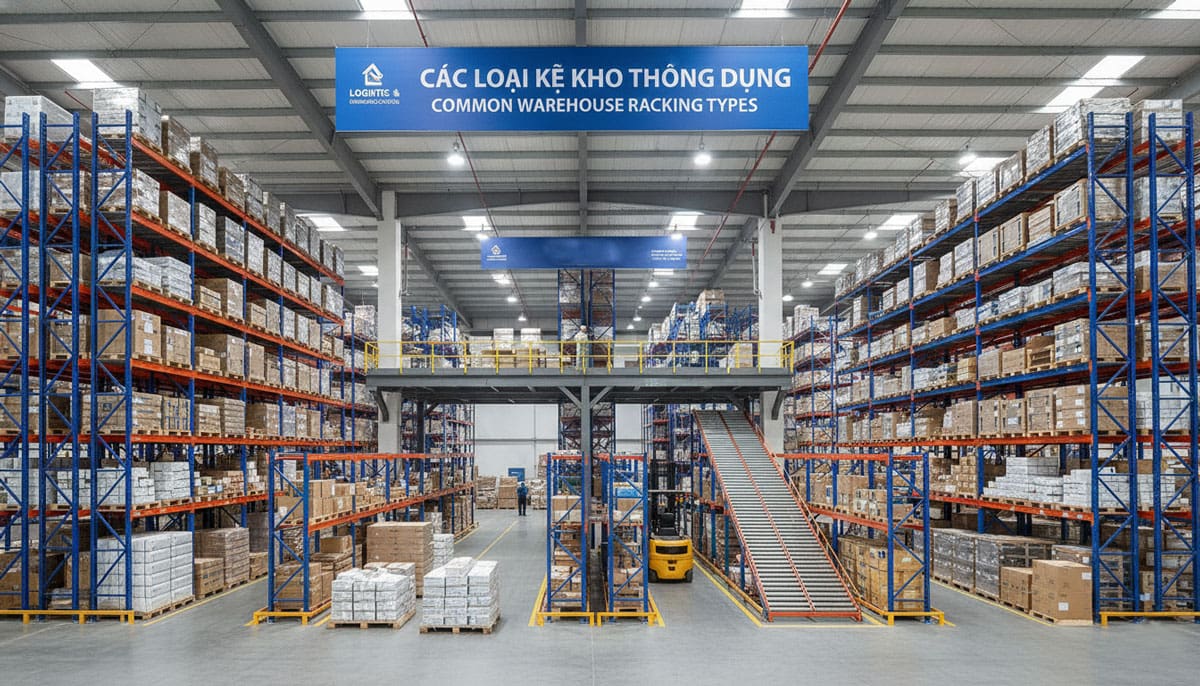
Warehouse racking systems are core solutions that help optimize space, ensure safety, and enhance warehouse operational efficiency. Depending on the type of goods, load capacity, inventory turnover, and warehouse area, logistics and storage businesses will choose different types of racks such as selective racking, drive-in racking, medium-duty racking, or mezzanine flooring. Selecting the right type of racking helps reduce long-term costs, increases scalability, and meets modern operational standards.
What are warehouse racking systems? Why are they crucial in warehouses?
Warehouse racking systems are specialized shelving units (often made of powder-coated steel) used to store goods vertically, helping to optimize space, manage inventory efficiently, and ensure safety in logistics warehouses, production warehouses, and self-managed storage facilities.
Real-world value:
- Increase warehouse capacity by 30–60%: Maximize ceiling height utilization instead of just floor space.
- Reduce risk of goods damage: Goods are layered, preventing direct stacking and protecting against moisture and mold from the ground.
- Standardize fire prevention & occupational safety procedures: Create clear aisles, allowing fire sprinkler systems to reach every corner and minimizing forklift collisions.
Why are warehouse racking systems “vital” for businesses?
If a warehouse is likened to a giant library, then warehouse racks are the shelves that prevent you from having to rummage through the entire building to find an item.
1. Optimize “Every Inch Counts”
Instead of goods occupying the entire floor, racking systems allow you to stack items high (up to 12-15m). This is extremely important for storage or 3PL logistics businesses, where every square meter is measured in dollars.
2. Smart Inventory Management (FIFO/LIFO)
Racking systems help you easily apply modern inventory management principles:
- FIFO (First In, First Out): Goods entered first are dispatched first, crucial for food and pharmaceuticals.
- LIFO (Last In, First Out): Goods entered last are dispatched first, suitable for construction materials or large quantities of homogeneous goods.
3. Protect Assets and People
- Moisture protection: Goods are elevated from the ground, avoiding humidity and rodents.
- Occupational safety: Racks are designed for precise load bearing (from a few hundred kg to several tons per level), preventing the risk of goods collapse that could endanger staff.
Classifying Warehouse Racking Systems by Load Capacity
Warehouse racking systems are typically classified based on their load-bearing capacity per shelf level. This classification helps businesses accurately determine the appropriate shelving type for their specific goods, from light document boxes to heavy industrial pallets weighing tons.
Golden Rule: Always choose racking with a design load capacity at least 10-15% higher than the actual goods weight to account for errors and ensure long-term structural durability.
Light-Duty Racking
This is the most common type of racking in daily life and offices.
- Load capacity: Typically under 200kg/level.
- Characteristics: Simple structure, often versatile slotted angle steel shelving. Quick to install, easy to adjust shelf spacing.
- Applications: Storing documents, books, household items, or small retail goods in self-managed warehouses.
- Advantages: Lowest cost, absolute flexibility.
Medium-Duty Racking
The “national” racking system for commercial and distribution warehouses.
- Load capacity: Ranges from 200kg – 500kg/level.
- Characteristics: Uses stronger beams and deck panels (steel sheets or wood). Goods are usually loaded/unloaded manually or with specialized step ladders.
- Applications: Warehouses storing auto/motorcycle parts, electronic components, pharmaceuticals, or FMCG (fast-moving consumer goods).
- Advantages: Good load-bearing capacity, high durability (often over 10 years), professional aesthetic.
Heavy-Duty Racking
The backbone of modern logistics centers.
- Load capacity: From 500kg to several tons/level.
- Characteristics: Large upright steel structure, extremely high load-bearing beams. Requires forklifts for loading/unloading goods. Popular types include Selective, Double Deep, Drive-in racking.
- Applications: Storing large palletized goods, industrial machinery, raw materials in logistics hubs or factories.
- Advantages: Excellent vertical space optimization (up to 12m), durable in harsh operating environments.
Quick Comparison Table of Racking Types by Load Capacity
| Criteria | Light-Duty Racking | Medium-Duty Racking | Heavy-Duty Racking |
|---|---|---|---|
| Max Load Capacity | < 200kg/level | 200kg – 500kg/level | > 500kg/level (up to 3000kg) |
| Loading Method | Manual | Manual / Step ladder | Forklift |
| Main Material | Slotted angle steel, steel shelves | Powder-coated steel | High-strength cold-rolled steel |
| Common Height | 1m – 2.5m | 1.5m – 4m | 3m – 12m |
Note: Never “test” the limits of your racking: A common mistake is concentrating goods in the middle of a shelf level. Always distribute weight evenly across the entire shelf surface to prevent beam deflection or upright deformation.
By 2026, many heavy-duty racking systems have integrated smart load sensors. If you overload, the system will send alerts directly to your phone or warehouse control center to prevent collapse.
Most Common Warehouse Racking Systems Today
Popular warehouse racking types are designed based on inventory retrieval methods (FIFO/LIFO) and storage density, meeting diverse needs from small warehouses to large logistics centers.
Choosing the right warehouse racking system is like solving a spatial puzzle: How can you store the most goods while retrieving them the fastest? Below are the “backbone” racking systems of the logistics industry in 2026.

Selective Pallet Rack
This is the ‘national’ or most common type of racking, found in almost every warehouse in Vietnam.
- Features: Each pallet occupies a separate, dedicated position on the rack. Forklifts can directly access any pallet without needing to move others.
- Advantages: Offers 100% pallet accessibility and absolute flexibility, ideal for warehouses managing thousands of different SKUs (Stock Keeping Units).
- Best suited for: B2C warehouses, e-commerce fulfillment centers, or facilities handling a wide variety of product types.
Drive-In / Drive-Through Racking
The ultimate solution for warehouses aiming to maximize space utilization.
- Features: Forklifts drive directly into the racking lanes to store pallets. This system significantly reduces or eliminates most aisles between rows of racks.
- Advantages: Achieves extremely high storage density (up to 70-80% of warehouse floor space).
- Best suited for: Homogeneous goods (same SKU), and large-batch inbound/outbound operations (e.g., beverage warehouses, packaged food storage).
Double Deep Racking
A clever variation of Selective racking designed to boost storage capacity.
- Features: Two rows of Selective racks are placed back-to-back, creating a two-pallet deep storage configuration.
- Advantages: Reduces the number of aisles, increasing storage space by approximately 30% compared to standard Selective racking.
- Note: Requires a specialized forklift with an extended reach (Deep Reach Forklift) to access pallets stored at the back.
Push Back Racking
Utilizes gravity to operate on a LIFO (Last-In, First-Out) principle.
- Features: Pallets are placed on nested carts that slide along slightly inclined rails. When the front pallet is removed, the pallets behind it automatically glide forward to the picking position.
- Advantages: Forklifts do not need to drive into the rack structure, unlike Drive-In systems, ensuring greater safety and faster retrieval speeds.
Flow Rack (Pallet Flow Racking – FIFO)
The ‘king’ of warehouses dealing with expiry dates or strict inventory rotation requirements.
- Features: Employs a system of rollers and gravity. Goods are loaded from one end and retrieved from the other.
- Advantages: Strictly adheres to the FIFO (First-In, First-Out) principle. Achieves extremely fast picking speeds thanks to gravity assistance.
- Best suited for: Food warehouses, pharmaceutical storage, and high-standard cold storage facilities.
| Rack Type | Accessibility | Storage Density | Picking Principle |
|---|---|---|---|
| Selective | 100% (Very High) | Low | Flexible |
| Double Deep | 50% (Medium) | Medium – High | LIFO |
| Drive-In | Low | Very High | LIFO |
| Push Back | Medium | High | LIFO |
| Flow Rack | High | High | FIFO |
Trend 2026: Many modern racking systems are now integrating IoT sensors at each pallet position. These sensors report real-time empty/full status directly to the Warehouse Management System (WMS), making inventory location as straightforward as finding a file on your computer.

Which Warehouse Racking System is Right for Your Business Model?
Choosing the right warehouse racking isn’t just about purchasing storage equipment; it’s a strategic challenge to optimize profit per square meter of warehouse space. With land costs at logistics hubs projected to rise significantly by 2026, an incorrect racking choice could slow down your entire operational chain and escalate long-term expenses.
To make the right choice, businesses should consider these four core factors:
- Goods type: size, weight capacity, uniformity
- Inbound/outbound frequency: fast or slow inventory turnover
- Warehouse area: floor space and ceiling height
- Investment budget: initial costs and long-term operating expenses
Quick Reference Guide by Common Warehouse Models
| Business Model | Suitable Racking Type | Core Advantages |
|---|---|---|
| General Logistics (3PL) | Selective, Double Deep | Flexible, 100% SKU accessibility, easily adaptable to contracts |
| Manufacturing / Cold Storage | Drive-In, Push Back, Radio Shuttle | Optimized storage density, reduced aisle space |
| Self-storage | Medium-duty racking, Mezzanine flooring | Divides space, flexible for manual handling |
| E-commerce | Flow Rack, Selective | Accelerates picking, supports FIFO, reduces order processing time |
Detailed Analysis Based on Actual Needs General Logistics & Distribution Warehouses (3PL)
3PL warehouses are characterized by diverse goods that constantly change according to each client – truly a mix of “everything under the sun.”
Recommended Solutions:
- Selective racking is an essential foundation
- Combine with Double Deep for long-term storage areas
Why It’s Effective:
- Selective allows access to any pallet without moving others
- Double Deep increases capacity by ~30% while maintaining operational control → Aligns with 3PL warehouse trends for 2026: flexible yet cost-optimized per m²
Manufacturing & Cold Storage Warehouses
Goods often have high volumes but few SKUs (e.g., beverages, frozen foods, raw materials for production).
Recommended Solutions:
- Drive-In / Push Back
- For large, highly automated warehouses: Radio Shuttle (robot racking)
Why It’s Effective:
- Maximizes aisle space reduction → increases storage density
- For cold storage, “compressing” goods reduces the volume requiring refrigeration → Saves significant electricity costs annually, aligning with ESG criteria
Family Warehouse & Document Storage
Target customers include individuals, households, and small offices, requiring easy access, flexibility, and security.
Recommended Solutions:
- Medium-duty racking for small to medium-sized items
- Mezzanine flooring to maximize warehouse height utilization
Why It’s Effective:
- Mezzanine flooring doubles usable space without needing to build extra floors
- Medium-duty racking allows for easy compartment division, offering flexible rental options based on m²/m³ needs → Highly suitable for urban self-storage models
E-commerce Warehouses
The greatest pressure lies in order processing speed (lead time) and picking accuracy.
Recommended Solutions:
- Flow Rack (gravity flow racking) for fast-moving items
- Selective for slower-moving inventory areas
Why It’s Effective:
- Flow Rack operates on a FIFO basis, with goods automatically sliding towards the picker
- Reduces warehouse staff travel time by approximately 40% → Increases order processing speed and reduces errors during peak seasons
There’s no single “best” racking type for all warehouses. The most suitable racking system is one that helps you maximize capacity, reduce operating costs, and accelerate goods handling within your specific business model.
Safety & Operational Standards for Warehouse Racking Installation
Warehouse racking must strictly adhere to design load standards, floor anchoring techniques, fire safety distances, and emergency exits to ensure safe operation and meet cargo insurance requirements. Key considerations:
- Load Signs: Clearly display the maximum load capacity for each rack level in an easily visible location.
- Fire Safety Clearance: Ensure a minimum distance of 50cm from the top of the stored goods to the sprinkler heads.
- Regular Inspections: Conduct structural rack inspections every 6-12 months to detect any early signs of deformation or rust.
Detailed Technical Requirements:
- Bolting: All heavy-duty rack uprights must be bolted to the concrete floor using expansion anchors to ensure stability and prevent tipping in case of minor impacts or seismic activity.
- Floor Flatness: The warehouse floor must meet standard flatness requirements. If the floor is uneven, the racking will twist, reducing its load-bearing capacity by 20-30%.
- Post Protectors: Install steel guards at rack corners to protect uprights from direct impact by forklifts – a leading cause of rack collapse.
- “Heavy Below – Light Above” Rule: Always prioritize placing the heaviest pallets on the ground floor or the lowest levels to lower the overall system’s center of gravity.

Modern Warehouse Racking Trends in Logistics & Self-Storage
The warehousing industry is rapidly shifting towards flexible, modular racking solutions that are easily reconfigurable and optimized for automation. This move aims to meet ESG trends and significantly reduce long-term operational costs.
Key Trends for 2026:
- Reusable Modular Racking: Smart designs allow for quick assembly, disassembly, and relocation without damaging components.
- Robot & AGV Optimized Racking: Features integrated rails and sensors for seamless coordination with Automated Guided Vehicles (AGVs).
- Urban Warehouse Design (Micro-fulfillment): Maximizes vertical space in the confined areas of major city centers.
In-depth Trend Analysis:
- Mezzanine Floor Systems: Instead of costly reinforced concrete construction, modern warehouses are utilizing steel floor racking to double their usable area. This is also a ‘green’ solution, as it’s fully recyclable.
- IoT-Integrated Smart Racking: Beams are equipped with vibration and load sensors. If excessive deflection or a strong impact is detected, the system automatically sends alerts to the warehouse manager’s phone.
- “Net-Zero” Warehouse Racking: Utilizes steel produced with renewable energy and VOC-free (Volatile Organic Compound) powder coating, helping businesses achieve ESG certification faster.
- High-Rise Urban Warehouses: In cities like Ho Chi Minh City and Hanoi, the trend of multi-story warehouses with specialized freight elevator systems is flourishing, employing flexible, medium-duty racking solutions.
If you’re planning to install new warehouse racking, always request as-built drawings and load capacity certification from your contractor. These documents are your ‘safeguard,’ making interactions with insurance providers and fire safety authorities much smoother.
FAQ
What is a warehouse racking system?
A warehouse racking system is a specialized steel framework designed to store goods vertically, optimizing floor space and enabling professional inventory management
How many types of warehouse racks are there based on load capacity?
Warehouse racks are typically divided into three types: Light-duty racks (under 200kg/level), Medium-duty racks (200kg – 500kg/level), and Heavy-duty racks (over 500kg/level).
Why is Selective Racking the most popular?
Selective Racking is popular due to its 100% direct access to every pallet, making it ideal for warehouses with high SKU counts and compatible with all forklift types.
What are FIFO and LIFO principles in warehousing?
FIFO (First-In, First-Out) is ideal for perishable goods. LIFO (Last-In, First-Out) is suitable for high-density storage of homogenous products.
Do warehouse racks need to be bolted to the floor?
Yes. All heavy-duty racking systems must be bolted to the floor using steel anchors to ensure stability and prevent collapse in case of accidental impact.
What is the fire safety distance for warehouse racks?
According to fire safety standards, there must be a minimum clearance of 50cm from the top of the goods to the fire sprinkler heads to ensure effective firefighting.
How to increase warehouse capacity without expanding the floor area?
You should use High-bay heavy-duty racks to utilize vertical space or install a Mezzanine floor to double your usable floor area.
How often should warehouse racks be inspected?
Businesses should perform weekly self-inspections and conduct deep technical audits every 12 months to detect structural deformations or corrosion.
Which business models are medium-duty racks suitable for?
Medium-duty racks are the perfect choice for retail stores, spare parts warehouses, pharmaceuticals, or self-storage service providers.
What are the smart racking trends in 2026?
The current trends are Radio Shuttle systems and IoT-integrated racks that provide real-time pallet location tracking and optimization for Autonomous Guided Vehicles (AGVs).