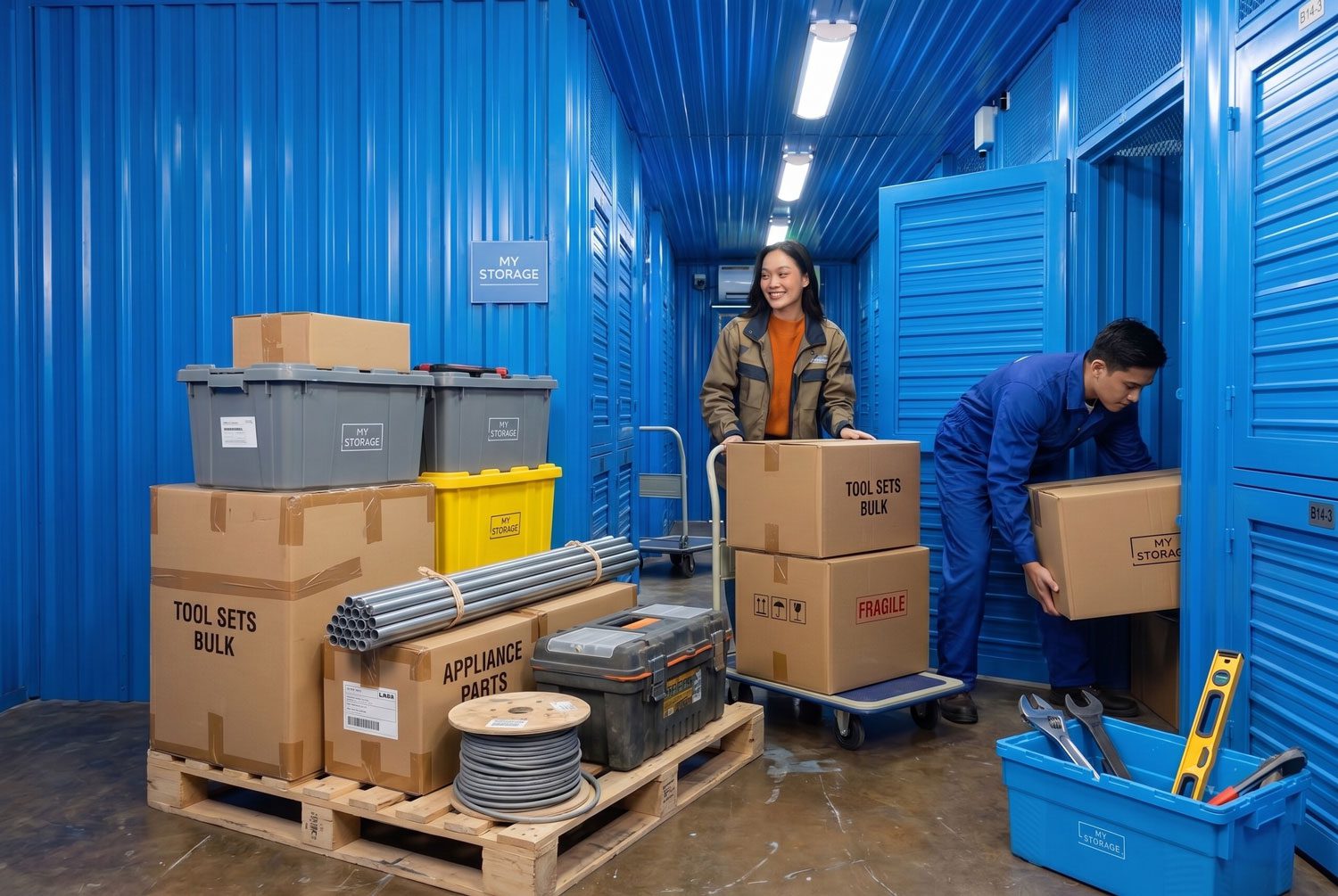
It is entirely possible. Many online shops today start from small apartments or townhouses with limited space. The key is knowing how to categorize goods, optimize storage space, and only keep the necessary amount of stock at home. When orders increase, you can combine external storage to scale up without needing to rent a large premises.
Challenges of Running an Online Shop in Small Spaces
Operating an online shop from home is convenient in the early stages but quickly becomes a bottleneck as sales grow. The five issues below often appear simultaneously and interact with each other, creating a difficult loop to escape without proper storage solutions.
Goods Occupying the Living Room and Living Space
In the beginning, a few boxes are easy to handle, but as sales grow steadily and stock is imported periodically, the total inventory volume increases much faster than the sales rate. The living room becomes a temporary warehouse, the dining table doubles as a packing station, and hallways filled with stacked cardboard boxes are a familiar sight for growing online shops that don’t yet have a dedicated warehouse. The family’s living space gradually shrinks, creating psychological stress that accumulates over time.
Cardboard Boxes Blocking Walkways
Cardboard boxes of goods blocking walkways are not only inconvenient for daily life but also pose a real safety risk. Fire exits are blocked, the risk of tripping increases, and in case of an emergency move, the entire stock becomes an obstacle. Additionally, boxes cluttering the hallways create an unprofessional, messy image when customers or partners visit.
Difficulty Finding Products When Orders Arrive
When goods are left in a mess without a clear classification system, every order processing takes extra time to find the right product, size, and color. This problem becomes more severe as the number of SKUs increases and items from different batches are mixed together in a cramped space.
| Number of SKUs | Average search time per order | Impact with 50 orders per day |
|---|---|---|
| Under 50 SKUs | 1–2 minutes per order | 50–100 minutes wasted per day |
| 50–200 SKUs | 3–5 minutes per order | 150–250 minutes wasted per day |
| Over 200 SKUs | 5–10 minutes per order | 250–500 minutes wasted per day |
Loss of Private Living Space
When there is no clear boundary between business and living space, the quality of life for the entire family is significantly affected. Children have no safe place to play, adults have no relaxation corner, and the whole house is in a state of clutter that is never fully cleaned because goods are constantly coming in and out. Psychological stress from living in a messy environment continuously affects work performance and the quality of business decisions.
Difficulty Restocking During Peak Seasons
During major sale seasons like 11.11, 12.12, or Tet, sellers need to import 3–5 times more stock than usual to avoid running out mid-sale. But when home space is already packed with daily goods, there is no room to import large batches. Consequently, you must import in small batches, losing cost advantages, or accept running out of stock mid-sale and losing revenue to competitors who prepared larger warehouses.
These difficulties are not signs of failure but signs that the shop is growing beyond the limits of its current operating model. Solving the space issue at the right time helps the shop continue to grow instead of being held back by logistics bottlenecks in your own home.
Common Items That Often Lead to “Warehouse Overflow” at Home
Goods with a large number of SKUs, diverse sizes, or those requiring large batch imports before sale seasons are the most prone to overflow. The eight groups below are the most common items where online sellers face space issues when operating from home.
| Product Group | Reason for overflow | Storage specifics | Signs a private warehouse is needed |
|---|---|---|---|
| Clothing | Each model has many sizes and colors, total SKUs easily exceed 500; seasonal stock accumulates | Needs to be hung or folded correctly to avoid wrinkles; zone by size and color | When clothes overflow from closets or start stacking on the floor |
| Cosmetics | Many product lines, short shelf life, requires standard temperature and humidity storage | Temperature below 28°C, humidity 50–65% RH, avoid direct light | When serums and creams start to discolor or separate due to heat |
| Phone accessories | Largest SKU count of all groups; cases can have thousands of codes by model and color | Zone by phone model and color; tiered shelving to avoid confusion | When the wrong delivery rate increases or it takes more than 5 minutes to find an SKU |
| Household goods | Large and bulky sizes, sets with many accompanying items | Sturdy shelves, do not stack too high to avoid falling | When household items start occupying living room corners and hallways |
| Mother and baby | Diverse products from clothes to supplies, sensitive to hygiene and preservation | Clean and dry environment, zone by age and product type | When baby gear takes over the bedroom and there’s no room for family life |
| Dry food | Expiry dates need strict management, prone to mold if humidity is high, attracts insects | Dry environment, humidity control, managed by First-In, First-Out (FIFO) principle | When food starts being kept in the kitchen with no more storage space |
| Gifts | Large imports before Tet, Valentine’s, March 8th; bulky items due to beautiful packaging | Avoid moisture damaging packaging, do not stack in many layers | When gifts take over an entire room before each holiday season |
| Stationery | Bulk imports for better cost prices; small products but in large quantities | Categorize by type, use divided boxes to avoid mixing | When stationery covers the desk and there is no more room to work |
- Clothing: This group has the fastest SKU accumulation rate because trends change constantly and each model requires multiple sizes and colors. A small fashion shop operating for one year can easily accumulate 200–500 SKUs, equivalent to dozens of cardboard boxes if there is no clear classification and warehouse system. Improperly stored clothing also becomes wrinkled and moldy, directly affecting the quality of goods delivered to customers.
- Cosmetics: This group has the strictest storage requirements among all common product categories. Incorrect temperature and humidity storage not only ruins the goods but also leads to customer complaints and negative reviews that affect the shop’s reputation long-term. This is also the group with the shortest shelf life, requiring strict inventory management according to the First-In, First-Out (FIFO) principle.
- Household Goods: Large size is the main issue for this group. A rice cooker, blender, or pan set can take up 10–20 times the volume of a cosmetic box of the same value. Household goods sellers often face warehouse overflow sooner than other groups, even with fewer SKUs.
- Mother and Baby: The characteristic of this group is high hygiene requirements because products come into direct contact with children, combined with a wide variety of products from clothing to school supplies. Mother and baby sellers often have to maintain inventory for many different ages, creating a large volume of SKUs and a need for clear classification space.
- Dry Food: The only group with a risk of attracting insects and pests if not stored correctly. Rice, beans, nuts, and packaged dry foods need a completely dry and airy environment; they cannot be kept in closets or under beds with personal items. Strict management of expiry dates by batch is a mandatory requirement to avoid selling expired goods.

Solutions for Efficient Online Selling in Small Homes
1. Keep Only Enough Stock for 1–2 Weeks
The simplest principle for space control: keep home inventory only at a level sufficient for 7–14 days based on current sales velocity. Any stock exceeding this threshold should be sent to a warehouse or restocked as needed rather than kept at home, which clutter your living space.
How to calculate a safe inventory threshold: take the average daily orders multiplied by 10–14 days, plus a 20% buffer for fluctuations. For example, a shop selling 20 orders per day for a specific product should keep a maximum of 280–340 units at home, with the remainder sent to a warehouse or awaiting restock.
2. Classify Goods by SKU and Dispatch Frequency
Organizing goods by sales frequency rather than category helps save significant time searching for items every day. Bestselling items should be placed in the most accessible positions, while slow-moving or backup stock should be tucked away in corners or sent to external storage.
| Frequency Group | Storage Location | Example |
|---|---|---|
| Over 5 orders per day | Right in front, within reach | Bestsellers, hot combos |
| 1–5 orders per day | Middle shelves, requires bending or slight reaching | Common products |
| Under 1 order per day | High shelves or hidden corners | Niche products, seasonal items |
| Rarely sold | External storage or labeled boxes | Backup stock, untested new samples |
3. Utilize Vertical Shelving Instead of Stacking on the Floor
Stacking goods on the floor wastes the entire vertical space, which is the greatest asset of a small apartment. Vertical shelves 1.8–2m high allow for 4–5 times more storage compared to horizontal floor stacking on the same footprint. Investing in industrial metal shelving with adjustable heights is the most flexible solution for home-based online shops.
Vertical shelving also prevents goods from direct contact with the floor, avoiding moisture seepage from below, making it easier to clean around, and creating airflow between levels.
4. Separate Living and Packing Areas
A physical boundary between business and living areas, even if just a curtain or a divider shelf, makes a huge difference in psychology and work efficiency. When there is a fixed packing area with a wide enough table, packing materials within reach, and goods organized nearby, order processing speed increases significantly compared to having to tidy up every time you pack.
A minimum packing area requires a table 80×60 cm wide, enough space for boxes, tape, labels, and 3–5 orders at once, near a power source for printing labels and connecting to the order management system.
5. Manage Inventory with Software or Spreadsheets
Managing inventory by memory or estimation leads to overselling and overstocking—two issues that directly waste capital and space. A simple spreadsheet updated every time goods are received or dispatched solves most of these problems without requiring investment in complex software at the early stage.
When orders exceed 30–50 per day or SKUs exceed 200 codes, you should switch to inventory management software integrated with e-commerce platforms for automatic synchronization and to avoid manual entry errors.
6. Avoid Overstocking Based on Intuition
Restocking based on intuition is the leading cause of inventory overflow in small spaces. Before every restocking decision, answer three questions: what is the current daily sales velocity, how many days will this batch take to sell out, and is there enough current space? If space is insufficient, either rent additional storage or restock less than originally planned.
Safety rule: do not import any batch with a volume greater than 50% of the existing storage space unless there is a clear plan for the excess.
7. Rent Storage When Scaling Up
The best time to rent storage is before your home space is completely full, not after. When goods start overflowing into the bedroom, walkways become cramped, and finding an item takes over 5 minutes, it is a signal to act immediately.
| Signs | Action |
|---|---|
| Inventory occupies over 30% of apartment floor space | Evaluate storage needs immediately |
| Each order takes over 5 minutes to find | Rent storage and set up a zoning system |
| Unable to stock large batches before sales due to lack of space | Rent additional storage before the next peak season |
| Family complains about living space | Move all goods to storage immediately |
8. Plan Stocking for Seasons and Sale Campaigns
Planning stock according to the annual sale calendar helps sellers stay proactive regarding both finances and storage space instead of reactively handling every situation.
| Timing | Space Preparation | Inventory Preparation |
|---|---|---|
| 6–8 weeks before 9.9, 11.11 | Assess current space, contact storage if expansion is needed | List SKUs that need increased inventory |
| 4 weeks before | Rent additional storage if needed, set up packing area | Import main batch, inspect and organize into storage |
| 2 weeks before | Final inventory check, top up if missing | Prepare packing materials and promotional combos |
| After the sale | Downsize storage if extra was rented, conduct inventory count | Plan for clearance or hold for the next round |

Renting a Mini Warehouse vs. Renting a Fixed Space for Storage?
For small and medium-sized sellers, mini warehouses are often a more efficient choice because you only pay for the space you actually need, with no operational costs and flexible monthly adjustments. Fixed premises are more suitable when the shop has stable revenue and needs workspace for staff.
| Criteria | Self-managed mini warehouse | Fixed space rental |
|---|---|---|
| Initial costs | 1–2 months deposit, starting from 300,000–500,000 VND | 2–3 months deposit, usually from 10–30 million VND |
| Monthly costs | 300,000–2,000,000 VND depending on size, including electricity and security | 3–15 million VND excluding utilities and operational costs |
| Contract commitment | Monthly, cancel anytime without penalties | Minimum 6–12 months, high penalties for early termination |
| Space flexibility | Increase or decrease from the following month | Fixed by contract, difficult to change |
| Security | 24/7 Camera, private PIN lock, permanent security guards | Depends on the building or requires additional investment |
| Setup time | Start immediately on the day of signing | 2–4 weeks for shelving, electricity, and infrastructure installation |
| Suitable for | Shops with 10–100 orders per day, needing seasonal flexibility | Shops with over 100 orders per day, needing staff on-site |
| Storage environment | Humidity and temperature control available | Requires additional investment if needed |
| Expansion flexibility | Easy, add adjacent units on a monthly basis | Difficult, depends on vacant space and renegotiation |
| Hidden costs | Almost none | Utilities, maintenance, insurance, warehouse staff |
- When to Choose a Mini Warehouse: A mini warehouse is most suitable during unstable growth phases, when storage needs fluctuate according to sale seasons, and when the seller does not yet need staff working at the warehouse regularly. Low costs and low financial risks help sellers focus capital on inventory and marketing instead of premises.
- When to Switch to Fixed Premises: Fixed premises are more logical when sales are stable at over 100 orders per day for at least 3 consecutive months, workspace is needed for 2–3 warehouse staff, you want to customize the space for specific workflows, and the rental cost can be offset by increased revenue.
You don’t need to choose one over the other from the start. Many sellers begin with a mini warehouse, accumulate enough data on actual needs, and move to fixed premises once they are certain about their scale. A mini warehouse is a risk-free stepping stone that helps sellers test their warehouse operation model before committing to larger costs.
Case Study: A Cosmetics Shop from a 60m² Apartment to 1,000 Orders per Month
An online cosmetics shop in HCMC initially operated entirely from a 60m² apartment. When orders increased from 10 to 35 per day, the living space was completely taken over, and storage quality began to affect the shop’s reputation. Switching to MyStorage mini warehouse was a decision that changed the entire operational model.
Initial Challenges
- Living Space Turned into a Warehouse: The 2-bedroom 60m² apartment was initially spacious enough for a couple and one small child. After 18 months of running the cosmetics shop, the second bedroom became the main warehouse, the living room had a corner filled with cardboard boxes, and the dining table doubled as a packing station every evening. There was no longer private space for the family, and the child had no safe place to play.
- Product Quality Affected: Cosmetics kept in a bedroom without continuous air conditioning faced daytime temperatures reaching 32–34°C in the summer. Vitamin C serums began turning yellowish-brown before their expiration date. Some batches of sunscreen separated by the time customers received them. For two consecutive months, 1–2 star reviews regarding product quality appeared, and the shop’s rating dropped from 4.8 to 4.5 on Shopee.
- Unable to Import Large Batches Before Sales: Before a double-day sale, the shop owner wanted to import a batch worth 80 million VND to get a better cost price and have enough stock for the entire period. However, the apartment had no room left, forcing them to split it into 4 smaller imports during October and November, losing a bulk discount of about 7% and incurring 4x the shipping costs instead of one.
Storage Solutions
- Phase 1 — Renting a 4m² Storage Unit as the Main Warehouse: The shop owner rented a 4m² unit at MyStorage for about 800,000 VND per month. All inventory, packaging materials, and cardboard boxes were moved to the warehouse. Only enough stock for 5–7 days of current sales was kept at home.
Tiered shelving was arranged in the unit, zoned by product line, with a small folding table as an inspection area before bringing items home for packing. Temperature and humidity in the warehouse remained stable year-round; serums and creams were stored in proper conditions for the first time since the shop started.
- Phase 2 — Expanding Before 11.11: Two months before the next 11.11 sale, the shop expanded into an adjacent 3m² unit, totaling 7m² for the 3 peak months. They imported a 100 million VND batch at once, receiving an 8% discount from the supplier and saving 3x the shipping costs compared to the previous year.
- New Operational Process: Every Monday, Wednesday, and Friday: collect enough stock from the MyStorage warehouse for 2–3 days. At home, only current stock and daily packaging materials are kept, with a neat packing area on one corner of the table. Evening packing became faster because the space was no longer cluttered and items were clearly categorized from the warehouse.
Results Achieved
| Metric | Before renting a warehouse | After renting a warehouse |
|---|---|---|
| Monthly orders | 350–400 orders | 900–1,100 orders after 6 months |
| Shopee rating | 4.5 due to quality complaints | 4.9 thanks to properly stored goods |
| Packing time | 8–12 minutes per order | 3–5 minutes per order |
| Damaged goods due to improper storage | 3–5 products per month, 500,000–2,000,000 VND loss | Almost none |
| Cost of goods sold | Multiple small imports with no discount | Reduced by 7–8% due to bulk imports |
| Apartment space | Second bedroom was a warehouse, living room cluttered | Second bedroom became a study room for the child |
| Warehouse costs | None, but high hidden losses | 800,000 VND per month during normal periods |
Monthly Cost and Benefit Summary Table
| Item | Amount |
|---|---|
| Warehouse rental cost | 800,000 VND |
| Savings from undamaged goods | 500,000–2,000,000 VND |
| Savings from bulk import costs | 2,000,000–4,000,000 VND based on sales |
| Increased revenue from better ratings | Hard to quantify exactly but significant |
| Value of reclaimed living space | 1,500,000–2,500,000 VND based on rental rates |
The decision to rent a warehouse didn’t come when the shop was too large, but when the owner realized the cost of not having a warehouse had far exceeded the rental cost months prior. Damaged goods, lower ratings, lost bulk discounts, and occupied living space are all real costs, even if they don’t appear clearly on a monthly financial statement.
FAQ
When should an online shop start renting storage?
When stock starts occupying living space, finding products takes more than 5 minutes per order, or importing bulk lots before sales is impossible due to lack of space. These three signals appearing together are the clearest sign that home-based operations have reached their limit.
Does MyStorage mini storage control temperature and humidity?
Yes. MyStorage maintains 20–26°C and 50–65% RH continuously, suitable for storing cosmetics, packaged food, leather goods, and sensitive electronics. These conditions are significantly better than typical Ho Chi Minh City apartments during hot and rainy seasons.
How much does a mini storage unit at MyStorage cost?
Small units of 1–3 m² start from 300,000–700,000 VND per month, suitable for shops processing under 30 orders daily. Units of 4–6 m² run 800,000–1,500,000 VND monthly for shops handling 30–80 orders per day. No hidden fees — electricity, security, and 24/7 access are included.
Can mini storage units be used for on-site order packing?
Yes, for units 4 m² or larger that can accommodate a folding table and packing materials. Many sellers choose to pack orders directly at the storage unit to save time transporting stock home, particularly effective during sale seasons when 100–300 orders need daily processing.
Is it safe to store cosmetics in a self-storage unit?
Safe if the facility controls temperature below 28°C and humidity at 50–65% RH. Vitamin C serums, retinol, and sunscreens are particularly sensitive to high temperatures. MyStorage maintains these conditions continuously, preventing discolouration, separation, and active ingredient degradation before expiry.
Is mini storage cheaper than renting a fixed commercial space?
Significantly cheaper for shops processing under 100 orders daily. Fixed premises typically cost 3–15 million VND monthly excluding utilities and operations, while mini storage runs 300,000–1,500,000 VND all-inclusive. Upgrading to fixed premises only makes sense when permanent on-site staff are needed.
Can storage space be scaled up or down according to sale seasons?
Yes. MyStorage offers month-to-month rental with size adjustments permitted at any time without penalty fees. Sellers typically expand by 2–4 m² before 9.9, 11.11, and Tết campaigns, then downsize once inventory returns to normal levels.
Should a new shop rent storage immediately?
Not necessarily if processing fewer than 15 orders daily and stock does not yet affect living space. Start renting when simultaneously testing 3 or more product lines, inventory regularly exceeds 2–3 large cartons, or household members begin complaining about space.
How should inventory be managed across two locations at home and in storage?
Establish a clear rule: keep only 5–7 days worth of stock at home, with the rest in storage. Use a spreadsheet or software updated immediately after each stock retrieval. Fixed pickup schedules 2–3 times weekly maintain stable home inventory levels without constant monitoring.
What preparation is needed before renting storage at MyStorage?
Estimate total stock volume to select the right unit size, and prepare tiered shelving and category labels to establish a zoning system from day one. Contact MyStorage for size consultation and storage can begin on the same day the agreement is signed without complicated procedures.