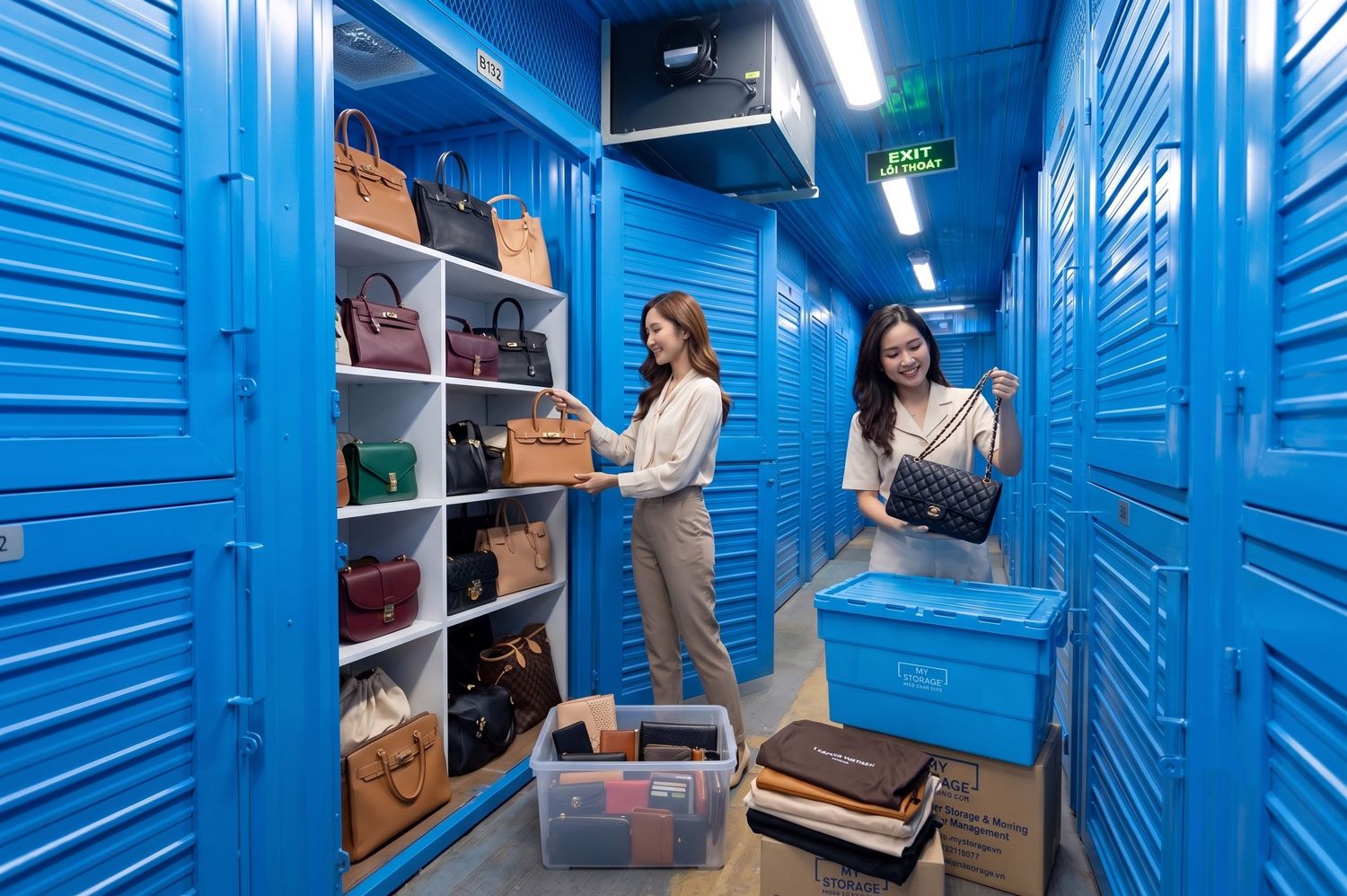
Luxury handbags can lose their shape, develop mold, peel, or depreciate in value if stored incorrectly. Common mistakes in storing handbags or leather goods such as hanging bags for too long, storing them in airtight plastic bags, keeping them in damp areas, or failing to clean them before storage can all compromise the quality of the leather and metal hardware. By simply changing a few habits, you can extend the lifespan and preserve the value of your collection.
Why Do Luxury Handbags Need Proper Storage?
Luxury handbags are genuine financial assets, not just fashion items. A well-maintained Hermès Birkin can appreciate in value over time, whereas the same bag, if affected by mold or metal oxidation, could lose 40–70% of its market value. Proper storage is the way to protect this investment.
Natural Leather Needs to “Breathe”
Natural leather is an organic material that remains active after tanning, requiring constant air exchange to maintain its natural moisture and elasticity. Unlike fabric or plastic, natural leather has a porous structure with millions of tiny pores that need air circulation to prevent it from becoming dry and brittle or accumulating excessive moisture.
When leather is trapped in plastic bags or completely unventilated closed cabinets, two problems can occur simultaneously: moisture buildup inside creates ideal conditions for mold growth, while gases from the leather’s natural decomposition process cannot escape, leading to changes in the leather’s color and smell over time.
High-end leather bags should be stored in breathable dust bags, not plastic bags, and in an environment with gentle air circulation.
Metal Hardware Is Prone to Oxidation
Metal hardware on luxury bags, such as locks, zippers, studs, and chains, is a crucial factor affecting the bag’s value and aesthetics. Gold plating, silver, and brass all oxidize when exposed to high humidity, creating a layer of tarnish that dulls the finish and can jam the mechanisms of locks and zippers.
| Metal type | Safe humidity threshold | Signs of oxidation |
|---|---|---|
| Gold-plated | Below 65% RH | Tarnishing, loss of luster, black spots |
| Silver-plated | Below 60% RH | Rapid blackening, difficult to repolish |
| Brass and alloys | Below 65% RH | Green patina, rust, jammed mechanisms |
| Stainless steel | Fairly durable but still affected | Dulling, stubborn stains |
Coatings and Adhesives Degrade Over Time
Many luxury bags feature protective coatings on the leather surface or use specialized adhesives on edges, corners, and joints between leather and hardware. Temperatures above 30°C soften and break down the bonds of these glues, leading to edge peeling, delamination, and opening of glued seams. Lacquer or patent leather coatings are particularly sensitive to heat and UV light, making them prone to cracking and peeling during sudden temperature changes.
Resale Value Depends Directly on Product Condition
The secondhand luxury handbag market is growing strongly in Vietnam and globally, with valuations clearly differentiated by product condition.
| Condition | Price relative to new | Real-world example |
|---|---|---|
| Mint condition, full accessories | 80–95% of new price, some lines exceed it | Hermès, Chanel classic flap retain or increase in value |
| Excellent, light signs of use | 60–80% of new price | Still a good investment if properly maintained |
| Good, visible signs of wear | 40–60% of new price | Significant value drop, harder to sell quickly |
| Fair, with damage | 20–40% of new price | Loss of most initial investment value |
| Moldy, severe oxidation | Below 20% or unsellable | Serious financial loss |
A Chanel Classic Flap purchased for 150 million VND and well-maintained for 5 years can be resold for 120–180 million VND depending on market conditions. The same bag, if severely moldy or with heavily oxidized hardware, might only fetch 30–50 million VND. The cost of proper storage over 5 years is typically under 10 million VND, making it a clearly profitable investment.

10 Common Mistakes When Storing Handbags and Leather Goods
Many designer handbags lose their shape, peel, or decrease in value not because of heavy use, but because they are stored incorrectly. Seemingly harmless habits like hanging bags for too long, storing them in airtight plastic bags, keeping them in damp places, or failing to check them periodically can all cause leather, metal hardware, and bag structures to degrade over time. Here are the 10 most common mistakes users often make when preserving designer handbags.
Mistake 1: Hanging Handbags for Long Periods
Hanging a bag by its straps for many consecutive months creates concentrated pressure at the attachment points, stretching and deforming the structure in a way that cannot be fully recovered.
Leather straps bear the entire weight of the bag when hung, stretching the attachment points to the body over time. For bags with metal chain straps, the weight of the chain plus the bag body creates continuous tension that deforms the mounting rings and the surrounding leather. Soft-structured bags like the Chanel WOC or bucket bags are particularly susceptible because they lack a rigid internal frame for support.
How to fix: Place the bag flat on a shelf or upright in a box with padding on both sides. If you want to hang it to save space, only hang it using hooks placed against the bag body rather than the straps, and do not leave it for longer than a few days.
Mistake 2: Not Stuffing to Maintain the Bag’s Shape
Leaving a bag completely empty for a long time causes it to collapse and creates permanent creases in the leather structure, which are difficult to restore even with later stuffing.
Leather has a shape memory. When a bag is left empty, the leather folds naturally under gravity and pressure from surrounding objects, creating creases that deepen over time. For soft-structured bags like the Celine Luggage or Balenciaga City, these creases significantly affect the appearance during use and reduce aesthetic value.
How to fix: Stuff with acid-free tissue paper, bubble wrap, or soft air pillows just enough for the bag to maintain its natural form, without overstuffing and straining the stitching.
Mistake 3: Storing Bags in Airtight Plastic Bags
Non-breathable plastic bags prevent moisture from escaping, creating a sealed, humid environment inside that is ideal for mold growth on the leather surface.
Even if the leather looks completely dry before storage, natural moisture from the leather still escapes slowly. In a sealed plastic bag, this moisture has nowhere to go, gradually accumulating and reaching a threshold sufficient to trigger mold after a few weeks to months. Mold forming inside a plastic bag is often detected late because it is not visible from the outside.
How to fix: Always use a dust bag made of breathable cotton or flannel. If the original dust bag is unavailable, use a thin cloth bag or wrap lightly in tissue paper before placing it in a box.
Mistake 4: Placing Bags in High-Humidity Areas
Cabinets near bathrooms, under beds, balconies, and unventilated storage rooms are the locations with the highest humidity in the house, making them completely unsuitable for long-term leather storage.
Natural leather has an organic protein structure that is an ideal food source for mold. When humidity exceeds 65% RH for prolonged periods, mold spores naturally present in the air begin to germinate and grow on the leather surface within 2–8 weeks.
| Storage Location | Typical Humidity | Risk |
|---|---|---|
| Cabinets near bathrooms | 70–90% RH | Very high |
| Low-level under-bed space | 70–80% RH | High |
| Uncovered balconies | Weather-dependent, 75–90% in rainy season | Very high |
| Unventilated storage rooms | 75–85% RH | High |
| Standard wardrobes | 65–75% RH | Medium |
| MyStorage units | 50–65% controlled RH | Low |

Mistake 5: Exposing Bags Directly to Sunlight
Direct sunlight causes three types of simultaneous damage: UV rays break down chemical bonds in leather dyes causing uneven fading, high temperatures evaporate natural oils in the leather making it dry and lose elasticity, and continuous daily heating and cooling cycles crack the surface at stress points like corners and folds. Light-colored leather bags and patent leather are particularly sensitive to all three of these effects.
How to fix: Store in a space without direct sunlight, avoiding placement near windows or balconies. A self-storage unit without sun-exposed windows is an ideal environment for this group of bags.
Mistake 6: Stacking Too Many Bags on Top of Each Other
Stacking bags creates uneven pressure on the bag underneath, causing deformation of the bag body and cracking of the leather surface at the points of greatest stress.
An average leather bag weighs 0.5–1.5 kg. Stacking 4–5 bags on top of each other creates a pressure of 2–6 kg on the bottom bag, continuously for many months. Bags with rigid structures like the Hermès Kelly withstand this better but are still affected at the corners. Soft bags like the Chanel Boy or soft leather totes will be visibly deformed after 2–3 months of being crushed.
Correct arrangement: Each bag should have its own spot on the shelf, not stacked. Bags should stand upright in their original boxes or be sandwiched between soft dividers. Storage with tiered shelving wide enough for each bag is the best solution.
Mistake 7: Not Cleaning Bags Before Storing
Dirt, sweat, and oils from hands accumulating on the leather surface not only soil it but also serve as an additional nutrient source for mold and bacteria during storage.
| Step | Action | Note |
|---|---|---|
| 1 | Dust with a dry microfiber cloth | Gently, following the grain of the leather |
| 2 | Clean stains with a specialized leather cleaner | Do not use alcohol or plain water on genuine leather |
| 3 | Let dry naturally and completely | Do not use a hair dryer, minimum 24 hours |
| 4 | Condition the leather with a suitable conditioner | Create a protective layer before storing |
| 5 | Lightly polish metal hardware | Use a soft flannel cloth, do not use chemicals |
Mistake 8: Not Checking Bags for a Long Time
Leather damage progresses slowly and silently. Mild mold in the early stages can be treated, but mold discovered late after several months has eaten deep into the leather structure and cannot be fully restored.
Periodic checks every 4–6 weeks help detect early signs of abnormalities such as small white spots starting to form, damp odors appearing in the box, saturated silica gel packets needing replacement, and metal hardware starting to tarnish. Early detection makes treatment much simpler than letting the damage spread.
Mistake 9: Storing with Sharp Objects or Heavy Items
Keys, jewelry with sharp edges, metal straps, and heavy items placed next to or on top of leather bags cause surface scratches, dented corners, and damage to metal hardware due to impact. Scratches on genuine leather and patent leather are almost impossible to fully recover even with polishing or conditioning. Each designer handbag should have its own separate space, without direct contact with any other items.
Mistake 10: Only Storing in a Cramped Wardrobe
A wardrobe containing too many clothes creates a non-ventilated environment where humidity accumulates and odors from surrounding clothes are easily absorbed, making it completely unsuitable for long-term storage of high-end leather goods.
| Issue | Cause | Impact on handbags |
|---|---|---|
| Lack of air circulation | Closed cabinet, cramped clothes | Humidity buildup, increased risk of mold |
| Odor absorption | Clothes carrying sweat and perfume smells | Leather absorbs surrounding odors which are difficult to remove completely |
| Difficulty controlling humidity | No control equipment | Entirely dependent on external weather conditions |
| Pressure from clothes | Cramped clothes pressing against the bag | Surface deformation and loss of shape over time |
A better solution than a regular wardrobe: Self-storage with humidity control at 50–65% RH, no odors from clothes, tiered shelving for each bag, and 24/7 security protecting high-value assets.

When Should You Use Storage Instead of Storing at Home?
Dedicated storage is suitable when the total value of leather goods exceeds the threshold that a home environment can safely preserve, or when the number of handbags exceeds the reasonable capacity of a wardrobe without compromising storage quality.
Handbag Collectors
Handbag collectors often face space issues earlier than any other group. When a collection exceeds 15–20 items, a standard wardrobe no longer has enough space to place each bag in its own spot without being crushed, squeezed, or lacking ventilation. Stacking or cramming bags into a closet is the fastest way to damage a valuable collection.
Self-storage with tiered shelving for each bag having its own spot, a humidity-controlled environment, and stable temperatures is a better preservation solution than any home wardrobe, especially for bags valued at 20 million VND or more where damage results in real financial loss.
Fashion Shop and Boutique Owners
Fashion stores often lack separate storage space, leading to inventory being crammed into showrooms or temporary warehouses that don’t meet preservation standards. Handbag inventory kept in hot, humid warehouses through the long rainy season in HCMC can develop mold and peeling before being sold.
| Shop Situation | Signs to Move to Specialized Storage |
|---|---|
| Inventory taking up display space | Display shelves full of unsold items instead of new arrivals |
| Goods damaged before sale | Mold, peeling, or yellowing appearing on inventory |
| Insufficient space for pre-sale stock | Having to import in small batches, losing out on good cost prices |
| Messy packaging and POSM | Damaged boxes, soggy packaging before use |
Luxury Resellers
Luxury resellers carry the highest financial risk of all groups because the value of each unit is immense. A Hermès or Chanel bag that gets moldy or has oxidized hardware during storage can lose 40–70% of its commercial value; losses can reach tens to hundreds of millions of VND from just one storage mishap.
Self-storage with 24/7 cameras, private PIN locks, and a controlled environment is a dual protection solution for both security and quality—two factors that directly determine the resale value of each bag.
Frequent Business Travelers
Frequent business travelers or those often away from home face a double risk: high-value handbags with no one to check them periodically, and a home environment without continuous air conditioning during the owner’s absence. Temperatures in a closed apartment in HCMC can rise to 35–40°C and humidity increases significantly, creating conditions for rapid leather damage in a short time.
Storing valuable handbags and leather goods in self-storage before each long trip is a way to protect assets without depending on someone being home.
Families Living in Small Apartments
Apartments of 45–65m² lack enough storage space for both daily items and handbag/leather collections requiring special care. When the wardrobe is full and handbags start being stored under the bed or on the balcony, it’s the clearest sign that an external storage solution is needed.
| Comparison | Storing at Home | MyStorage |
|---|---|---|
| Humidity control | No, weather-dependent | 50–65% RH maintained continuously |
| Temperature | 28–38°C during hot season | 20–26°C stable |
| Security | General apartment security | 24/7 cameras, private PIN lock |
| Space for each bag | Limited, prone to stacking | Individual shelves, no crushing |
| Periodic checks | Depends on habits | 24/7 access to check anytime |
| Cost | No direct cost but high potential loss | From 300,000–800,000 VND per month |
The decision to switch to storage doesn’t depend on the number of bags but on the total value of the collection. When the total value of handbags and leather goods exceeds 50 million VND, the cost of proper preservation in self-storage is a reasonable investment to safeguard that asset value.
Safe Storage Solutions for Handbags and Leather Goods
MyStorage provides self-storage with humidity control, air conditioning, and 24/7 security, suitable for preserving valuable handbags, shoes, leather wallets, and fashion accessories. Free up home space while your assets are protected under the right conditions.
Standard Preservation Environment for Leather Goods
| Standard | MyStorage | Home Wardrobe |
|---|---|---|
| Humidity | 50–65% RH maintained continuously | 70–85% in rainy season, uncontrolled |
| Temperature | 20–26°C stable year-round | 28–38°C during hot season |
| Ventilation | Active ventilation and dehumidification | Stagnant air in closed closets |
| Light | No direct sunlight | Light may leak through closet gaps |
| Hygiene | Epoxy floors, periodic pest control | Depends on home cleaning habits |
Sizes Suitable for Every Need
| Size | Suitable for | Reference Capacity | Reference Cost |
|---|---|---|---|
| 1–2 m² | Individuals with 10–20 bags, personal leather goods | 15–25 bags on tiered shelves, plus shoes and wallets | 300,000–600,000 VND per month |
| 3–5 m² | Serious collectors, small resellers | 30–60 bags with tiered shelves, original boxes, and accessories | 700,000–1,200,000 VND per month |
| 6–10 m² | Handbag shops, luxury resellers | Seasonal inventory, packing area, packaging, and POSM | 1,300,000–2,500,000 VND per month |
| 10 m² or more | Boutiques, distributors | Entire inventory by product line | Contact for a quote |
Security for High-Value Assets
| Protection Layer | Details |
|---|---|
| 24/7 HD Cameras | Covers all hallways and entrances, 90-day footage storage |
| Personal PIN Lock | Each unit has a unique code, only the owner can open it |
| On-site Security | Controlled access to the storage area |
| Access Log | Records time and identity for every entry |
Flexibility Based on Actual Needs
Monthly storage rental with no long-term commitment, increase or decrease space at any time. 24/7 access with a personal PIN code to check and retrieve bags anytime without an appointment. Suitable for both long-term storers and shops needing expansion during sale seasons.
Suggested Organization Within the Storage Unit
| Item Type | Optimal Arrangement |
|---|---|
| Structured Bags | Place upright in original boxes with dustbags, one bag per shelf compartment |
| Soft-structured Bags | Stuff with tissue paper to maintain shape, place in fabric dustbags, do not stack |
| Leather Shoes | Stuff with newspaper to maintain shape, place in fabric bags, arrange in pairs on shelves |
| Wallets & Small Accessories | Store in divided boxes, clearly labeled on the outside |
| Original Boxes | Stack vertically or horizontally depending on design, no more than 2–3 layers high |
Luxury handbags deserve to be preserved according to their value. MyStorage provides an environment that a standard wardrobe cannot create, at a cost much lower than the damage from a storage mishap.
FAQ
Is self-storage adequate for storing luxury handbags?
Yes, if the facility maintains 50–65% RH and 20–26°C like MyStorage. These conditions are significantly better than standard home wardrobes in Vietnam, especially during the rainy season when indoor humidity regularly exceeds 75–85% RH for months at a time.
What preparation is needed before putting bags into long-term storage?
Wipe the surface clean with a soft dry cloth, condition the leather appropriately, stuff with tissue paper to maintain shape, place in a breathable fabric dustbag, and add a silica gel packet to the box. Thoroughly cleaning and drying before storage is the most critical step as accumulated dust and moisture accelerate deterioration during storage.
Should luxury bag resellers store inventory at home or in a storage unit?
In storage when total inventory value exceeds 50 million VND. A single mould or hardware oxidation incident can reduce a luxury bag’s resale value by 40–70%. Storage costs are far lower than losses from even one preservation incident, and facility security is significantly stronger than at home.
What specific storage conditions do Hermès and Chanel bags require?
50–60% RH and 18–22°C are ideal for the togo, epsom, and lambskin leathers used in these bags. Completely avoid UV light, prevent contact with perfume or chemical odours, and each bag needs its own dustbag without touching other surfaces.
Can premium leather shoes be stored alongside handbags in the same unit?
Yes, if clearly zoned and shoes are properly prepared before storage. Shoes should have clean soles, be stuffed with newspaper to maintain shape, placed in individual fabric bags per pair, and kept on separate shelving from bags to prevent sole dust and odour from affecting bag leather.
What special considerations apply to patent leather bags?
Patent leather is extremely sensitive to temperature and sticks to other surfaces upon direct contact. Never allow patent leather to touch any surface directly, including fabric dustbags, as separation can pull away the lacquer coating. Wrap lightly in tissue paper before placing in a dustbag and store at a stable temperature without sudden fluctuations.
How often should bags in storage be checked?
Every 4–6 weeks is ideal for early detection of any issues. Each check should include replacing silica gel if it has changed colour, inspecting leather surfaces for unusual white spots, assessing metal hardware condition, and lightly wiping surfaces with a dry cloth before returning to storage.
Can bag shops use MyStorage units for order packing?
Yes, if the unit is 5–6 m² or larger to accommodate a dedicated packing area alongside storage. Many shops adopt this approach as it saves time transporting stock between storage and packing locations, particularly effective during sale seasons when large order volumes need rapid processing.
Should original boxes and accompanying accessories also be stored?
Yes, and they should be, as original boxes and accessories like authentication cards, keys, and charms directly affect resale value. Boxes should stand upright to prevent warping, stacked no more than 2 layers high, with silica gel placed in each box to preserve both the bag and accompanying items under optimal conditions.
What steps are needed to start storing luxury bags at MyStorage?
Clean and prepare all bags before bringing them in, then contact MyStorage to select the right unit size for the collection’s quantity and dimensions. Bring small shelving if needed to optimise space within the unit and establish a zoning system from day one for easy retrieval and periodic inspection going forward.