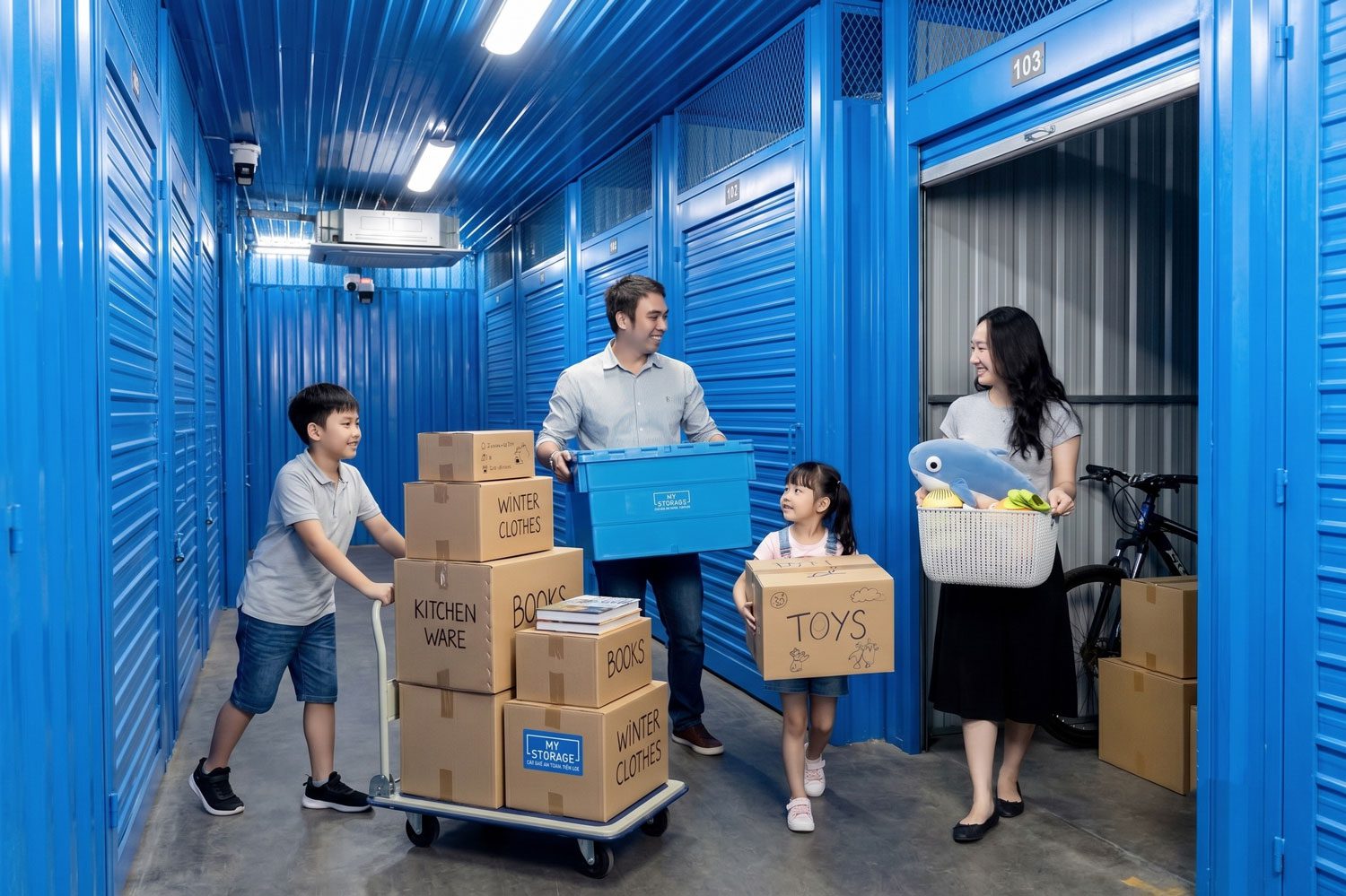
A 2-bedroom apartment can be perfectly spacious and tidy if you know how to categorize, organize, and store items reasonably. Instead of buying more cabinets or cluttering the house, many families choose to keep daily essentials in the apartment and store seasonal items, spare furniture, or rarely used belongings in mini storage units to optimize their living space.
Why Do 2-Bedroom Apartments Quickly Become Cramped?
A 2-bedroom apartment isn’t cramped because of its original design, but because the rate of accumulating belongings far exceeds the rate of decluttering. Six main causes, from changes in family members to online shopping habits, accumulate gradually over the years until every empty space is occupied.
- Increasing Family Size: A 2-bedroom apartment is typically bought or rented for two people or newlyweds, with a storage system designed just for that scale. When children arrive, grandparents move in, or relatives stay long-term, the volume of belongings grows exponentially while the floor area and shelving systems remain unchanged. A family growing from 2 to 4 members doesn’t just double their clothing; they also accumulate entirely new items like cribs, strollers, and high chairs that the original apartment layout never accounted for.
- Ever-Growing Baby Gear: Children are the fastest source of clutter in any household because their needs change constantly through each developmental stage. Clothes for every age milestone, age-appropriate toys, increasing school supplies, and support equipment like walkers, high chairs, and cribs take up significant space. Families with 1–2 children under 6 in a 2-bedroom apartment often find that kids’ items occupy 25–35% of the total storage area, equivalent to 8–12 m² in a 45–60m² unit.
- Seasonal Clothing: Winter blankets, heavy coats, summer swimwear, and holiday outfits are items used for only 2–3 months a year but occupy closet space year-round. In a 2-bedroom apartment with 2–4 members, the family’s total seasonal gear can easily fill 1–2 medium-sized wardrobes, especially when each member has specific outfits for every season without a proper rotation system.
- Old Electronics: Old phones, laptops, TVs, and household appliances are often kept after upgrades because of the mindset that they “might still work” or uncertainty about how to dispose of them. Charging cables, original boxes, and accessories accumulate with every upgrade, creating a drawer or cabinet full of unused electronics that have yet to be cleared out.
- Rarely Used Furniture: Spare chairs for guests, extra stools, or decorative shelves bought on impulse that don’t fit the actual space are often pushed into corners or onto the balcony after a short period of use. In a 2-bedroom apartment with limited space, every piece of furniture not used regularly takes up a significant portion of the already scarce floor area.
- Frequent Online Shopping: The speed of shopping via e-commerce platforms and flash sales causes many families to receive goods faster than they can use or discard old ones. Major sales events throughout the year often lead to a sudden surge in incoming items without a corresponding organization plan, putting immediate pressure on the apartment’s space in the following weeks.
A 2-bedroom apartment doesn’t lack living space; it lacks storage space that matches the family’s actual growth rate. The solution isn’t necessarily moving to a larger apartment, but rather separating rarely used items from the main living area.

Storage Principles to Keep Your Apartment Spacious
A spacious apartment is not the result of owning fewer things, but rather the result of placing the right items in the right spots based on their frequency of use. The following five principles help optimize space without having to give up the things you truly need.
Only Keep Daily Essentials Inside the Apartment
The most core principle: your main living space should only contain items used at least 1–2 times per week. Daily essentials such as work clothes, primary kitchen utensils, personal toiletries, and work equipment should be placed in the most accessible locations within the apartment.
Everything else, even if it still has value, should be moved out of daily sight so that your living space isn’t overwhelmed both visually and physically.
Categorize Items by Frequency of Use
Instead of categorizing by type like clothing, electronics, or kitchenware, sorting by frequency of use helps you decide on the most accurate storage locations.
| Frequency Group | Definition | Suitable Storage Location |
|---|---|---|
| Daily | Used at least 3–4 times per week | Most accessible shelves and drawers within reach |
| Weekly | Used 1–2 times per week | Mid-level shelves, no need for a central position |
| Monthly | Used less than 4 times per month | High shelves, under the bed, or deep inside cabinets |
| Seasonal | Used less than 3 months per year | Mini storage outside the apartment or high-up boxes |
| Rarely used | Keepsakes, documents, spare items | Self-storage, without taking up apartment space |
Categorizing this way ensures every item has a logical spot based on actual usage, rather than being randomly arranged by emotion or old habits.
Utilize Vertical Space
2-bedroom apartments often have limited floor area, but ceiling heights of 2.7–3m or more are frequently underutilized. Installing floating shelves from 1.8m up to the ceiling significantly increases storage capacity without taking up extra floor space.
Built-in wardrobes extending to the ceiling take advantage of the full height instead of stopping at the standard 2m mark. Hooks and hanging racks behind doors, kitchen cabinets, and in bathrooms are often overlooked spots that contribute significantly to the apartment’s total storage capacity.
Seasonal Storage
Seasonal items should be completely separated from the daily storage system and moved into a rotation cycle based on the time of year.
| Season | Items to take out | Items to put away |
|---|---|---|
| Before Summer | Swimwear, fans, sun protection gear | Thick blankets, winter coats |
| Before Rainy Season | Raincoats, boots, dehumidifiers | Unnecessary dry season items |
| Before Tet | Decorations, festive outfits | Temporarily less important daily items |
| After Tet | Daily items return | Tet decorations, excess gifts |
Storing seasonal items in self-storage units of 1–2 m² completely frees up 1–2 wardrobes in the apartment, while providing better preservation thanks to a climate-controlled environment compared to home closets.
Don’t Turn the Bedroom Into a Storage Room
Bedrooms, especially the second bedroom in a 2-bedroom apartment, often turn into a dumping ground for items with nowhere else to go: suitcases, outgrown baby clothes, unopened cardboard boxes, and spare furniture. When a bedroom loses its primary function of rest, the sleep quality and daily life of the members using that room are directly affected.
The principle to apply: bedrooms should only contain furniture for sleep and personal activities, not long-term storage. If the second bedroom is gradually turning into a warehouse, it is a clear sign that the apartment needs extra external storage space, rather than sacrificing a functional room to solve a temporary problem.

Items You Should Move Out of Your Apartment
The ten categories of items below are not needed daily but still hold functional or sentimental value, making them ideal for storage in a mini self-storage unit instead of occupying primary living space in a 2-bedroom apartment.
| Item Category | Frequency of Use | Space Occupied at Home | Reason to Move to Storage |
|---|---|---|---|
| Winter clothing | 2–3 months per year | 1–2 large closet shelves | Heavy blankets and coats take up space year-round despite only being used for a short season |
| Suitcases | A few times per year | 0.5–1 m² of floor space | Bulky and difficult to tuck away in closets, often left in the middle of rooms or under beds |
| Christmas decorations | 1 month per year | 1–2 cardboard boxes | Trees, decorative lights, and ornaments are only used during short holiday periods |
| Occasional decorations | A few times per year | 1–3 cardboard boxes | Tet decorations, birthday supplies, and family event banners are rarely used but hard to discard |
| Spare furniture | Rarely or for special occasions | 1–3 m² of floor space | Extra chairs and folding tables for guests occupy room corners all year round |
| Sports equipment | Seasonal or irregular | 0.5–1.5 m² | Rackets, golf clubs, and large gym equipment are hard to integrate into small living spaces |
| Bicycles | A few times per week to a few times per year | 1–1.5 m² | Occupy significant floor space and are difficult to store neatly in small apartments |
| Books rarely re-read | Rarely | 2–4 m² of wall space | Accumulate quickly over the years, taking up entire bookshelves and spilling onto the floor |
| Outgrown children’s items | No longer used at the current stage | 2–4 m² | Clothes and toys from various age stages accumulate rapidly |
| Old records and documents | Rarely consulted but must be kept | 0.5–1 m² | Legal papers and old contracts need to be stored but do not require frequent access |
- Winter Clothing: Heavy blankets, puffer jackets, and thermal wear are only necessary during the 2–3 coldest months but occupy 1–2 closet shelves for the remaining 9 months. Packing them in vacuum bags or lidded boxes and sending them to mini storage immediately frees up the most vital closet space in the apartment.
- Suitcases: A family set of 3–4 suitcases often lacks a fixed spot in a 2-bedroom apartment, leading to them being left in bedrooms or stacked in corners. Sending suitcases to storage and retrieving them before each trip is the most effective way to handle this group of items.
- Christmas and Occasional Decorations: Holiday decorations share the common trait of high sentimental value but very short usage periods. Instead of letting them occupy closet corners or under-bed space year-round, storing them and taking them out only when needed preserves their decorative value without affecting daily living space.
- Spare Furniture: Extra chairs, folding tables, and furniture used only when guests visit are often pushed into living room corners or onto balconies, reducing the spacious feel of the entire apartment. Storing furniture in a warehouse and bringing it back when hosting guests is a more practical solution than letting it occupy daily usable area.
- Sports Equipment and Bicycles: Bulky sports gear like bicycles, golf clubs, or large gym equipment is very difficult to integrate harmoniously into a small apartment’s living space. A mini storage unit with sufficient ceiling height and convenient access is a much more suitable storage location than a bedroom or a common hallway.
- Books and Records: Books that are rarely re-read and paper documents that must be kept by law but are seldom consulted are the two groups that accumulate most silently over time. Mini storage with a climate-controlled environment provides better preservation than home storage, which is particularly important for legal documents that need to remain in original condition for many years.
- Outgrown Children’s Items: For families planning to have more children or wishing to pass items down to relatives, storing children’s gear by size in mini storage is a more sensible choice than keeping it at home where it takes up space or donating it in haste only to have to buy it again later.
Real-Life Example: A Family of 4 Living Comfortably in a 2-Bedroom Apartment
A simple change in storage habits can transform a cramped 2-bedroom apartment into a comfortable living space for a family of four without the need for renovation or moving. The case study below illustrates a real-life transformation from an overcrowded state to a fully optimized space.
Status Before the Change
A family of four, including parents and two young children, lives in a 55m² 2-bedroom apartment in Ho Chi Minh City. The second bedroom, originally intended as an office, gradually turned into a storage room after three years of living there.
Their accumulated belongings included 3 suitcases of various sizes, 8 general storage boxes containing books, old electronics, and miscellaneous items, baby gear from infancy to the present, a large stroller no longer in regular use, and numerous seasonal outfits for all four members.
| Area | Status before the change |
|---|---|
| Second bedroom | Almost unusable, containing 8 storage boxes and a stroller occupying 70% of the room area |
| Balcony | Cluttered with suitcases, unused children’s items, and objects waiting to be processed |
| Main closet | Overloaded with seasonal clothes for the whole family, making it hard to find daily outfits |
| Living room | One corner occupied by items with no designated place |
The Transformation Process
- Step 1 — Keep only daily-use items
The family reviewed all belongings and categorized them by actual frequency of use. Daily items such as work clothes, children’s school supplies, and essential kitchenware were kept in accessible locations within the apartment. - Step 2 — Move rarely used items to mini storage
Suitcases, 6 out of 8 general storage boxes, outgrown baby gear, and the large stroller were moved to a 4 m² mini storage unit at MyStorage. Seasonal clothing for the entire family was also packed and stored, keeping only the current season’s outfits in the closet. - Step 3 — Donate old clothes and items to charity
During the sorting process, the family discovered many children’s and adult clothes that were still in good condition but no longer needed or planned to be kept. These items were taken to charity bins instead of being kept or discarded, both freeing up space and creating value for those in need.
Results After the Change
| Area | Before | After |
|---|---|---|
| Second bedroom | Storage room, unusable | Became a functional home office for both parents |
| Balcony | Cluttered with suitcases and baby gear | Completely clear, with space for evening relaxation |
| Main closet | Overloaded, hard to find items | 35–40% more empty space, easy to find and retrieve daily clothes |
| Living room | A corner occupied by items waiting to be processed | Completely tidy, providing a larger play area for the children |
| Monthly cost | No storage costs but low quality of life | Approximately 800,000–1,000,000 VND per month for a 4 m² storage unit |
Upon completion, the family noted that the biggest change wasn’t just the amount of items moved out, but the addition of a fully functional room in an apartment that previously felt cramped. The second bedroom went from a place no one wanted to enter to a daily workspace for the couple—a transformation they previously thought could only be achieved by moving to a larger apartment.

MyStorage Helps Make 2-Bedroom Apartments More Spacious
MyStorage provides mini storage units in various sizes from 1–23 m³, perfect for storing seasonal clothing, suitcases, spare furniture, baby gear, books, and documents. You only keep what you truly need in your apartment, while the rest is safely preserved in a clean, secure facility and easily accessible whenever required. For items you no longer wish to keep, the MyStorage charity locker is the next destination.
Diverse Sizes to Suit Every Need
| Size | Reference Capacity | Best For |
|---|---|---|
| 1–2 m³ | 3–5 boxes, 1–2 suitcases | Couples or small families, basic seasonal storage |
| 3–5 m³ | 8–12 boxes, family suitcase sets, baby strollers | Families of 3–4 with baby gear from various stages |
| 6–10 m³ | 15–25 boxes, small furniture, bicycles | Families needing to move multiple types of items at once |
| 11–23 m³ | Room furniture, sports equipment, combined goods | Large households or diverse storage needs |
Tailored for Each Category of 2-Bedroom Apartment Items
| Item Category | Apartment Issues | How MyStorage Solves Them |
|---|---|---|
| Seasonal clothing | Occupies 1–2 closet shelves year-round despite only being used for 2–3 months | 50–65% RH humidity prevents mold, retrieve exactly when needed |
| Suitcases | No fixed spot, left in the middle of the room or under the bed | Store them, retrieve before each trip, completely freeing up space |
| Outgrown baby gear | Accumulates quickly through stages, taking up 2–4 m² | Store by size, keep for the next child or relatives without cluttering the home |
| Spare furniture | Extra chairs and folding tables occupy living room corners year-round | Store them, bring back for guests or special occasions |
| Books and documents | Accumulate silently, taking up wall and cabinet space | Humidity-controlled environment preserves them better than at home |
Safe and Easy Access
| Standards | How MyStorage Delivers |
|---|---|
| Security | 24/7 cameras, individual PIN locks for each unit, only the owner has access |
| Environmental control | 50–65% RH humidity, 20–26°C temperature stable year-round |
| Access | 24/7 via personal code, no prior booking required |
| Flexible rental | Monthly basis, adjust unit size anytime with no penalties |
Charity Locker — The Destination for Items No Longer Needed
During the apartment decluttering process, not every item needs to be kept. Clothes and belongings in good condition that are no longer needed can be brought to the MyStorage charity locker at 375 Vo Nguyen Giap, HCMC. Items must be washed and completely dry before being dropped off; heavily torn or moldy-smelling items are not accepted.
An effective 2-bedroom apartment decluttering session often ends at MyStorage in two ways: items to keep go into storage, and items to give away go into the charity locker. The apartment returns to its true living function without sacrificing what the family actually needs.
FAQ
What size unit should a family of 4 in a 2-bedroom apartment rent?
Depending on actual volume, 3–5 m³ is typically suitable for a family of 4 with baby items, suitcases, and seasonal clothing. Starting with a smaller unit and expanding once actual needs become clear after 1–2 months is also a practical approach
Will seasonal clothing develop mould in storage?
No, if the facility maintains 50–65% RH humidity control like MyStorage. Clothing should be washed and fully dried before packing, stored in boxes or vacuum bags, with silica gel added for extra moisture protection during long-term storage.
How long should outgrown children’s items be kept in storage?
It depends on family plans. If another child is planned within 1–3 years, storing by size is reasonable. If there are no plans for reuse, donating rather than long-term storage is more practical, saving costs and getting items to those in need sooner.
Where should you start when a second bedroom has become a storage room?
Begin by sorting everything in the room into three groups: daily-use items stay, infrequently used but valuable items move to mini storage, and unwanted items get donated or sold. Once cleared, the room can be repurposed according to the family’s actual needs.
How should family suitcases be stored for easy retrieval?
Arrange suitcases from largest to smallest, placing the most frequently used one near the unit entrance for easy access. Labels indicating short-trip versus long-trip suitcases help avoid checking each one when retrieving quickly before a trip.
How much does a 4m² unit cost monthly at MyStorage?
Specific pricing depends on location and timing. Contact MyStorage directly for an accurate quote for a 4m² unit. Generally this cost is significantly lower than moving to a larger apartment just to gain additional storage space.
Can furniture like spare chairs and folding tables be stored?
Yes. MyStorage units ranging from 1–23 m³ accommodate spare furniture such as extra chairs, folding tables, and small shelving. Disassembling where possible saves space and makes transport in and out of the unit easier.
What types of clothing does the MyStorage charity wardrobe accept?
Accepts clean and wearable clothing including adult and children’s items, jackets, and school uniforms. Items must be washed and fully dried before drop-off. Heavily torn, permanently stained, or mouldy items are not accepted.
Do books and documents need special packaging for storage?
They should be packed in sturdy cartons, each weighing no more than 15–20 kg, with paper or moisture-resistant padding at the bottom. Important documents should be placed in separate waterproof bags or boxes and clearly labeled for easy retrieval when needed.
What should be prepared before renting storage and donating at MyStorage?
Sort household items into three groups: keep, store, and donate. Contact MyStorage for unit size consultation based on the items needing storage. For donations, wash and neatly pack items before bringing them to the charity wardrobe at 375 Vo Nguyen Giap.