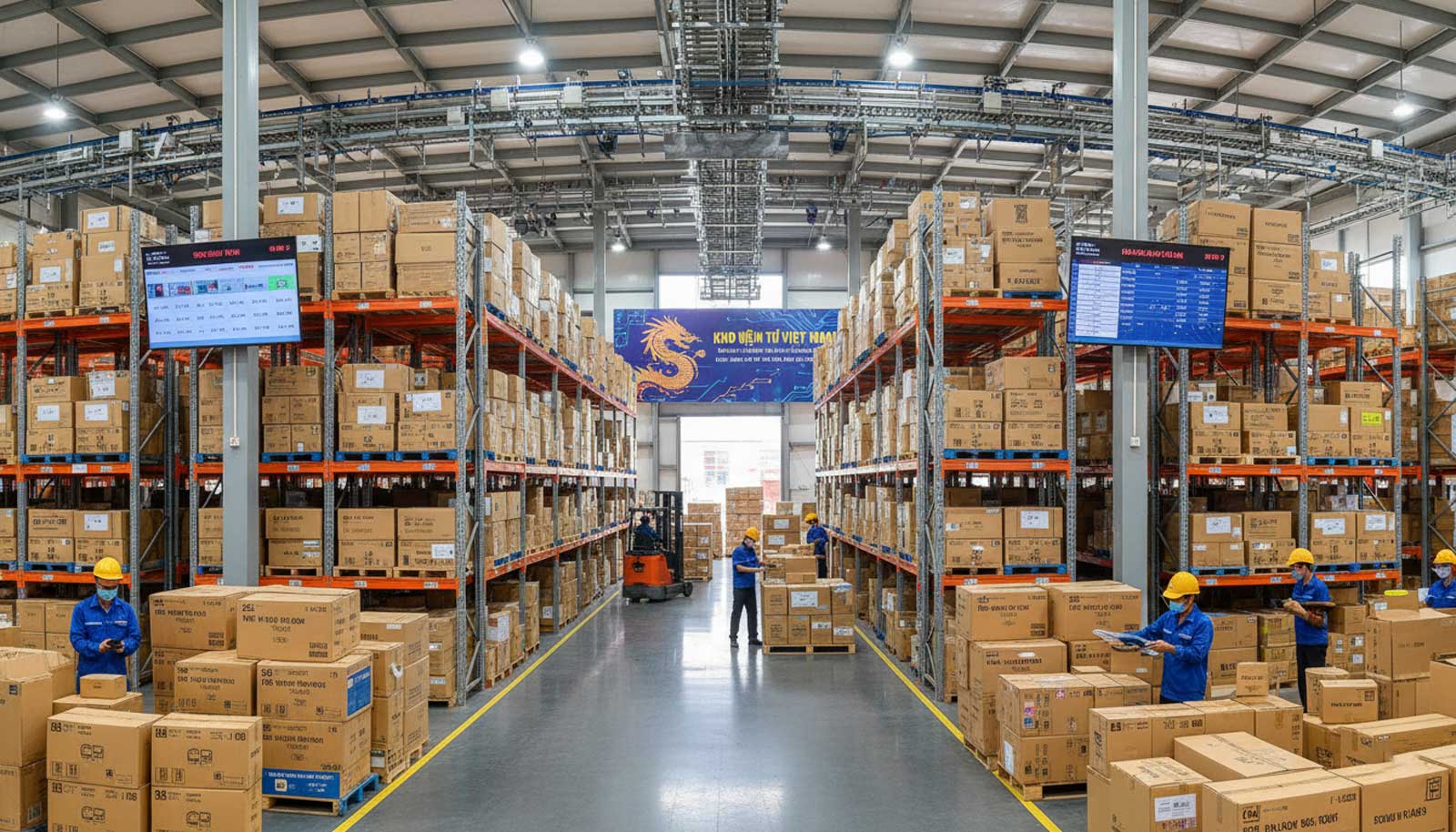
Businesses’ warehouses can store a diverse range of items, from e-commerce goods, raw materials, and documents to office equipment or high-value items. Choosing the right type of warehouse helps businesses optimize costs, manage inventory efficiently, and scale flexibly.
What Do Businesses Typically Store in Warehouses?
Businesses use warehouses to store goods, assets, or physical records to optimize workspace, reduce premises costs, and ensure continuous operations. In Vietnam, the demand for business warehouse rental is rapidly increasing, driven by the growth of e-commerce (~20% annually, Statista 2024) and the expansion wave of SMEs, which currently allocate 15–25% of their total operating costs to warehousing and logistics.
However, not all businesses require the same type of warehouse. The best starting point is to determine what you are storing, as this dictates the required space, storage conditions, security level, and the type of business warehouse that fits your budget.
Business & E-commerce Goods Storage
E-commerce warehouse tenants represent the largest and fastest-growing customer segment in Vietnam. Online businesses, from Shopee and Lazada shops to D2C brands, need warehouses to separate inventory from office or home spaces, while also meeting the market’s increasingly high order processing speed.
This group is characterized by diverse SKUs and fast turnover; goods entering the warehouse today might be shipped within 24–72 hours. This demands warehouses with clear classification systems, clear aisles, and quick retrieval capabilities, rather than prioritizing maximum stacking density.
Additionally, seasonal goods pose a unique challenge for this group: Tet (Lunar New Year) goods, Back-to-school items, and year-end products often see a sudden increase of 3–5 times compared to regular months.
Renting flexible monthly warehouses instead of investing in fixed facilities allows businesses to expand and contract space according to their business cycles without wasting premises costs.
Vietnam’s e-commerce market reached 20.5 billion USD in 2023, a 25% increase compared to 2022 (VECOM, 2024), leading to a corresponding increase in demand for suburban fulfillment warehouses, especially in Ho Chi Minh City and Hanoi.
Raw Materials & Manufacturing Goods Storage
For small and medium-sized manufacturing businesses, raw material warehouses act as a “buffer” between suppliers and the production line, helping to prevent production disruptions when supplies are delayed or orders surge. Without this buffer, a batch of raw materials arriving 3 days late could halt the entire production line.
This group often has higher technical requirements: high floor load capacity (for heavy materials like metals, chemicals), good ventilation systems (for easily oxidized materials), and inventory management according to FIFO (First In – First Out) or FEFO (First Expired – First Out) to ensure the quality of input materials.
Strict inventory control in this group is not just a matter of efficiency but also financial cost: raw materials stored for too long represent “tied-up” capital that doesn’t generate profit. This is why many manufacturing businesses are shifting from self-built warehouses to renting professional warehouses with integrated WMS (Warehouse Management System).
Documents, Records & Legal Archives
This is a less-discussed but more common need than you might think, especially for long-standing businesses in finance, insurance, real estate, healthcare, and legal sectors.
Vietnam’s Accounting Law (Law No. 88/2015/QH13) stipulates that businesses must retain accounting documents for a minimum of 5–10 years depending on the type, and important legal records may need to be kept permanently. For businesses operating for 10–20 years, this volume of documents can occupy tens of square meters of office space – space that is becoming increasingly expensive in central Ho Chi Minh City and Hanoi.
Renting specialized document storage warehouses completely frees up that space, often at 60–70% lower cost compared to office space of the same area. Specific requirements for this group: dry warehouses, humidity controlled below 65%, no insects, and an indexing system for record retrieval when needed.
Equipment, Furniture & Office Assets Storage
Businesses undergoing office relocation, mergers, restructuring, or branch expansion often face the challenge of having a large quantity of desks, computers, and office equipment that needs temporary storage for 1–6 months – too long to keep in the office, too short to invest in a dedicated warehouse.
Monthly self-storage is an ideal solution for this group: rent exactly the space needed, pay monthly, and access items without prior notice. For sensitive IT equipment or machinery, priority should be given to warehouses with temperature and humidity control to prevent electronic circuit boards from oxidizing after a few months of storage.
High-Value & Specialized Goods Storage
The final group, but with the most stringent requirements. High-end electronics, watches, wine, imported cosmetics, artwork, or collectibles demand storage and security conditions far beyond conventional warehouses.
For this group, three factors are crucial when choosing a warehouse:
- Environmental control: Stable temperature of 18–25°C, humidity of 45–55% RH, no direct sunlight. Temperature fluctuations of even 5–8°C within a day can affect the quality of some sensitive items like vintage wine or biological pharmaceuticals.
- Multi-layered security: 24/7 HD cameras, individual locks for each storage unit, access control via key cards or personal PINs, and on-site security guards. Some specialized warehouses also offer integrated safes within storage units.
- Goods insurance: Reputable warehouses always have clear insurance policies for stored goods – this is a mandatory question to ask before sending high-value items: “What is the maximum insurance limit for a storage unit and what is the compensation process?”
| Type of Stored Goods | Priority when Choosing a Warehouse | Suitable Warehouse Type |
|---|---|---|
| E-commerce goods / fast turnover | Suburban location, flexible contracts, WMS | Fulfillment center / Self-storage |
| Manufacturing raw materials | High floor load capacity, FIFO/FEFO management | Industrial warehouse Class B–A |
| Documents & records | Humidity control, indexing, security | Specialized document storage warehouse |
| Equipment & furniture | Monthly flexibility, self-access | Self-storage |
| High-value goods | Temperature control, security, insurance | Specialized warehouse / Climate-controlled |
Classifying Business Storage Needs
A business’s storage needs depend on its industry, size, and stage of development – from flexible short-term storage during transition phases to long-term specialized warehouses for core operations. Correctly understanding which group you belong to helps businesses avoid two common mistakes: renting a warehouse too large for actual needs (wasting fixed costs) or choosing the wrong type of warehouse, leading to damaged goods, slow operational processes, and costly mid-term relocation.

Group 1 — Short-Term Storage
Characteristics: Unexpected demand, storage duration from a few weeks to several months, constantly changing volume and type of goods.
This group of needs is most common for businesses undergoing office relocation, where furniture, equipment, and documents require a safe temporary home for 1–3 months during the transition between two locations. Also in this group are businesses dealing with seasonal goods: warehouse demand surges before Lunar New Year, the Back-to-school season, or major sales events (11/11, Black Friday), then contracts afterwards.
Another common scenario is goods awaiting distribution: imported goods have arrived, but distribution orders aren’t ready, requiring temporary storage while awaiting customs clearance or delivery vehicles. Short storage times but rapid inbound/outbound pressure are core requirements.
Suitable Solutions: Self-storage and mini-warehouses that allow monthly rental, no long-term contracts needed, and free access to retrieve goods anytime during operating hours. This is an optimal choice as businesses don’t have to commit to a large fixed cost for temporary needs.
Practical Tip: When renting short-term storage, always clarify the renewal policy and early termination clauses. Some providers impose penalties for early returns or require 30–60 days’ notice, which completely negates the “flexibility” advantage of short-term storage.
Group 2 — Operational Storage
Characteristics: Continuous goods turnover, high inbound/outbound frequency, directly linked to a business’s daily revenue.
This is the largest and fastest-growing demand group in Vietnam, driven by the e-commerce wave. Businesses selling online via Shopee, Lazada, TikTok Shop, or their own websites require inventory storage space near urban centers to shorten delivery times – a competitive advantage that is increasingly crucial as customers have grown accustomed to same-day delivery or morning orders for afternoon receipt.
Retail warehouses serving store chains also fall into this group: goods arrive from suppliers at a central warehouse, then are regularly distributed to each branch according to a fixed schedule. Cross-docking warehouses are a specific variation where goods enter and exit the warehouse almost immediately, without long-term storage, prioritizing speed and flexible goods arrangement according to orders.
Suitable Solutions: Fulfillment warehouses integrated with WMS (Warehouse Management System) to automate picking, packing, and order tracking processes. Shared warehouses are a cost-optimal choice for SMEs that don’t have enough volume to fill a dedicated warehouse, paying only for the actual space used and the number of pallets processed.
Group 3 — Long-Term Storage
Characteristics: Goods or documents stored for an extended period (1 year or more), low retrieval frequency, prioritizing low cost and stable storage conditions over access speed.
This demand group is present in most long-standing businesses but is often handled in the most expensive way possible: occupying costly office space in city centers to store documents that are only accessed a few times a year.
Legal & accounting records are types of documents legally required for long-term storage under Vietnamese law — accounting vouchers for a minimum of 5–10 years (Accounting Law 88/2015/QH13), tax records for a minimum of 10 years, and labor and social insurance records potentially needing permanent retention. For businesses operating for 10–15 years, this easily translates to dozens of boxes of documents occupying 20–40 m² of office space in Ho Chi Minh City and Hanoi, currently priced at 300,000–800,000 VND/m²/month.
Infrequently used assets: spare machinery, old equipment not yet liquidated, and office furniture from closed branches also fall into this category. Keeping them in the office is wasteful; selling them might be regrettable; renting low-cost long-term storage is the most reasonable solution.
Suitable Solutions: Dedicated document storage with indexing systems, humidity control below 65% RH, and no direct sunlight. Some providers also offer document digitization services combined with physical storage – an optimal solution for businesses wanting quick access without needing to visit the warehouse.
Warehouse Rental Cost Comparison: Renting dedicated document storage typically costs 60–70% less than equivalent office space, saving 5–15 million VND/month depending on the area and volume of documents.
Group 4 — Specialized Storage
Characteristics: Goods requiring specific storage conditions that conventional warehouses cannot meet, such as controlled temperature, enhanced security, or hazardous material handling.
This demand group has the highest barriers in terms of both rental costs and technical requirements, but it also offers no alternatives: businesses must either have a compliant warehouse or risk goods damage, loss of value, or legal violations.
Cold storage serves fresh food, dairy, pharmaceuticals, and vaccines — categories requiring strict temperature maintenance from -25°C (freezer storage) to 2–8°C (chilled storage). Even a 2–3°C temperature fluctuation for a short period can ruin an entire batch. In Vietnam, cold storage demand is surging with the growth of agricultural and seafood exports. Cold storage rental prices currently range from 7–15 USD/m²/month, 2–3 times higher than regular warehouses.
High-value goods storage, such as for electronics, watches, wine, and imported cosmetics, requires multi-layered security: 24/7 HD cameras, individual cell locks, card-based access control, on-site guards, and alarm systems directly connected to a monitoring center. Warehouse inventory insurance is an indispensable requirement; coverage limits and compensation terms must be confirmed in writing before goods are stored.
Hazardous Materials warehouses (for industrial chemicals, paints, solvents, lithium batteries) must comply with QCVN 65:2018/BKHCN and specific fire prevention and fighting regulations: isolated zones, forced ventilation systems, waterproof flooring, and spill containment tanks. Storing these types of goods in a conventional warehouse poses not only product risks but also serious legal and safety risks.
Suitable Solutions: Specialized warehouses licensed for the specific type of goods. When renting this type of warehouse, always request to see the operating license relevant to your goods – not all warehouses labeled “cold storage” are licensed to store pharmaceuticals, and not all warehouses advertising “chemical storage” fully meet fire prevention and fighting standards as regulated.
| Demand Group | Duration | Retrieval Frequency | Warehouse Selection Priority | Suitable Warehouse Type |
|---|---|---|---|---|
| Temporary | Weeks – Months | Infrequent | Flexible, no long-term commitment | Self-storage, mini-warehouse |
| Operational | Long-term | Daily | Location, processing speed, WMS | Fulfillment center, shared warehouse |
| Long-Term Storage | 1 year or more | Rarely | Low cost, storage conditions | Document storage, archival storage |
| Specialized | Flexible | Depends on goods type | Technical conditions, licenses, insurance | Cold storage, specialized warehouse |
Simple Rule: If you’re unsure which group you belong to, start by asking, “How often do my goods need to be retrieved?” The answer will immediately eliminate 2–3 unsuitable options and significantly narrow down the list of warehouses to consider.
Comparing Common Warehouse Types for Businesses
Each warehouse type has distinct characteristics regarding costs, control levels, and intended use. Businesses need to choose based on actual operational needs and budget — because there’s no single “best” warehouse type, only the one most suitable for a specific problem. Logistics costs currently account for 10–20% of Vietnamese businesses’ revenue (McKinsey, 2023), and selecting the right warehouse type is one of the most effective levers to optimize this figure.
Self-Storage
Self-storage is a model where businesses rent a separate, lockable locker, with personal access, free to enter and manage goods in their own way without the need for warehouse staff from the rental unit to interfere with internal processes.
This model is best suited for SMEs, startups, and businesses with fluctuating storage needs. The core appeal is flexibility: renting month-to-month, expanding or shrinking space without breaking long-term contracts, and no need to invest in specialized warehouse operational staff. For businesses dealing with seasonal goods or those in a model testing phase, this is often an ideal starting point.
Reference costs in Vietnam: 500,000 – 2,500,000 VND/unit/month depending on area (2–50 m²) and location. Self-storage costs in central Ho Chi Minh City and Hanoi are 30–50% higher than in suburban areas but significantly save on transportation costs if the business needs frequent access to goods.
Limitations to note: Self-storage places full operational responsibility on the business for arranging goods, counting inventory, and tracking stock. There’s no WMS (Warehouse Management System) and no staff to assist with picking/packing. For businesses processing over 50 orders/day, this model starts to become inefficient and they should consider switching to a fulfillment center.
Signs it’s time to “graduate” from self-storage: When you spend more than 2 hours a day just finding and retrieving goods in the warehouse, or your order discrepancy rate exceeds 2%, that’s a clear signal to transition to a more professional operational solution.

Fulfillment Warehouses
A fulfillment center operates on a business model where companies outsource services instead of leasing space. Goods are entrusted to professional warehouse operators who manage the entire process, including inbound processing, storage, picking, packing, and handover to delivery carriers.
This is an optimal choice for rapidly growing e-commerce businesses when order volumes are sufficient for outsourced warehouse operations but not yet large enough to build their own warehouse and team. The biggest advantage is a 20–30% reduction in order processing time, thanks to standardized processes and integrated WMS technology. Simultaneously, businesses convert fixed costs (warehouse rent, personnel) into variable costs (paid per actual order processed).
Fulfillment fee structures typically consist of three components: storage fees (per pallet or m³/month) + order processing fees (per order or per SKU) + packaging fees (per packaging type). Total costs range from 15,000 – 50,000 VND/order depending on scale and complexity, significantly lower than in-house warehouse operating costs when accounting for full staff salaries, premises, and equipment.
A limitation to note: Businesses lose some direct control over goods and packaging processes, which can impact customer experience if an unprofessional fulfillment provider is chosen. Always request to see a detailed SLA (Service Level Agreement), especially commitments on on-time order processing rates and order error rates, before signing a contract.
Break-even point for considering fulfillment: If a business processes over 30–50 orders/day and is spending more than 1 full-time employee on warehouse operations, a fulfillment center often offers greater overall cost savings compared to self-managing a warehouse.
Cold Storage
Cold storage is the only warehouse type on this list for which businesses have no alternative if goods require temperature control, such as fresh food, milk and dairy products, pharmaceuticals, vaccines, and temperature-sensitive cosmetics. Without suitable cold storage, goods lose value or violate food/pharmaceutical safety regulations – a risk that cannot be offset by cost savings.
Cold storage in Vietnam is divided into three main temperature segments:
- Freezer Storage: Maintains -18°C to -25°C. Used for frozen seafood, meat, ice cream, and frozen processed foods. This segment has the highest operating costs due to high electricity consumption.
- Chiller Storage: Maintains 0°C to 8°C. Used for fresh fruits and vegetables, fresh milk, common pharmaceuticals, and some vaccines. Most common in retail chains and supermarkets.
- Air-conditioned Storage: Maintains 15°C to 25°C with strict humidity control. Used for high-end pharmaceuticals, wine, chocolate, and some sensitive agricultural products.
Reference costs: Freezer storage in Vietnam is currently leased at 7–15 USD/m²/month, 2–3 times higher than regular warehouses, reflecting the investment in refrigeration equipment, electricity costs, and specialized operational requirements. However, for businesses exporting seafood, fruits, vegetables, and processed foods, this is a mandatory cost to access EU and US markets with their continuous cold chain requirements.
Mandatory question when leasing cold storage: “In the past 12 months, have there been any power outages or refrigeration equipment failures? If so, what was the maximum temperature reached in the warehouse and how long did it take to resolve?” — this answer is more important than any technical specifications in a brochure.
Specialized Warehouses
Specialized warehouses represent the remaining group, encompassing all types of storage facilities designed and licensed for specific goods or industries that cannot be replaced by conventional warehouses without violating legal regulations or safety standards.
- Chemical & Hazardous Materials Warehouses: Must comply with QCVN 65:2018/BKHCN, featuring isolation zones by chemical group, waterproof flooring, spill containment systems, forced ventilation, and safe distances from surrounding structures. Storing chemicals in a regular warehouse is a legal violation and can lead to business license revocation.
- Pharmaceutical Warehouses (GDP-compliant): Must comply with Good Distribution Practice as regulated by the Ministry of Health and WHO, featuring continuous temperature and humidity control, 24/7 logging, and strict procedures for expired and recalled goods. Mandatory for businesses importing, distributing, or exporting pharmaceuticals in Vietnam.
- High-Value Goods Warehouses: Designed with multi-layered security as a priority, including HD cameras covering 100% of the area, individual cell locks, personal magnetic card access control, 24/7 security guards, and clear limits on stored goods insurance. Suitable for businesses storing high-end electronics, jewelry, watches, and imported wines.
Specific limitation of this group: The supply of specialized warehouses in Vietnam is still limited, especially outside major urban areas. Businesses in tier-2 provinces often have to accept longer distances or higher transportation costs to access compliant warehouses.
| Criteria | Self-Managed Warehouse | Fulfillment Warehouse | Cold Storage | Specialized Warehouse |
|---|---|---|---|---|
| Model | Self-operated | Outsourced service | Self/Outsourced service | Self/Outsourced service |
| Rental Cost | Low – Medium | Per order | High | Medium – Very High |
| Flexibility | High | Medium | Low | Low |
| Inventory Control | Full control | Shared | Full control/Shared | Full control |
| Technical Requirements | Low | Low | Very High | Very High |
| Suitable for | SMEs, startups, seasonal goods | Fast-growing E-commerce, D2C | F&B, pharmaceuticals, agricultural products | Chemicals, pharmaceuticals, high-value goods |
| Strongest Point | Flexible, low initial cost | Processing speed, operational optimization | Preservation of sensitive goods | Compliance with specialized legal requirements |
| Main Risk | No operational support | Dependence on partner quality | High costs, limited supply | Few options, rigid pricing |
Rules for choosing a warehouse based on development stage:
- Startup / under 30 orders/day: Self-managed warehouse → low cost, maximum flexibility
- Growth / 30–500 orders/day: Fulfillment center → optimized operations, focus on business
- Specialized goods: Cold storage or specialized warehouse → no alternative, prioritize correctness over cost
- Large scale / over 500 orders/day: Consider a private warehouse with integrated WMS → comprehensive control and long-term cost optimization
Warehouse Selection Checklist for Businesses
A suitable warehouse needs to ensure a convenient location, transparent costs, robust security, and scalability to meet business needs. However, most businesses often only compare rental prices per square meter, choose the cheapest option, and then discover other issues after signing the contract. This checklist is designed to help you ask the right questions before you sign, not after.
Criterion 1 — Location & Accessibility
Location isn’t just about the distance in kilometers; it’s about the actual travel time from the warehouse to delivery points during peak hours, the accessibility for large trucks, and the additional monthly transportation costs incurred.
Questions to answer before choosing a warehouse:
- How long does it take to get from the warehouse to your most frequent delivery locations between 7–9 AM (not off-peak hours)?
- Are there any vehicle load limits on the road leading to the warehouse? Can a 40-foot container truck access it?
- Is the warehouse located on a route with specific truck restrictions during certain hours? (This is especially crucial in Ho Chi Minh City and Hanoi, where many routes prohibit trucks from 6–9 AM and 4–8 PM)
- Are there any ongoing infrastructure projects nearby that could cause long-term traffic congestion?
Reference thresholds:
- E-commerce fulfillment warehouse: within 15–20 km from urban centers to ensure same-day delivery
- Raw material warehouse for manufacturing: within 30 minutes from the factory to prevent supply chain disruptions
- Archival document storage: location is less critical; prioritize low cost and proper storage conditions
Practical Tip: Drive from the warehouse to your three most critical delivery points during peak morning hours before making a decision. A warehouse that’s 20% cheaper but adds 45 minutes of travel each way could end up costing you more in labor and fuel expenses.

Criterion 2 — Costs & Transparency
Warehouse rental costs are often quoted per m²/month, but that’s just the tip of the iceberg. Many businesses sign contracts only to discover hidden fees that make the actual total cost 30–50% higher than the initial figure.
Checklist of fees to clarify before signing:
- Does the m²/month rental price include VAT?
- What is the management fee / service charge?
- Electricity costs: metered individually or shared equally? How much per kWh?
- Goods insurance fee: mandatory or optional? What is the maximum coverage limit?
- Security deposit: how many months? How long until refunded after vacating the warehouse?
- Penalty for early termination: what percentage and how is it applied?
- After-hours access fee (if evening/weekend work is needed)?
- Equipment usage fees: are forklifts, pallet jacks, and shelving charged extra?
- Annual rent adjustment fee: what percentage and based on which index?
How to Calculate the True Total Cost of Occupancy (TCO):
Don’t compare warehouses solely by the rental price per m². Make sure to add up: rent + electricity + management fees + insurance + additional transportation costs due to location + operational labor costs. The final figure is the fair basis for comparing different options.
Warning signs: If the warehouse’s sales representative cannot fully list all fees within 5 minutes or answers “let me check” to more than two questions on the list above, request a detailed written quotation before continuing negotiations.
Criterion 3 — Security & Safety
Warehouse security isn’t a matter of “if damage occurs” but “how damage is handled when it occurs.” Two factors need independent assessment: prevention systems and compensation mechanisms.
Prevention system checklist:
- CCTV cameras: do they cover 100% of the warehouse area, including blind spots?
- Minimum camera data retention period? (Standard minimum: 30 days)
- Is security present 24/7 at the gate or only during the day?
- Access control: physical keys, key cards, or personal PINs?
- Is there an alarm system connected to a monitoring center?
- Who else can access your storage unit besides you? (Warehouse staff? Security? Management?)
- What is the identity verification process for unfamiliar individuals collecting goods on your behalf?
Compensation mechanisms checklist — equally important:
- Does the contract include clauses for compensation for lost/damaged goods?
- What is the maximum compensation amount? Is there a per-incident limit?
- Goods insurance: provided by the warehouse or do you need to purchase your own?
- Insurance claim process: what documents are required and how long does it take?
- In the past 12 months, have there been any incidents of lost or damaged goods at the warehouse?
Criterion 4 — Flexibility & Scalability
Businesses’ storage needs change over time, especially for growing SMEs or seasonal businesses. An inflexible warehouse contract can become a financial burden precisely when you need capital for business expansion.
Flexibility clause checklist:
- What is the minimum contract term? Are monthly rental packages available?
- Renewal conditions: automatic renewal or re-signing required? Does the price change?
- Can you increase space within the current building when needed?
- Can you reduce space if demand shrinks? What are the conditions?
- Early termination penalty: calculated based on remaining months or a different formula?
- If the business wants to move to a different unit within the same building, is there a fee?
- What is the policy if the warehouse owner needs to reclaim the space before the contract expires?
Important note: If your business has distinct seasonal business cycles, with warehouse needs 3–4 times higher from October–December than other months, prioritize finding a warehouse with a temporary seasonal expansion mechanism rather than committing to a large fixed area year-round. Some self-storage facilities allow renting additional units weekly during peak season; clarify this policy beforehand.
Criterion 5 — Infrastructure & Storage Conditions
This is the most frequently overlooked set of technical criteria until goods are damaged by mold, pests, or high temperatures, or staff spend 30 minutes searching for a package because the warehouse lacks shelving and a sorting system.
Physical infrastructure checklist:
- What is the maximum floor load capacity in tons/m²? Is it sufficient for your goods?
- Warehouse height (to the lowest beam): is it sufficient for multi-tiered stacking?
- Shelving: is it provided or do you need to bring your own? What is the shelf load capacity?
- Forklifts, pallet jacks: are they available in the warehouse? How are they charged?
- Loading dock door width? Is there a dock leveler for trucks to back up to?
- Warehouse floor: flat and free of cracks? (Uneven floors damage pallet jack wheels and increase the risk of goods falling.)
Storage conditions checklist:
- Ventilation system: natural or forced? Does the warehouse get hotter than 40°C in summer?
- Humidity control: is there a dehumidification system? What is the average humidity in the warehouse?
- (Humidity >75% RH causes mold on goods, documents, and electronic equipment.)
- Is there air conditioning? If so, who pays for the electricity?
- Pest control and extermination system: is it regularly maintained?
- Warehouse roof: does it leak during the rainy season? Ask the operations staff, not the sales department.
- Warehouse fire protection system: sprinklers, fire extinguishers, exit signs — are they still valid?
| Criterion | Key Question | Acceptable Level |
|---|---|---|
| 1 | Location | Travel time to main delivery points during peak hours? |
| 2 | Total Cost | What is the total monthly TCO including all ancillary fees? |
| 3 | Cameras | Retention period? 100% coverage? |
| 4 | Insurance | Maximum compensation for lost goods? |
| 5 | Flexibility | Can you terminate early with reasonable fees? |
| 6 | Scalability | Can you expand space within the same building? |
| 7 | Floor Load | Max tons/m²? |
| 8 | Humidity | Average humidity in the warehouse? |
| 9 | Fire Safety | Fire safety certificate validity? |
| 10 | Actual Operations | Any incidents of damaged/lost goods in the past 12 months? |
Golden Rule for Warehouse Visits: Visit in the afternoon on a normal workday, not early morning or on weekends. Observe how operations staff work, how vehicles enter and exit the warehouse, and what the warehouse truly looks like when active, not when it’s been tidied up for visitors.
If your business needs a flexible, secure, and cost-optimized storage solution, self-storage is a suitable option to start without significant upfront investment.
FAQ
What type of warehouse should a business choose based on its needs?
The right warehouse choice depends on three core factors: inventory turnover frequency, product characteristics, and budget. SMEs or startups with flexible needs should start with self-storage on monthly terms — low cost, no long-term commitment. When processing 30–50+ orders per day, a fulfillment center optimizes operations and reduces order processing time by 20–30%. Products requiring special storage conditions (temperature control, high security) must use specialized warehouses — there is no viable alternative.
How much does self-storage for businesses cost in Vietnam?
Self-storage rental costs in Vietnam range from VND 500,000 – 2,500,000 per unit per month depending on size (2–50 m²) and location. Units in central Ho Chi Minh City and Hanoi are typically 30–50% more expensive than suburban areas. Beyond the base rent, always clarify additional charges such as electricity, management fees, insurance, and after-hours access fees — these can increase the true total cost by 20–40% above the listed price.
What is the difference between a fulfillment center and self-storage?
Self-storage means the business rents space — arranging, managing, and controlling inventory independently but handling all operations itself. A fulfillment center means the business rents a service — the warehouse operator handles all receiving, picking, packing, and handover to couriers. Self-storage suits low turnover frequency and high flexibility needs; fulfillment suits high order volumes where the business wants to focus on sales rather than warehouse operations.
What hidden fees should businesses watch out for when renting a warehouse?
The most common hidden fees when renting warehouse space include: separately metered electricity (often priced above standard rates), management/service charges (5–15% of rent), mandatory cargo insurance fees, early termination penalties (typically 1–3 months’ rent), after-hours access charges, and annual rent adjustment fees indexed to CPI. The best way to avoid surprises: request a detailed written fee breakdown covering all charges before signing any contract.
When should a business switch from in-house storage to professional warehouse rental?
There are four clear signals it’s time to move to a professional warehouse: (1) Staff spend more than 2 hours per day just locating and retrieving inventory; (2) Order error rate exceeds 2%; (3) Merchandise is encroaching on office or production space and disrupting operations; (4) Logistics costs exceed 20% of revenue — a threshold indicating inefficient warehouse operations. Businesses spending 15–25% of operating costs on storage are at industry average — if costs consistently exceed this, professional warehouse rental typically delivers better overall economics than self-operation.
What special requirements does a business document storage warehouse need to meet?
A business document storage facility must meet four core requirements: (1) Humidity control — maintained below 65% RH to prevent mold; humidity above 75% can destroy paper documents within months; (2) No direct light exposure — UV radiation causes ink to fade and paper to become brittle over time; (3) An indexing system — enabling rapid document retrieval without manual searching; (4) Security and access control — legal and accounting records contain sensitive information requiring strict protection. Under Vietnamese Accounting Law, accounting documents must be retained for a minimum of 5–10 years depending on type.
How can a business verify actual warehouse quality before signing a rental contract?
Five practical steps to verify warehouse quality before signing: (1) Visit on a regular weekday afternoon — not early morning or weekends when the facility has been tidied up for visits; (2) Ask operations staff about incidents — not the sales team; (3) Request the most recent fire safety inspection report and safety certification; (4) Check the warehouse’s blind spots — wall moisture, signs of pests, roof condition; (5) Ask directly: “Has there been any lost or damaged cargo incident in the past 12 months?” — both the answer and the staff’s reaction are valuable indicators.
How does warehouse location affect a business’s actual operating costs?
Warehouse location directly impacts three costs that are often underestimated: (1) Transportation costs: A warehouse 20% cheaper but adding 45 minutes of travel time each way can cost significantly more through fuel and labor expenses; (2) Delivery speed: E-commerce fulfillment warehouses need to be within 15–20 km of the urban center to guarantee same-day delivery — an increasingly critical competitive advantage; (3) Truck restrictions: Many roads in Ho Chi Minh City and Hanoi prohibit trucks during 6–9 AM and 4–8 PM — warehouses located on restricted routes will regularly disrupt receiving and dispatch schedules.
What protective clauses should a business negotiate in a warehouse rental contract?
Six important clauses to negotiate in a warehouse rental contract: (1) Cargo compensation — maximum liability if goods are lost or damaged while in the warehouse; (2) Price adjustment policy — frequency and maximum annual increase percentage; (3) Early termination conditions — reasonable penalty fees and notice periods (ideally no more than 2 months’ rent); (4) Service Level Agreement (SLA) — for fulfillment centers: on-time processing rate and maximum error rate; (5) Audit rights — the right to request periodic independent warehouse inspections; (6) Force majeure clause — how to handle situations where the warehouse cannot provide services due to uncontrollable events.
What trends are reshaping how Vietnamese businesses choose and use warehouse space over the next 3–5 years?
Three major trends are redefining the warehouse market for businesses in Vietnam: (1) On-demand warehousing — renting warehouse space by the day or week through digital platforms, ideal for e-commerce businesses with strong seasonal demand fluctuations; (2) WMS technology integration and automation — warehouses connecting directly to Order Management Systems (OMS) and e-commerce platforms, automatically processing from order receipt to courier handover; (3) ESG requirements from international partners — growing numbers of FDI companies are requiring partner warehouses to hold ISO 14001 certification and provide energy data per GHG Protocol standards — a trend expected to become a standard contract condition by 2026–2027.