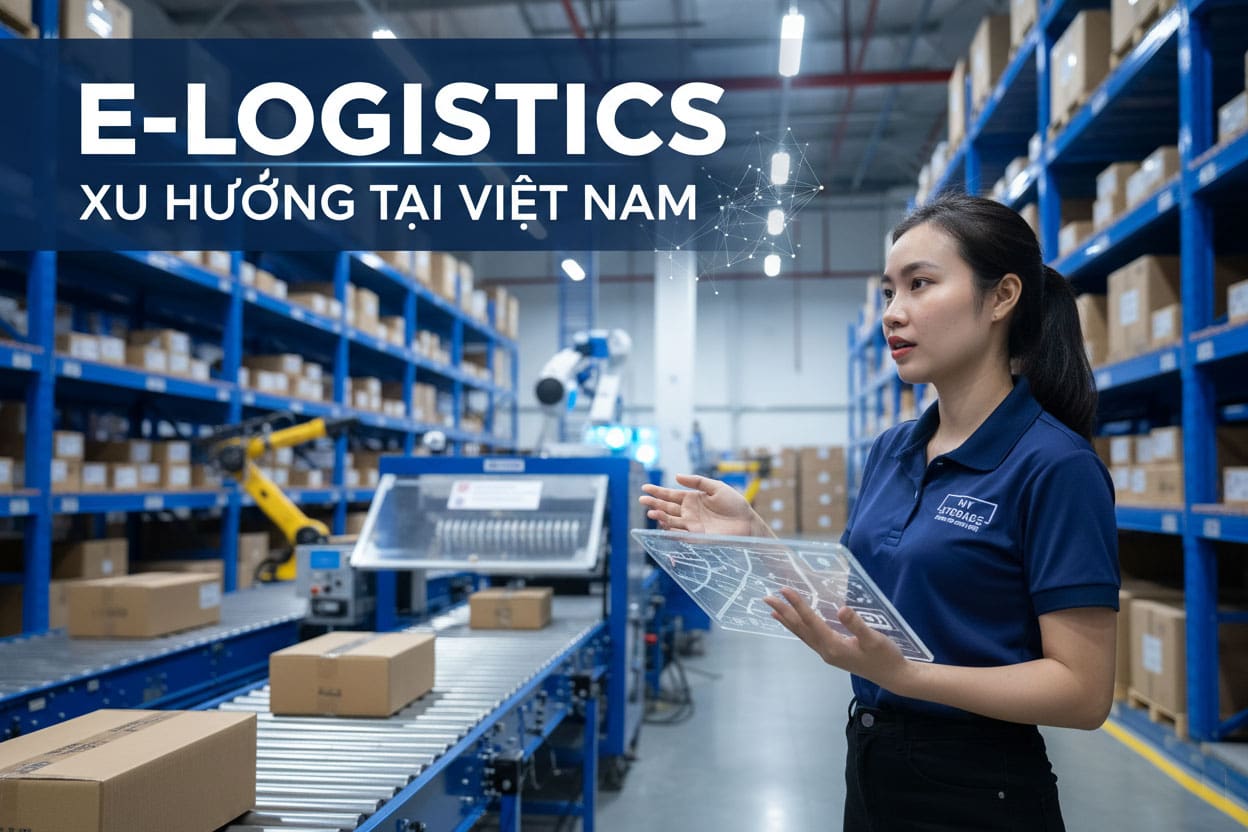
E-Logistics is a digitally integrated logistics model designed to handle order processing, transportation, and distribution of goods in e-commerce. It optimizes supply chain efficiency and meets the ever-increasing demand for rapid delivery in Vietnam.
What is E-Logistics? Characteristics & Role in E-commerce
E-Logistics utilizes digital technology and the internet to optimize operations, from order reception to “last-mile” delivery. It is perfectly suited for the unique characteristics of small, high-volume orders and the fast delivery requirements of e-commerce.
1. What is E-Logistics?
E-Logistics (Electronic Logistics) is the process of managing the flow of goods by applying digital technology and the Internet. It encompasses all activities from order processing, warehouse management, and packaging to delivery and returns, all facilitated through online platforms.
While traditional logistics typically handles large shipments (B2B), E-Logistics was created to solve the challenge of “Millions of individual orders to millions of destinations.”
2. Core Characteristics of E-Logistics
Compared to traditional logistics, E-Logistics possesses distinct features:
- Speed is a critical factor: Customers in 2026 no longer want to wait. The concept of “Instant delivery” within 30 minutes to 2 hours has become the new standard.
- “Small, fragmented, and numerous” orders: Instead of transporting a single container of goods, E-Logistics handles millions of small packages to millions of different individual addresses.
- Real-time Tracking System: Buyers need to know exactly where their package is (being picked up, at a transit warehouse, or 500m from their doorstep).
- Reverse Logistics: The return rate in e-commerce is very high (approximately 15-30%). E-Logistics must have a fast and cost-effective returns process.
- Last-mile delivery: This is the most complex and costly stage (accounting for up to 53% of total shipping costs), requiring the involvement of elite delivery teams and autonomous delivery robots.
The Difference: Traditional Logistics vs. E-Logistics
| Criterion | Traditional Logistics | E-Logistics |
|---|---|---|
| Target Audience | Businesses (B2B) | End Consumers (B2C/D2C) |
| Type of Goods | Large shipments, pallets, containers | Small packages, individual items |
| Destination | Fixed (dealers, stores) | Variable (homes, offices) |
| Flow of Goods | Primarily one-way | Two-way (strong return flow) |
| Technology | Supportive (Excel, ledgers) | Mandatory (AI, API, Big Data) |
3. The “Backbone” Role of E-Logistics in E-commerce
By 2026, E-Logistics is no longer just a supporting service but a top competitive weapon for e-commerce platforms:
- Enhancing Customer Experience: Fast and accurate delivery is the biggest reason customers return for future purchases.
- Optimizing Operational Costs: Through AI algorithms to consolidate orders and optimize routes, businesses can minimize shipping costs.
- Smart Inventory Management: E-Logistics allows businesses to know exactly which items are “hot” in which areas, enabling them to distribute goods to the nearest micro-fulfillment centers.
- Expanding Borderless Markets: Thanks to cross-border E-Logistics, a craftsman in Hoi An can deliver a leather bag to a customer in New York within 3-5 days.
According to reports from VECOM and market research organizations, the volume of e-commerce orders has maintained rapid growth momentum since the explosive 47% surge in 2020. By 2026, delivery density in major cities has reached a level where “one order is successfully delivered every 10 seconds.”

E-Logistics Scale & Trends in Vietnam
E-Logistics in Vietnam is experiencing rapid growth, fueled by a booming e-commerce market that handles millions of orders monthly and attracts dozens of logistics service providers expanding their networks.
Vietnam is currently one of the brightest stars on Southeast Asia’s e-commerce (EC) map. By 2026, E-Logistics will no longer be a race for order volume but will have shifted to a competition for technological efficiency and ultimate user experience.
1. Market Scale: The “Juggernaut” Shows No Signs of Stopping
The E-Logistics market in Vietnam has made astonishing leaps, driven by online shopping habits that have become deeply ingrained in people’s lives.
- GMV Growth: According to reports from Google & Temasek, Vietnam’s e-commerce Gross Merchandise Value (GMV) is projected to reach tens of billions of USD by 2026.
- User Habits: Approximately 86% of online consumers maintain and even increase their shopping frequency post-pandemic.
- Order Volume: Leading logistics providers currently process an average of 2 to 4 million orders daily during peak seasons (Mega Sales).
2. Competitive Landscape: The Battle of 50+ “Titans”
The market is witnessing a clear differentiation among three main groups of players:
| Provider Group | Key Representatives | Strengths |
|---|---|---|
| Traditional Postal Services | VN Post, Viettel Post | Extensive network covering all 63 provinces, reaching remote areas. |
| Tech Logistics (Startups) | Giao Hàng Tiết Kiệm (GHTK), Giao Hàng Nhanh (GHN), Ninja Van | Flexible, strong technology, extremely fast intra-city delivery speed. |
| In-house Systems | Shopee Express, SPX, TikTok Shop Logistics | Controls the entire process from platform to customer, optimizing shipping costs for the platform. |
3. Top 4 Dominant E-Logistics Trends for 2026
If you’re doing business online, here’s what you’ll see (and need to adapt to) right now:
Ultra-fast Delivery
The concept of “same-day delivery” is outdated. Now, it’s a race for Instant Delivery (30 minutes – 2 hours). “Micro-fulfillment centers” are appearing densely within residential areas to shorten the last-mile distance.
Automation and Smart Warehouses
Sorting Centers for GHN and Shopee currently boast over 90% automation rates. The use of robotic arms and smart conveyor belts helps reduce error rates to below 0.1% and shortens sorting time from several hours to just a few minutes.
Green E-Logistics
This is no longer just a slogan. The use of electric motorbikes for shippers and biodegradable packaging is becoming a standard for logistics providers to win over Gen Z customers and meet investors’ sustainability criteria.
Cross-border E-commerce
Purchasing goods from China, South Korea, or the US to Vietnam is now as seamless as domestic purchases. Electronic customs clearance systems and bonded warehouses help reduce waiting times from 2 weeks to 3-5 days.
By 2026, Big Data will be the “fuel” for E-Logistics operations. Logistics providers can now predict which areas will see high order volumes during upcoming Flash Sales, allowing them to pre-position goods there before customers even click “Buy.”
Growth Opportunities & Investment Appeal
Vietnam is among the top 10 fastest-growing e-logistics markets globally, presenting significant opportunities for logistics businesses, 3PL/4PL providers, and investors, driven by a robust e-commerce foundation and increasing delivery demand.
By 2026, Vietnam’s E-Logistics market will no longer be just a “rising star” but will have truly transformed into a “goldmine” for both domestic and international investors. Having entered the Top 10 fastest-growing emerging E-Logistics markets worldwide, Vietnam is currently experiencing a massive influx of capital.
1. Growth Engine: The E-commerce Scale Boost
Investment appeal stems from the impressive growth figures of the total Gross Merchandise Value (GMV) across the entire E-commerce sector.
- Market Value: By 2026, Vietnam’s E-commerce is projected to reach approximately 32 – 35 billion USD. To manage this enormous volume of goods, the logistics system must expand accordingly.
- Compound Annual Growth Rate (CAGR): Maintained at 20 – 25% per year.
2. The Dedicated Logistics Real Estate Boom
The E-Logistics explosion has led to an urgent demand for smart warehousing infrastructure, which is currently a prime target for “giants” like BW Industrial, Logos, and GLP.
- Fulfillment Centers (Order Fulfillment Centers): Massive warehouses (over 10,000m² in area) integrating high automation are being rapidly constructed at the gateways of Hanoi and Ho Chi Minh City.
- Micro-fulfillment Centers (Urban Satellite Warehouses): This presents an opportunity for smaller investors. Transforming old urban premises into ultra-small warehouses to facilitate 1-hour express deliveries is a lucrative trend.
- Cold Storage for Food E-commerce: With the rise of online groceries (e-grocery), the cold storage segment is severely undersupplied, driving up rental prices and offering extremely attractive profit margins.
3. The “Playground” for Logistics Tech Startups
Beyond “bricks and mortar,” E-Logistics 2026 is a game of artificial intelligence. Tech startups have a once-in-a-lifetime opportunity to raise capital:
- AI Route Optimization: Solutions that optimize routes to reduce fuel costs by 15-20%.
- Smart Lockers: Addressing contactless delivery challenges and optimizing “last-mile” costs as shippers no longer need to wait for customers.
- Green Logistics: Solutions for carbon footprint management and electric vehicle conversion are being actively sought after by ESG investment funds.
4. Why Do Foreign Investors Choose Vietnam?
| Attraction Factor | Details |
|---|---|
| Golden Population Structure | Over 70% of the population uses smartphones and has extremely high online shopping habits. |
| Accelerating Infrastructure | The North-South expressways and Long Thanh International Airport are nearing completion, shortening nationwide transportation times. |
| Supply Chain Shift | The “China + 1” trend is positioning Vietnam as a new manufacturing and distribution hub in the region. |
| Supportive Policies | The government prioritizes digital transformation and promotes the development of Logistics services as a crucial infrastructure sector. |
The “battle” for E-Logistics in Vietnam has now shifted from price competition to technological depth. Investors who master data and more effectively solve the last-mile delivery challenge will capture 80% of the market share.

Major Challenges for E-Logistics in Vietnam
The primary challenges for E-Logistics include limited infrastructure, high operating costs, inefficient operational management, and uneven technological capabilities among businesses.
Despite its “breakneck” growth, the development path for E-Logistics in Vietnam by 2026 is not entirely rosy. Infrastructure and cost “bottlenecks” present a formidable challenge that any business must confront to thrive in this competitive landscape.
Below are the 5 biggest challenges hindering the progress of E-Logistics in Vietnam:
1. High Transportation Infrastructure and Logistics Costs
This is a systemic challenge. Despite numerous improvements, logistics costs in Vietnam still account for approximately 16–20% of GDP — significantly higher than the global average and neighboring countries like Thailand or Singapore.
- Urban Congestion: In Hanoi and Ho Chi Minh City, hourly load restrictions and traffic jams make express deliveries a real challenge in terms of time and fuel.
- Dispersed Warehousing System: Many warehouses are still located far from major arterial roads, leading to increased middle-mile transit costs.
2. Last-Mile Challenges in Rural Areas
While delivery in major cities has become highly optimized, remote and rural areas remain a “difficult terrain” full of challenges.
- Unclear Addresses: The system of house numbers and alleys in rural areas is often imprecise, making GPS navigation difficult and causing shippers to spend significant time searching for routes.
- Low Order Density: Transporting a long distance just to deliver a small package dramatically increases the operating cost per order, making it difficult to achieve economies of scale.
3. Shortage of Digital Logistics Workforce
Technology can be acquired, but the skilled personnel to operate it are severely lacking.
- Lack of Specialized Personnel: The industry is in dire need of experts who not only understand transportation operations but also possess capabilities in data analysis (Big Data), AI management, and operating automated warehouse systems.
- Uneven Technological Capabilities: While “big players” are already utilizing robots, many small and medium-sized enterprises still manage warehouses with Excel and manual operations, creating disruptions throughout the entire supply chain.
4. Pressure from COD Habits and Return Rates
Vietnamese consumers still maintain the habit of “seeing the goods before paying” (COD – Cash on Delivery).
- Cash Flow and Security Risks: Shippers often carry large amounts of cash, posing potential risks of loss. Businesses also incur additional costs for cash management and reconciliation.
- High Cancellation Rates: Post-payment makes it easier for customers to refuse to accept goods (‘bombing’ orders). E-commerce return rates typically range from 15–20%, causing double losses in two-way shipping costs.
5. Price War and “Paper-Thin” Profit Margins
With over 50 entities vying for a slice of the E-Logistics pie, the race to cut prices and capture market share is fiercely competitive.
- Record-Low Shipping Fees: To retain e-commerce platforms and large shops, many logistics providers must accept prices that yield little to no profit, or even losses, just to maintain volume.
- Costly Technology Investment: Businesses are simultaneously forced to reduce shipping fees and invest millions of USD in automated sorting systems to increase speed, creating immense financial pressure on Logistics Start-ups.
| Challenge | Direct Consequence | Desired Solution |
|---|---|---|
| High Logistics Costs | Reduced competitiveness of goods | Invest in synchronized, multimodal infrastructure |
| COD Habit | Increased risk, high management costs | Promote cashless payments |
| Shortage of digital workforce | Hinders digital transformation speed | Specialized training in Log-Tech |
| Rural Infrastructure | Long delivery times, high fees | Develop franchised post offices, satellite warehouses |
Challenges are precisely opportunities for those who can solve them. By 2026, entities that master predictive AI technology to reduce return rates and optimize order density in rural areas will hold the “key” to victory.

Effective E-Logistics Solutions for 2026
Key solutions include investing in warehouse & transport infrastructure, implementing TMS/WMS technology, offering risk-covering insurance, and building an optimized distribution system to boost e-logistics efficiency.
By 2026, E-Logistics will no longer be a race of “who delivers cheaper” but rather “who masters data and smarter infrastructure.” As operating costs soar and customer expectations reach an “instant” level, businesses need groundbreaking and practical solutions.
1. Smart Warehouse Ecosystem & Satellite Distribution Centers
To solve the last-mile delivery challenge in congested megacities, warehouse structures need to evolve:
- Micro-fulfillment Centers (Satellite Warehouses): Instead of a massive central warehouse on the outskirts, establish smaller facilities (50-200m²) right within residential areas. This shortens delivery distances to under 3-5km, supporting 30-60 minute delivery targets.
- AS/RS Systems (Automated Storage and Retrieval Systems): Utilize robots and automated conveyors for order picking. By 2026, these systems have become more cost-accessible, accelerating order processing speeds by 3-4 times compared to manual methods.
- IoT-based Environmental Control: For sensitive goods (cosmetics, functional foods), 24/7 IoT sensor monitoring of temperature/humidity is a mandatory requirement to reduce spoilage rates.
2. Comprehensive Digitalization with AI and Cloud-based TMS/WMS
Software is no longer just a supporting tool; it’s a “prerequisite” for survival.
- AI Route Optimization: AI algorithms help drivers avoid real-time traffic hotspots and intelligently consolidate orders. This solution saves 10-15% on fuel costs — a significant figure amidst fluctuating energy prices.
- Demand Forecasting: Leverage Big Data to predict which areas will experience “Flash Sale” order surges, thereby pre-positioning inventory at satellite warehouses before customers even click “Buy.”
- Multi-channel Data Synchronization: Ensure seamless API connectivity between e-commerce platforms (TikTok Shop, Shopee) and warehouse systems to maintain accurate inventory, preventing “bait-and-switch” scenarios that lead to order cancellations.
3. Risk Management & Transparent Order Insurance
2026 sees an increase in fraud and lost goods. Having an “insurance safety net” is crucial:
- Online Cargo Insurance: Directly integrate insurance fees into shipping costs. Providers like Bao Viet and various Insurtech companies are offering automated compensation processes via unboxing photos/videos, resolving claims within 24 hours instead of weeks.
- Shift from COD to Digital Payments: Promote e-wallets and Apple Pay/Google Pay to reduce cash risks for shippers and decrease “return-to-sender” rates. When customers pay upfront, their responsibility to receive the goods is significantly higher.
4. Public-Private Partnership (PPP) Model in Logistics Infrastructure
Leverage major government infrastructure projects to optimize goods flow:
- Utilize New Mega-ports & Airports: Connect warehouses with North-South expressways and Long Thanh Airport (currently in completion/partial operation phase) to boost cross-border E-Logistics.
- M&A Wave: Domestic enterprises (like Viettel Post) are significantly increasing capital to partner with international corporations, aiming to inherit advanced management technology and expand their franchised post office network.
| Solution | Main Objective | Key Performance Indicator (KPI) |
|---|---|---|
| Micro-fulfillment | Hyper-speed delivery | Delivery time < 2 hours |
| AI Route Optimization | Cost savings | 15% reduction in fuel costs |
| Smart Insurance | Risk mitigation | Claims processing time < 24 hours |
| AS/RS Warehouse | Increased productivity | Picking speed +300% |
By 2026, “Green” and “Digital” must go hand-in-hand. An optimized E-Logistics process not only delivers fast but also needs to demonstrate low carbon emissions to retain demanding Gen Z customers.
The Role of Warehousing & Fulfillment in E-Logistics
Modern warehousing and integrated fulfillment systems reduce delivery times, optimize inventory, and create a superior customer experience in e-commerce.
Within the 2026 E-Logistics ecosystem, warehouses and fulfillment services are no longer “static storage facilities.” They have evolved into “physical data processing centers” – where every second saved in the warehouse directly translates into a competitive advantage on customers’ shopping apps.
Below are the “backbone” roles of warehousing and fulfillment in shaping the modern e-commerce experience:
1. The Location Battle: Central Warehouses vs. Satellite Warehouses
Current warehouse network design combines scale and speed to optimize last-mile costs.
- Central Warehouses: Typically located on the outskirts with vast areas, serving as “master warehouses” for storing large quantities of goods, handling B2B shipments, and distributing inventory to smaller facilities.
- Micro-fulfillment Centers (MFCs): These are the “weapons” of 2026. These warehouses are situated right within urban areas (sometimes utilizing old supermarket or store premises) to facilitate 30–60 minute deliveries.
- Role: MFCs help minimize last-mile delivery distances – the most costly segment of the supply chain.
2. Automation & Robotics Applications
The speed of E-Logistics has surpassed human manual processing limits. Modern fulfillment relies on:
- Autonomous Mobile Robots (AMRs): These robots navigate warehouses independently to bring shelves of goods to pickers (Goods-to-Person model), increasing picking productivity by 3–4 times.
- Robotic Arms: Integrate AI and computer vision to accurately identify and pick thousands of different SKUs from cartons, reducing error rates to near zero.
- Automated Sorting Systems: Capable of processing tens of thousands of parcels per hour, directing them to the correct postal routes in mere seconds.
3. WMS/TMS Data Integration: The Synergy
A fulfillment center operates efficiently only when information flows seamlessly.
- WMS (Warehouse Management System): Precisely manages each shelf location, controls expiry dates (FEFO – First-Expired, First-Out), and coordinates robots within the warehouse.
- TMS (Transport Management System): Manages vehicle fleets, optimizes delivery routes, and updates order statuses in real-time.
- The Synergy: When WMS “reports” that goods are packed, TMS immediately “calls” the nearest driver for pickup. Data integration via API allows customers on Shopee or TikTok Shop to see the status: “Goods being sorted at warehouse” just minutes after clicking “buy.”
By 2026, Fulfillment is truly the “face” of a brand. Customers don’t remember how large your warehouse is; they only remember how quickly their package appeared at their doorstep after a single click.
E-Logistics is a crucial factor helping Vietnam solve the “fast delivery & low cost” challenge, while also unlocking breakthrough potential in the regional logistics market over the next decade.
FAQ
What is the most cost-effective way to transition to green logistics?
Start with AI route optimization. Before investing in expensive electric vehicles, using software to reduce “empty mileage” and waiting time can cut fuel costs and emissions by 15% immediately with a low initial investment.
How does e-logistics differ from traditional warehousing?
Traditional logistics focuses on the movement of large shipments (B2B), while e-logistics is built for “large volume – small packages.” It requires real-time tracking, integration with e-commerce platforms, and robust reverse logistics processes to handle returns.
Why is “Last-mile delivery” the most expensive part of E-Logistics?
Last-mile delivery accounts for up to 53% of total shipping costs. Challenges such as urban traffic congestion, incorrect addresses, and multiple deliveries (especially for COD orders) make this stage inefficient and costly.
What is a Medium-Scale Warehouse (MFC) and why do I need one?
MFCs are small, highly automated warehouses located right in the heart of the city. By 2026, they will be a key component for express delivery (30-60 minutes), allowing you to store goods closer to customers and significantly reduce last-mile transit time.
How does AI help reduce the rate of “bomb orders” (returns)?
AI uses predictive analytics to analyze customer history and tag “high-risk” profiles. It can suggest prepayment for certain orders or optimize delivery times when customers are most likely to be home, reducing the rate of failed deliveries.
How to transition to green e-logistics without impacting profitability?
Start by optimizing packaging sizes to fit products perfectly, increasing stack density and reducing the number of trips. Switching to electric motorcycles for last-mile deliveries also helps reduce fuel and maintenance costs in the long term.
What impact does cross-border logistics have on Vietnamese SMEs?
It creates a level playing field. With integrated cross-border e-logistics, a small Vietnamese brand can deliver goods to global markets (US, EU) in just 3-5 days, bypassing traditional distributors and directly reaching global customers (D2C).
Why is “Data Integration” More Important Than Warehouse Size in E-Logistics?
A huge warehouse is useless if it’s not synchronized with the sales floor. Real-time data integration ensures you never oversell (run out of stock) and allows for flexible inventory allocation, moving goods to where demand is high.
What is the standard “order cycle time” for E-Logistics in 2026?
In 2026, the standard for “Click-to-Ship” (from order placement to warehouse departure) is under 2 hours. The total “Click-to-Door” cycle time for urban areas is currently expected to be within a day or under 24 hours.
What is the impact of CBAM on Vietnam’s logistics industry?
The Carbon Border Adjustment Mechanism (CBAM) means that exporters must report their carbon footprint in their logistics. If the supply chain is not “Green,” your products will face higher tariffs when entering the EU market.