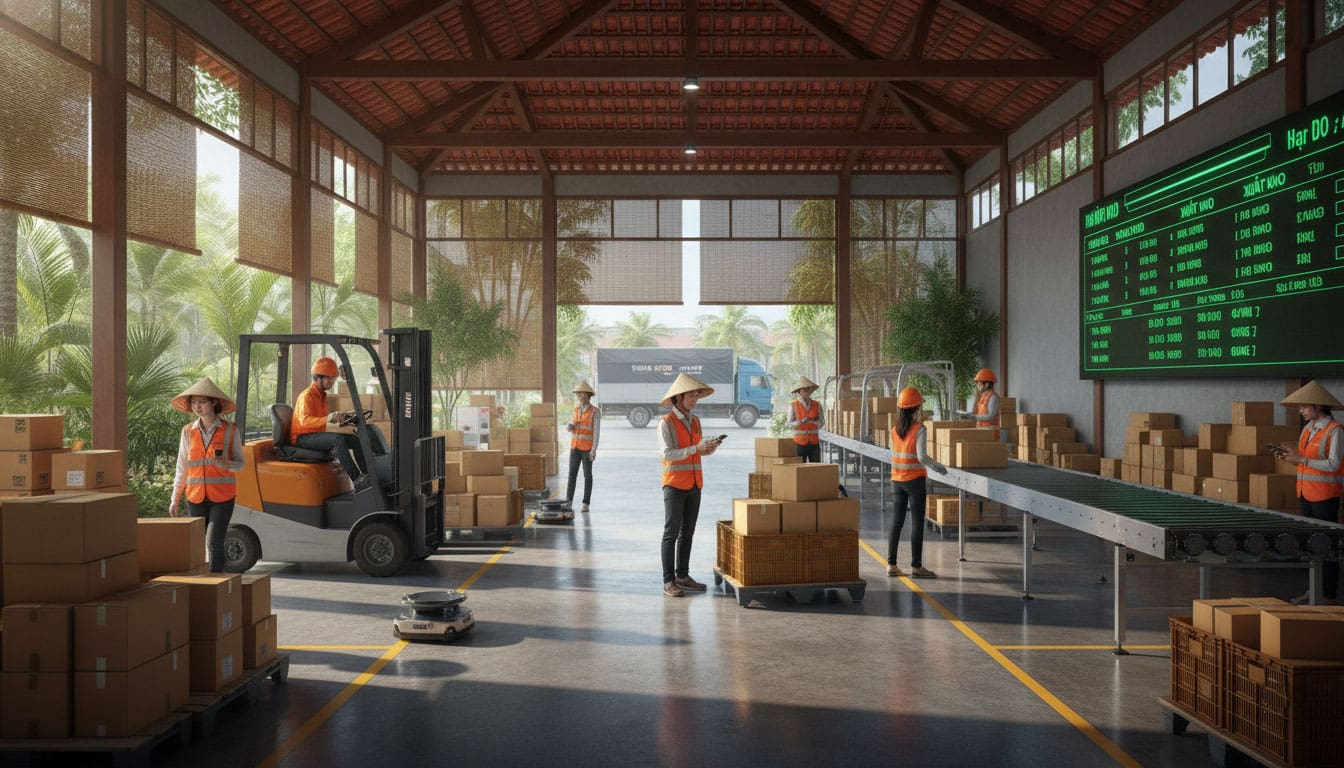
A standard warehouse operation process helps businesses control goods, reduce losses, and optimize costs. Discover 7 steps for managing and operating a warehouse according to actual logistics industry standards.
What is a Warehouse Operation Process?
A warehouse operation process is a set of steps and regulations designed to ensure that all activities related to storing, receiving, dispatching, and inventorying goods within a warehouse are carried out rigorously, consistently, safely, and efficiently. In the field of logistics and storage, this process acts as the “backbone” for controlling goods, optimizing operations, and preventing potential risks.
Definition in Logistics & Storage
In practice, a warehouse operation process typically includes:
- Goods Receiving: Checking and confirming quantity/quality upon goods entry into the warehouse.
- Storage: Arranging goods in correct locations with appropriate storage conditions.
- Goods Dispatch: Preparing, checking, and delivering goods according to dispatch orders.
- Inventory Control: Periodically reconciling physical counts with system data to identify discrepancies.
- Warehouse Maintenance and Cleaning: Ensuring the warehouse environment is always clean, safe, and protected against fire hazards.
Role of Warehouse Operations
1. In the Supply Chain
The warehouse operation process is a crucial link determining the speed and accuracy of the supply chain. For instance, in large manufacturing enterprises, if goods receiving or dispatch is delayed or inaccurate, the entire production and delivery schedule will be affected cascadedly.
2. In Inventory Management
A well-structured process helps minimize inventory, prevent losses, control expiry dates, and ensure rational goods rotation. In many logistics businesses, implementing a Warehouse Management System (WMS) alongside standard procedures has reduced receiving and dispatch errors to under 1%, saving hundreds of millions of VND annually.
3. In Cost & Risk Control
Efficient warehouse operations help businesses reduce storage, labor, and shrinkage costs, while also controlling risks such as fire, loss, and damage. Practical experience shows that warehouses with regular inventory procedures and strong coordination between warehouse staff and accountants rarely experience significant data discrepancies.
Distinguishing Warehouse Types in Business Practice
- Traditional Warehouses/Factories: Primarily used for storing goods of a single enterprise, managed manually or semi-automatically, with often fixed and less flexible receiving-dispatch processes.
- Logistics Warehouses: Professionally operated, integrating various services (consolidation, distribution, packaging), often utilizing modern management software, and catering to multiple clients. For example, the distribution centers of Tiki, Shopee, Lazada, etc., are all large-scale logistics warehouses.
- Self-Storage Warehouses: Provide small, separate storage spaces for individuals/businesses to manage themselves, with 24/7 access. This is an optimal solution for online shops, small businesses, or families needing flexible and secure storage.
As someone who has operated warehouses for manufacturing businesses, I’ve observed that clear processes help minimize errors, shorten goods receiving and dispatch times, and increase customer satisfaction. Especially with self-storage, customers have flexible access, reducing reliance on warehouse staff, but still need to adhere to safety procedures and periodic inventory checks to mitigate risks.
Warehouse operation is the foundation for businesses to effectively control goods, optimize the supply chain, save costs, and minimize risks. Whether it’s a traditional, logistics, or self-storage warehouse, establishing and adhering to operational procedures is a prerequisite for sustainable and professional development.

Why Do Businesses Need a Standard Warehouse Operation Process?
A well-structured warehouse operation process is a vital factor for logistics, manufacturing, and trading businesses to effectively control assets and operate efficiently. Here are the key reasons:
- Reduce Loss & Inventory Discrepancies: Without a strict control process, warehouse losses often account for 3–5% of annual revenue – a significant figure for medium and large enterprises. Transparent procedures for every inbound, outbound, and inventory check help detect and prevent discrepancies and losses due to operational errors or fraud early on.
- Accelerate Inbound – Outbound Speed: A standard process helps shorten order processing times and minimize intermediate steps, thereby increasing labor productivity and responding faster to customer needs. In practice, businesses that apply scientific inbound – outbound processes often reduce time by 20–30% compared to manual management.
- Ensure Goods Safety & Fire Prevention and Fighting (PCCC): A comprehensive process includes steps for checking and maintaining the PCCC system and guiding employees to comply with safety regulations, helping to minimize risks of fire, explosion, and goods damage, protecting the business’s reputation and assets.
- Easy Scalability During Growth: As a business grows, the volume of goods and the frequency of inbound – outbound operations increase significantly. If a standard process is already in place, expanding the warehouse, adding personnel, or investing in new technology will proceed smoothly without operational disruptions.
- Comply with Legal Regulations: Many industries require storage processes to meet legal standards such as PCCC, insurance, or quality certifications (e.g., GSP in the pharmaceutical industry). A standard process not only protects the business legally but also facilitates contract signing with major partners.
Businesses with professional warehouse processes typically maintain tight inventory control, minimize losses, and build a solid foundation for sustainable development and easy scalability. This is the secret that helps many logistics, retail, and manufacturing businesses maintain a competitive edge in the market.
7 Steps for a Standard Warehouse Operation Process
Step 1: Goods Receipt (Inbound)
The warehouse operation process begins with receiving goods. This is a crucial step to ensure accurate input data and prevent future losses. When goods arrive at the warehouse, staff need to:
- Check documents: Cross-reference accompanying documents such as warehouse receipts, invoices, and delivery notes.
- Verify quantity, type, and condition of goods against the information on the documents to detect discrepancies immediately upon receipt.
- Create a report if there are discrepancies in quantity, quality, or type, to establish a basis for resolution and protect the business’s interests.
According to a survey by Vietnam Supply Chain, businesses that strictly control the inbound stage often reduce inbound losses from 3% to less than 1%.
Step 2: Classification & Storage Location Assignment
After receipt, goods are classified and arranged into the correct locations to facilitate subsequent steps. This is based on:
- Type of goods: Flammable, food, components, medical supplies, etc.
- Outbound frequency: Frequently dispatched goods should be placed near the main aisle; less frequently dispatched goods can be placed further away.
- Storage conditions: Temperature, humidity, fire prevention, security.
- Applying FIFO/FEFO: For goods with expiration dates or those needing priority dispatch, adhere to the FIFO (First-In, First-Out) or FEFO (First-Expired, First-Out) principles.
Warehouses applying scientific classification help shorten picking times and reduce errors by 15–20% compared to haphazard storage.
Step 3: Goods Storage & Preservation
After classification, goods need to be stored under appropriate conditions to maintain quality and safety. Requirements:
- Control temperature and humidity suitable for each type of goods.
- Use shelves, pallets, ensuring wide aisles for convenient inspection, inbound/outbound operations, and fire prevention.
- For specific goods:
- Flammable goods: Store separately, away from heat sources, with specialized PCCC systems.
- High-value goods: Store in secure areas with continuous CCTV surveillance.
- Documents, records: Use moisture-proof, pest-proof storage, easily retrievable.
Statistics show that warehouses with appropriate preservation processes reduce the rate of goods damage to less than 0.5% per year.

Step 4: Inventory Management
Accurate inventory management is crucial for preventing losses and promptly meeting market demands. Key actions include:
- Inventory recording: This can be done manually (ledgers, Excel) or by using modern Warehouse Management System (WMS) software.
- Regular stocktaking: Conduct weekly, monthly, or quarterly checks to reconcile physical counts with system data.
- Low stock or dead stock alerts: Set up an alert system to proactively replenish stock or manage long-standing inventory.
Implementing WMS software can help reduce inventory discrepancies from 5% to less than 1%, leading to significant cost savings in management.
Step 5: Order Processing & Outbound Logistics
When a dispatch request is received, processing steps need to be clear, fast, and accurate:
- Receive dispatch request: From customers, sales departments, or project managers.
- Picking, packing, labeling: Ensure accuracy according to the order, avoiding any mix-ups.
- Final check before delivery: Confirm quantity, type, and condition of goods.
Businesses with efficient outbound processes typically reduce order error rates to below 0.3%.
Step 6: Transportation & Handover
The transportation and handover stages determine the quality of logistics services and customer satisfaction:
- Coordinate with transport units: Schedule deliveries and arrange suitable vehicles.
- Check seals: Ensure goods remain intact when leaving the warehouse.
- Sign-off & system update: Confirm delivery and update status in the software for easy tracking.
Warehouses with well-structured handover procedures reduce complaint rates due to loss or damage to below 0.2%.
Step 7: Reporting & Operational Improvement
At the end of the cycle, continuous reporting and improvement are indispensable steps to enhance operational efficiency:
- Report on inventory, order processing times, discrepancies, and incidents occurring monthly/quarterly.
- Analyze operational effectiveness, optimize warehouse layout, refine work processes, and propose improvement solutions based on actual data.
Businesses that consistently implement reporting and improvement often save 10–15% in operating costs and increase their responsiveness when scaling up.
Adhering to all 7 steps of this process not only helps maintain strict inventory control and minimize losses but also boosts productivity, service quality, and sustainable development for the business.
Essential Standards for Warehouse Operations
Warehouse operation isn’t just about arranging and storing goods; it also involves strict adherence to legal, safety, and risk management standards. A compliant warehouse helps businesses minimize losses, prevent incidents, and enhance reliability within the supply chain.
1. Fire Prevention and Fighting Standards for Warehouses (Decree 136/2020/ND-CP)
Fire prevention and fighting (PCCC) is a mandatory requirement for most types of warehouses in Vietnam. Non-compliant warehouses can face operational suspension, causing severe disruption to businesses.
Basic requirements include:
- Automatic or semi-automatic fire alarm and suppression systems
- Emergency exits, signs, and emergency lighting
- Valid PCCC approval and acceptance records
According to official statistics, most major warehouse fires causing significant damage originate from PCCC systems that are not regularly inspected or were non-compliant from the outset.
2. 24/7 Security & Surveillance
Warehouse security is a critical factor, especially for warehouses storing:
- High-value goods
- Easily consumable items
- Company documents and records
Standard security systems include:
- 24/7 surveillance cameras with data storage for a minimum of 30 days
- Access control using cards, codes, or authorization levels
- Security personnel or a centralized monitoring center
Many businesses report that investing in surveillance systems helps reduce the risk of loss and goods disputes by 30–50% compared to warehouses without centralized control.
3. GSP – Good Storage Practices (for Pharmaceuticals)
For warehouses storing medicines, functional foods, or medical devices, GSP is a mandatory standard regulated by the Ministry of Health.
Key GSP requirements include:
- Continuous temperature and humidity control
- Clear storage zones
- Strict inbound – outbound – inventory procedures
- Tracking and traceability records
Failure to meet GSP can render a business ineligible to operate and may lead to product recalls or destruction.
4. ISO 9001 / ISO 45001 (if applicable)
While not mandatory, ISO standards offer significant advantages for medium to large-scale warehouse operations.
- ISO 9001: Standardizes quality management processes
- ISO 45001: Ensures occupational health and safety
Businesses adopting ISO often improve operational efficiency by 10–20% while enhancing their reputation when working with major partners and international clients.
Comparing Self-Operated Warehousing vs. Professional Warehouse Rental
| Criterion | Self-Operated Warehousing | Professional Warehouse Rental |
|---|---|---|
| Initial Investment Cost | Very high: land cost, construction, fire prevention & fighting (PCCC), shelving, security systems | Low – no initial infrastructure investment needed |
| Monthly Operating Costs | High and fixed (personnel, maintenance, utilities, security) | Flexible, based on rented area and duration |
| Cash Flow Management | Can easily strain cash flow, difficult to adjust short-term | Easy to control, suitable for optimizing cash flow |
| Warehouse Personnel | Requires a specialized warehouse management team, regular training | Reduces the burden of human resource management |
| Legal & Operational Risks | Business bears all risks (PCCC, safety, insurance) | Risks are shared with the professional operating unit |
| Standard Compliance | Must self-ensure PCCC, security, industry regulations | Already has a system that meets standards |
| Scalability (Expansion/Reduction) | Difficult to expand quickly, high costs for changes | Flexible to increase/decrease area as needed |
| Implementation Time | Long (from several months to over 1 year) | Fast, can be used almost immediately |
| Suitable for Businesses | Large enterprises with stable, long-term needs | SMEs, e-commerce, startups, flexible needs |
| Total Long-Term Costs | Can be low if scale is very large and stable | Often saves 20–30% for SMEs & startups |
When Should Businesses Consider Professional Warehouse Rental?
Warehouse rental is a suitable option if your business:
- Needs warehouses for small and medium-sized enterprises (SMEs)
- Operates an e-commerce business or sells online
- Is a logistics startup needing to optimize initial costs
- Has short-term, seasonal, or fluctuating storage needs
In reality, many businesses choose warehouse rental because it helps them:
- Reduce total operating costs by 20–30%
- Increase flexibility when expanding or downsizing
- Focus resources on sales & growth
Safe & Flexible Warehouse Rental Solutions from MyStorage
MyStorage offers modern self-storage services, perfect for individuals, small and medium-sized businesses, online shops, and startups. Our warehouse system is designed to meet high standards of safety, security, and convenience:
- Private storage spaces, available in many flexible sizes
- 24/7 access, allowing you to pick up and drop off items at your convenience
- Continuous camera surveillance & security, meeting PCCC standards
- Clean, humidity-controlled environment, protecting goods long-term
- Clear contracts, transparent costs, easy budget control
If you’re looking for a simple, safe, and easily scalable storage solution, MyStorage is a reliable choice to optimize space and operating costs.

The choice between self-operating a warehouse and renting a professional one depends on each business’s scale, budget, and development strategy. For entities requiring flexibility, cost optimization, and reduced operational risks, professional warehouse rental is a solution that helps them focus resources on core business activities while ensuring safety and compliance with necessary standards.
FAQ
Should a business operate its own warehouse or outsource storage?
It depends on business size, budget, inventory stability, and internal management capability.
What are the advantages of operating your own warehouse?
It suits large companies with stable storage needs and sufficient long-term investment capacity.
What is the biggest drawback of operating a warehouse in-house?
High upfront investment and full responsibility for legal and operational risks.
What problems does renting professional storage solve?
It reduces capital investment, saves manpower, and improves operational flexibility.
Is renting storage truly more cost-effective?
For SMEs and e-commerce businesses, renting often saves 20–30% in operating costs.
Which businesses should prioritize renting storage?
SMEs, startups, online sellers, and businesses with seasonal storage needs.
Are there safety or legal risks when renting storage?
Risks are lower when choosing providers with proper fire safety, security, and clear contracts.
Can businesses scale storage space when renting?
Yes. This is a key advantage over operating an in-house warehouse.
Is renting storage suitable for short-term needs?
It is ideal for peak seasons, relocations, or market testing phases.
What should businesses consider before renting storage?
Businesses should assess location, infrastructure, hidden costs, safety standards, and provider credibility (such as MyStorage).