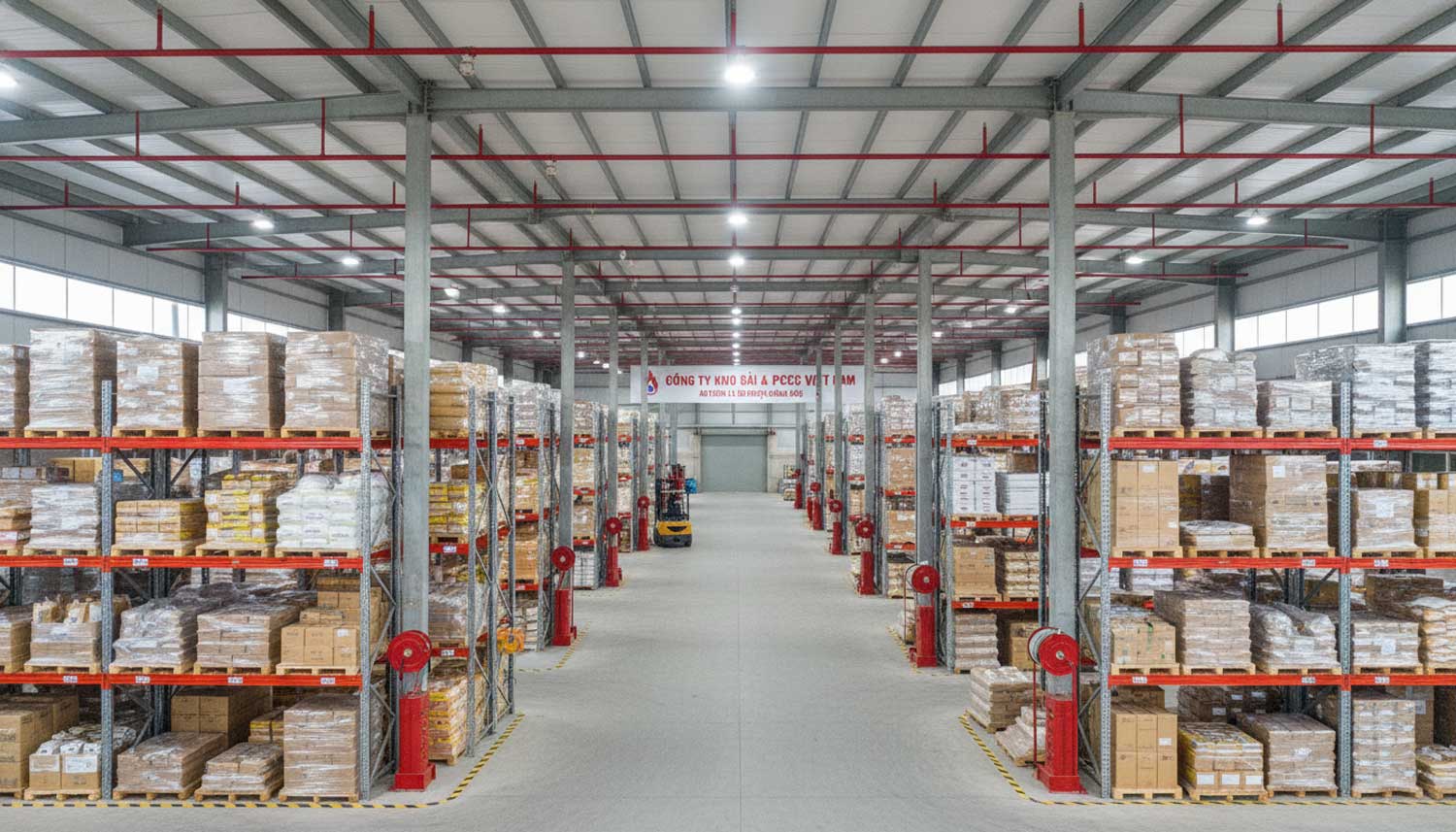
Understanding the Latest Warehouse Fire Prevention & Safety Standards: Design Requirements, Fire Alarm & Suppression Systems, Legal Documentation, and Safety Inspection Checklist.
Why Are Warehouse Fire Safety Standards Crucially Important?
1. Context: Increasing Fire and Explosion Risks Amidst Warehouse Growth
In Ho Chi Minh City and other major urban areas, the number of warehouses, logistics centers, and e-commerce warehouses has rapidly increased in recent years. The larger their scale, the higher the risk of fire and explosion due to the storage of vast quantities of goods, flammable materials (such as cartons box, plastics, and packaging), and continuously operating electrical systems. Even a minor incident can spread quickly in just a few minutes, threatening both valuable goods and human lives.
2. Real-World Consequences of Non-Compliance with Fire Safety Standards
- Asset Loss: Fire temperatures in warehouses can exceed 800°C, leading to the complete destruction of goods, machinery, and equipment.
- Business Interruption: When a fire occurs, businesses are forced to cease operations and deal with the aftermath, disrupting supply chains and eroding customer trust.
- Severe Financial Losses: According to statistics from the Fire Prevention, Fighting and Rescue Police Department, hundreds of fires occur annually in Vietnam at production facilities and warehouses, causing trillions of VND in damages.
- Legal Liability: Warehouse owners or investors may face significant penalties or operational suspension if their facility fails to meet mandatory fire safety standards.

3. Warehouse Fire Prevention and Fighting (FPF) Standards – Mandatory Requirements under Current FPF Law
Fire Prevention and Fighting (FPF) is not merely a risk management solution; it is a mandatory legal obligation for all types of warehouses, production workshops, and storage centers.
Specifically, according to current regulations:
- Law on Fire Prevention and Fighting No. 27/2001/QH10 (amended and supplemented in 2013).
- Decree 136/2020/NĐ-CP: Detailing the implementation of the FPF Law, requiring warehouses to establish FPF management dossiers, appraisal, and acceptance.
- Circular 149/2020/TT-BCA: Guiding the inspection and maintenance of automatic fire fighting and fire alarm systems.
- Applicable Vietnamese Standards (TCVN):
- TCVN 2622:1995 – Fire prevention and fighting for buildings and structures – Design requirements.
- TCVN 3890:2009 – FPF equipment for buildings and structures – Equipping, arrangement, inspection, maintenance.
- TCVN 5738:2021 – Automatic fire alarm systems – Technical requirements.
Thus, “warehouse FPF standards are mandatory requirements under the current FPF Law” – not only to comply with legal regulations but also to protect assets, personnel, and the sustainability of businesses.
A standard-compliant FPF system helps businesses:
- Prevent fires and explosions right from the design and operational stages.
- Minimize material and human damage in the event of an incident.
- Increase reputation and reliability in business cooperation and logistics.
Therefore, investing in proper FPF standards is not an expense but a measure to protect businesses from risks and maintain stable long-term operations.
Legal Basis & Standards Related to Warehouse FPF
1. Current Laws and Decrees
-
- Law on Fire Prevention and Fighting 2001 (Law No. 27/2001/QH10) – the foundational document regulating the responsibilities of organizations and individuals in FPF work.
- Law amending and supplementing a number of articles of the FPF Law 2013 – supplementing regulations on appraisal, acceptance, and ensuring FPF safety during operation.
- Decree 136/2020/NĐ-CP dated November 24, 2020, of the Government – detailing the management, inspection, design appraisal, and acceptance of FPF works, while specifically classifying high-risk fire and explosion establishments, including warehouses, storage facilities, and production workshops, as mandatory inspection subjects.
- National Technical Regulation QCVN 06:2022/BXD – “Fire Safety for Buildings and Structures” issued by the Ministry of Construction, stipulating design requirements, arrangement of escape routes, fire-resistant materials, and fire alarm and fighting systems for various types of buildings, especially industrial warehouses and logistics centers.
2. Key Vietnamese National Standards (TCVN) Applied in Warehouse Fire Prevention and Fighting
| Standard Code | Full Name | Key Content & Scope of Application |
|---|---|---|
| TCVN 2622:1995 | Fire Prevention and Fighting for Buildings and Structures – Design Requirements | Provides general regulations on architectural solutions, technical systems, and fire safety distances in warehouse design. |
| TCVN 3890:2009 | Fire Prevention and Fighting Equipment for Buildings and Structures – Equipping, Arrangement, Inspection, Maintenance | Guides the arrangement of fire extinguishers, fire alarm systems, fire hoses, and specifies periodic inspections to ensure effectiveness in case of an incident. |
| TCVN 5738:2001 | Automatic Fire Alarm Systems – Technical Requirements | Specifies technical standards, sensitivity, monitoring scope, and installation requirements for fire alarm systems in industrial buildings and warehouses. |
| TCVN 5760:1993 | Fire Fighting Systems – General Requirements for Design, Installation, and Operation | Provides fundamental principles for designing water, gas, foam, and CO₂ fire suppression systems. |
| TCVN 7435-1:2004 | Fire Fighting Equipment – Gas Fire Extinguishers – Part 1: Technical Requirements, Testing | Outlines technical requirements and safety testing for CO₂, N₂, Halon gas cylinders, etc., used in goods storage warehouses. |
3. Significance for Warehouse Operating Businesses
The aforementioned documents and standards form the mandatory legal basis for the design, construction, and operation of warehouses. Non-compliance with fire prevention and fighting standards can lead to project acceptance refusal, operational suspension, or penalties as stipulated in Decree 144/2021/ND-CP.
Conversely, facilities that fully comply will receive fire safety certification, enhancing their reputation, reducing risks, and meeting insurance requirements as well as modern logistics operational audits.
Full adherence to the Fire Prevention and Fighting Law 2001 & 2013, Decree 136/2020/ND-CP, QCVN 06:2022/BXD, along with TCVN standards 2622, 3890, 5738, 5760, and 7435-1, serves as crucial authoritative evidence, demonstrating that the warehousing facility meets fire and explosion safety standards in accordance with Vietnamese law.
Fire Prevention and Fighting Design Standards in Warehouses
Fire-Resistant Building Materials
When designing a warehouse, the primary consideration must be the use of fire-resistant building materials. Structural components such as walls, roofs, and doors should achieve a fire resistance rating of EI60–EI120, depending on the type of goods stored and the warehouse’s fire and explosion hazard class. This helps limit the risk of fire spreading to other areas in the event of an incident.
Furthermore, floors, beams, and steel structures must be coated with fire-resistant materials that meet current TCVN standards (e.g., TCVN 2622:1995, TCVN 3890:2009). Additionally, areas penetrating walls, ceilings, or electrical conduits and ventilation ducts need to be treated with fire-resistant materials to prevent the spread of fire and hot gases.
Escape Routes and Fire Compartmentation
According to QCVN 06:2022/BXD, warehouses with an area of 500 m² or more are required to have at least two independent escape routes to ensure the safety of personnel and rescue teams in the event of a fire.
Some basic technical requirements:
- Minimum escape route width: 1.2 meters.
- Maximum escape route length: not exceeding 40 meters from the furthest point in the warehouse to the exit door.
Additionally, warehouses must be divided into independent fire compartments, each with a fire resistance rating appropriate for the type of goods stored.
- For warehouses smaller than 100 m², at least one separate fire compartment can be arranged, equipped with fire extinguishers and smoke detectors.
- For warehouses larger than 500 m², fire-rated walls achieving EI120 and self-closing fire doors are required between areas, especially when storing various types of goods (e.g., plastics, chemicals, paper).

Fire Safety Clearance Distances
Warehouses must be constructed with appropriate safety distances to prevent the spread of fire to residential areas or adjacent structures. According to regulations, a warehouse must be at least 9–12 meters away from residential areas, depending on the fire hazard level and the type of materials used in the building.
For warehouses storing chemicals, solvents, fuels, or hazardous flammable materials, strict adherence to specific regulations such as QCVN 01:2020/BCT and QCVN 06:2022/BXD is required, which may mandate isolation distances of 15 to 30 meters.
Additionally, the overall design needs to ensure:
- Internal access roads are at least 3.5 meters wide for fire trucks.
- Fire truck turning radius is ≥ 12 meters.
- Fire hydrants and fire fighting water reservoirs are located within a ≤ 150 m radius around the warehouse to ensure rapid response capabilities.
In summary, fire safety design standards for warehouses not only meet legal requirements but are also a core factor in protecting assets, people, and maintaining stable business operations. Adhering to technical standards and national regulations from the design phase will help businesses minimize risks and ensure long-term operational safety.
Fire Alarm and Suppression System Standards
To ensure absolute safety for goods and assets in the warehouse, fire alarm and suppression systems must be designed and installed according to specified standards. Below are the basic requirements for a standard fire prevention and fighting (PCCC) system:
Fire Alarm System
- Smoke and heat sensors must be installed in all enclosed areas of the warehouse to detect fire hazards early.
- The fire alarm control panel should be placed in an easily observable location, convenient for inspection and troubleshooting when necessary.
- The system must integrate sirens and fire alarm lights to promptly alert staff and customers in emergency situations.
Automatic Fire Suppression System
- Sprinklers (automatic water spray heads) must be installed according to TCVN 7336:2003, ensuring automatic water discharge upon detection of abnormal temperature increases.
- Water flow must be at least 5–10 liters/m²/minute, depending on the type of goods stored in the warehouse.
- For warehouses storing highly flammable goods, a Foam fire suppression system (specialized fire-fighting foam) is mandatory to enhance fire extinguishing effectiveness and reduce damage.
Mobile Fire Fighting Equipment
- CO₂ and MFZ4 powder fire extinguishers must be equipped in appropriate quantities based on the warehouse area, ensuring the ability to immediately handle small fires before they spread.
- Fire hydrants must be spaced 45–60m apart, facilitating easy access for fire trucks to connect and draw water when needed.
- Fire safety instruction boards must be clearly displayed and easily visible at every entrance and exit, helping everyone quickly understand evacuation procedures and incident handling.
Full compliance with these standards not only effectively protects goods but also ensures the safety of human lives in all emergency situations.
Warehouse Fire Safety System Operation and Maintenance Standards
To ensure absolute safety for goods and personnel, the warehouse’s fire prevention and fighting (PCCC) system must be operated and maintained according to standards. The basic standards include:
- Regular Inspections
System inspection and maintenance must be performed regularly and on schedule:
- Fire alarm system: inspected at least once a month to ensure continuous optimal operation and timely fault detection.
- Sprinkler system: inspected every 3–6 months to ensure spray heads are always ready to operate in case of fire.
- Fire pumps: need to be test-run once a week to detect malfunctions and ensure water pressure meets standards.
- Training & On-site Fire Safety Team
Personnel and procedures are key factors in fire safety work:
- 100% of staff must be trained in fire safety, understanding incident handling procedures.
- An internal fire safety team needs to be on duty 24/7 for large-scale warehouses, ensuring emergency response when necessary.
- Mandatory Fire Safety Documentation
Legal and technical documents must be stored and updated completely:
- Certificate of fire safety design approval as per regulations.
- Fire safety acceptance records after completion and commissioning.
- Equipment & maintenance logbook to monitor operational status and maintenance history of the entire system.
Warehouse Fire Safety Checklist
To ensure safe operation, warehouses should regularly review the following checklist:
- Fire alarm system is 100% operational, not turned off or without power.
- Sprinklers are complete, correctly positioned, and ensure standard water pressure.
- Emergency exits are always clear and not obstructed by goods.
- Fire extinguishers are within their expiry date, correctly placed, and easily accessible.
- Evacuation plans are posted in easily visible and accessible locations for everyone.
- Absolutely no goods stored exceeding the designed load capacity of the floor/shelves.
- No chemicals or flammable materials stored near heat sources.
- An internal fire safety team is on standby, ready to handle incidents.
This checklist aids in warehouse operations and serves as a reference standard for periodic inspections and evaluations.

Common Fire Safety Violations in Warehouses
In reality, many warehouses still commit common violations that pose significant safety risks:
- Blocked emergency exits: → Solution: Always keep emergency exits clear and post clear warning signs.
- Irregular fire extinguisher checks: → Solution: Establish a regular inspection schedule and replace expired extinguishers according to manufacturer recommendations.
- Disabled or unpowered fire alarm systems: → Solution: Check power sources, install power loss indicators, and remind staff not to arbitrarily disconnect the system.
- Warehouse renovations without re-approval of fire safety plans: → Solution: Any changes in architecture or function must be re-approved in accordance with current fire safety regulations.
Proactively preventing and rectifying these errors is the best way to ensure safety and legal compliance.
Tips for Choosing a Fire Safety Compliant Warehouse
When selecting a warehouse for storing goods, you should prioritize the following criteria:
- The warehouse has undergone full fire safety inspection and acceptance, with clear certification issued by competent authorities.
- Equipped with a 24/7 camera system, wide truck access, and a safe, fire-resistant concrete floor.
- An integrated fire alarm and suppression system that is regularly maintained.
- Prioritize professional operating units with an in-house fire safety team, such as MyStorage, to ensure the warehouse is always safe, clean, and highly secure.
Choosing a fire safety compliant warehouse not only protects assets but also ensures the safety of people and the reputation of your business.
Fire safety standards for warehouses are a mandatory factor directly impacting the safety of goods and business operations. Understanding the requirements for design, fire alarm and suppression systems, and operation will help you choose the right compliant warehouse, minimize risks, and meet legal regulations.
FAQ
What fire safety standards apply to warehouses?
They include requirements for building design, escape routes, fire alarms, suppression systems, safety distances, and legal fire certification.
Is an automatic fire alarm system mandatory for warehouses?
Most warehouses must install automatic fire alarm systems according to TCVN 5738 and Decree 136/2020.
When are two emergency exits required in a warehouse?
Warehouses larger than 500m² or with many occupants must have at least two emergency exits.
What are the fire extinguisher requirements for warehouses?
CO₂ and dry powder extinguishers meeting TCVN 7435 must be placed every 20–30 meters.
Are sprinkler systems mandatory?
Warehouses storing flammable goods or with large floor areas typically require sprinklers, per TCVN 7336.
What fire safety documents are required for a warehouse?
Required documents include fire design approval, acceptance records, maintenance logs, and fire response plans.
How often should fire alarm systems be inspected?
At least once per month, with regular testing to ensure proper functionality.
Are there special fire safety standards for chemical storage?
They require separated zones, ventilation, explosion-proof equipment, and chemical-response plans.
What are the penalties for non-compliant warehouses?
Penalties may include fines, forced shutdown, or revocation of operational permits per Decree 144/2021.
How can I verify if a rental warehouse meets fire safety standards?
Request fire safety approval documents and check exits, alarm/suppression systems, and security infrastructure.