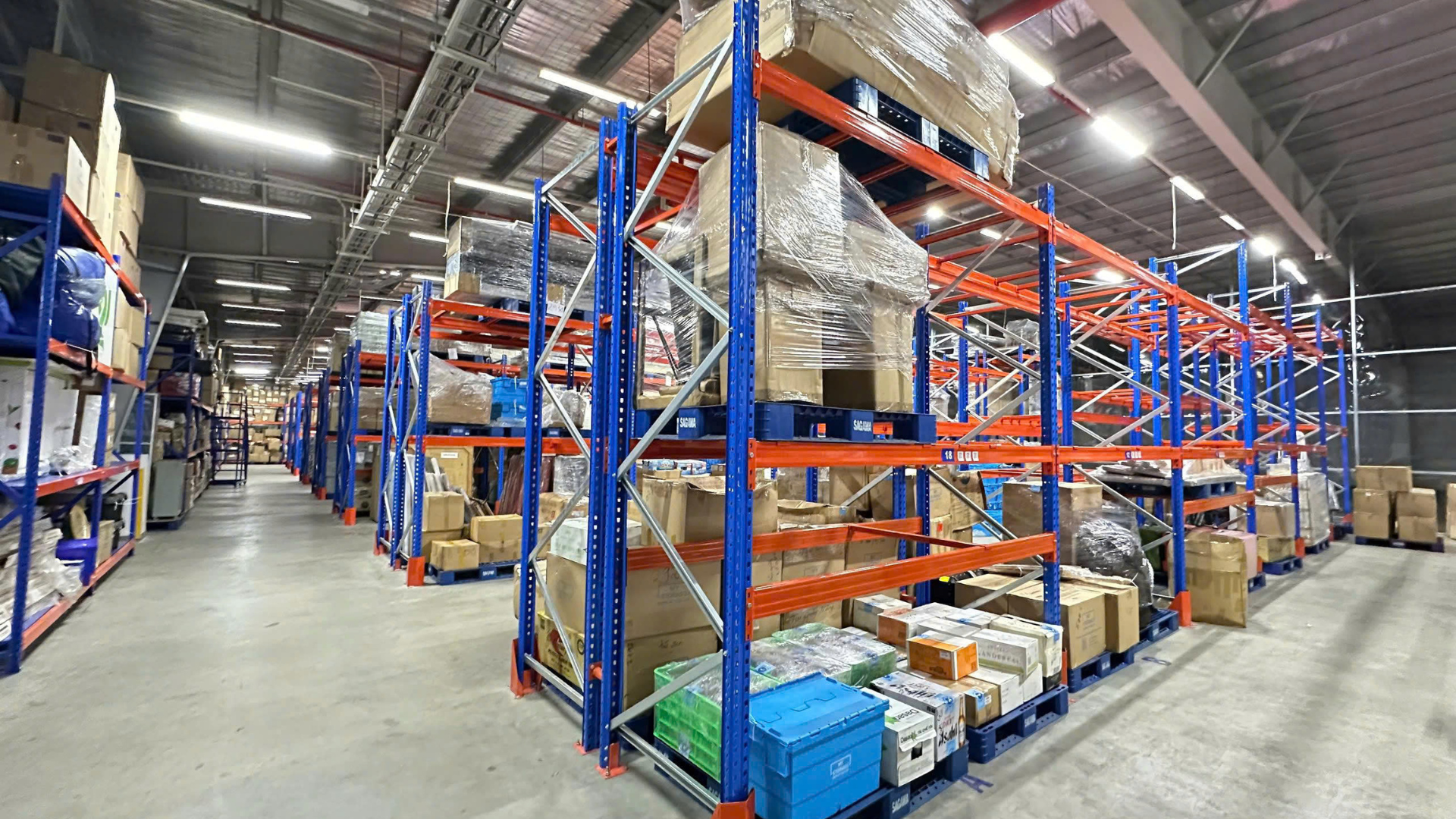
In the field of investment, leasing, and warehouse development, clearly distinguishing whether a warehouse is classified as industrial or commercial real estate is very important. Each type has different legal characteristics, construction standards, management mechanisms, and value exploitation: commercial real estate typically includes office buildings, shopping centers, retail spaces, etc., serving business operations and services for end customers; while industrial real estate is geared towards production, processing, assembly, and logistics, often requiring high technical infrastructure and proximity to industrial zones, ports, or major transport routes.
In practice, warehouse classified as industrial real estate because they directly serve the functions of storage, transshipment, and distribution of goods within the production and logistics chain.
However, depending on the purpose of use, scale, and location, warehouses may also exhibit characteristics of commercial real estate—especially mini-warehouses, self-storage facilities, and record storage in urban areas catering to flexible rental needs or services for small and medium-sized enterprises. Accurately identifying this nature helps businesses and investors choose the most suitable operational and exploitation strategies aligned with their needs and business goals.
Concept of Real Estate Types and Basic Characteristics
Commercial Real Estate
Commercial real estate refers to properties used to generate profit through leasing, investment, or operating business activities. It includes types such as offices, shopping centers, retail spaces, hotels, and small warehouses serving distribution or storage of goods near central locations.
Characteristics:
- Prime locations, situated in central areas or densely populated regions, easily accessible.
- Emphasis on aesthetics, modern design, and amenities for tenants.
- Convenient transportation, close to major roads, parking lots, and public transport.
- Lease contracts are often long-term, providing stability for both investors and tenants.
- Typically includes professional management services, security, and building maintenance.
Industrial Real Estate
Industrial real estate is primarily used for production, storage, distribution of goods, or other industrial activities such as factories, large production workshops, and warehouses.
Characteristics:
- Large land and factory areas, high ceilings, and strong structural frameworks.
- Usually located near industrial zones, ports, ring roads, and key logistics routes.
- Prioritizes practicality, ease of expansion, and arrangements for large-scale production and transportation.
- Integrated technical infrastructure: fire protection systems, three-phase electricity, water supply, and truck/container parking.
- Flexible lease contracts, suitable for expansion needs or changes in production.

Warehouse, Storage Facility
A warehouse is a type of real estate used for storing, preserving, and distributing goods, materials, or documents storage for businesses, individuals, or e-commerce warehouse. Warehouses can be independent or integrated into commercial or industrial projects.
Characteristics:
- Diverse Sizes: Ranging from mini warehouses (5–30 m²), medium warehouses (30–300 m²) to large warehouses (over 1,000 m²).
- Optimized Storage Design: High ceilings (typically 6–12m), load-bearing floors, and large entry and exit doors.
- Security Systems: Equipped with surveillance cameras and fire protection systems that meet standards.
- Flexible Locations: Can be found in industrial zones (industrial characteristic) or near city centers and major streets (commercial characteristic).
- Diverse Purposes: For storing goods, transshipment, cold storage, document storage, or e-commerce.
- Flexible Lease Agreements: Available for short-term or long-term, with professional management services or self-management.
Warehouses are a type of real estate that combines characteristics of both commercial and industrial sectors, serving both production-logistics needs and the demand for storage and distribution of goods for various customer groups.
Is a Warehouse Industrial or Commercial Real Estate?
A warehouse is a unique type of real estate located at the intersection of industrial and commercial sectors. However, in essence, most warehouses are still classified as industrial real estate for the following reasons:
- The primary function of a warehouse is to store, preserve, transship, and distribute goods—directly supporting production, logistics, and supply chain operations.
- Locations and designs typically prioritize proximity to industrial zones, ports, and major transport routes, featuring physical characteristics such as high ceilings, load-bearing floors, and spacious areas for truck/container access.
- Legal Aspects: Most large warehouse projects are built on industrial land or non-agricultural business land, subject to industry standards for construction, fire protection, and environmental regulations.
However, warehouses can also exhibit commercial elements in certain cases:
- Mini warehouses, self-storage facilities, and small record storage located in commercial buildings or urban areas serve flexible rental services, catering to individual customers or small businesses.
- Some warehouses integrate operational services and short-term rentals for e-commerce, retail, or urban logistics.
While warehouses are primarily regarded as industrial real estate, in practice, depending on the purpose of use, scale, and location, they can also exhibit characteristics of commercial real estate. Proper differentiation helps businesses and investors choose the most suitable strategies aligned with their needs and business goals.

The Role of Warehouses and Classification of Warehouses by Function
| Warehouse Type | Function / Need | User Group | Common Size | Characteristics |
|---|---|---|---|---|
| General Storage Warehouse | Storing manufactured goods and finished products | Manufacturing and distribution companies | 500–5,000 m² (or larger) | Large area, high ceilings, load-bearing floors |
| Transshipment Warehouse | Consolidating, breaking down, and rapid distribution | Logistics companies, e-commerce | 200–2,000 m² | Location near central/logistics, continuous entry and exit |
| Cold Storage Warehouse | Preserving temperature-sensitive goods | Food, pharmaceuticals, cosmetics | 20–1,000 m² | Temperature control, refrigeration systems |
| Document Storage Warehouse | Storing papers, records, and documents | Offices, law firms, accounting firms | 5–30 m² | Small area, security, moisture resistance |
| Production Warehouse | Combining storage and supporting production lines | Factories, workshops | 1,000–10,000 m² | Integrated with production areas, convenient internal transport |
| Mini / Self-Storage Warehouse | Small, flexible storage | Individuals, online shops, startups | 5–30 m² | Small area, short/long-term rental options |
| Short-Term / Flexible Rental Warehouse | Meeting seasonal, event, or urgent needs | Businesses, event organizers | 10–200 m² | Flexible contracts, diverse sizes |
| E-commerce Warehouse | Storing, packaging, and rapid distribution | E-commerce platforms, online shops | 50–1,000 m² | Modern management, integrated software, urban proximity |
| Urban Distribution Warehouse | Optimizing last-mile deliveries, fast shipping | Delivery units, e-commerce | 30–300 m² | Near city centers, convenient for small vehicles, flexible deliveries |
Many warehouses can integrate multiple functions or adapt flexibly according to actual needs. The user groups range from individuals and small businesses to large corporations.
Implications for Investment and Warehouse Leasing
Understanding and distinguishing between commercial and industrial real estate helps businesses and investors choose the right type of warehouse and location that aligns with their business objectives.
Currently, warehouses are an attractive segment due to consistently high occupancy rates (often reported to be over 94–96% in major cities) and significantly lower construction or rental costs compared to office or retail spaces.
However, when deciding to lease or invest in a warehouse, businesses need to clearly identify their actual needs:
- If only small, flexible storage with quick delivery is required: prioritize mini warehouses or urban commercial storage, which can be rented short-term at reasonable costs.
- If serving large-scale production, logistics, or supply chains: opt for large industrial warehouses with high ceilings, located near ports, industrial zones, or key logistics routes.
Accurately identifying these needs will help optimize costs, select the right products, and enhance operational efficiency and asset exploitation.
Although warehouses exist between the concepts of commercial and industrial real estate, primarily being viewed as industrial real estate, the clear distinction between these two characteristics plays a crucial role in optimizing location choices, investment costs, and operational efficiency.
Businesses and investors should carefully consider characteristics, location, and usage objectives before deciding to lease or invest in a warehouse, ensuring that the warehouse solution aligns best with their development strategy and actual needs.
FAQ
Is a warehouse classified as industrial or commercial real estate?
A warehouse sits between commercial and industrial real estate categories, but fundamentally it is often classified as industrial real estate because it primarily supports production, storage, and distribution functions.
What’s the difference between commercial and industrial real estate?
Commercial real estate focuses on business and service operations in central areas, while industrial real estate is geared toward production, logistics, and large-scale goods storage.
Are mini warehouses or self-storage considered commercial real estate?
Mini warehouses, self-storage, or small document storage facilities in urban areas can have commercial real estate characteristics as they serve flexible rental needs for individuals and small businesses
Are traditional warehouses typically industrial or commercial?
Traditional warehouses with large space, high ceilings, and logistics-oriented design are typically classified as industrial real estate.
How does classifying warehouses affect businesses?
Accurate classification helps businesses choose the most suitable warehouse type, location, cost structure, and legal compliance for their logistics or commercial strategy.
Are warehouses in central urban areas considered commercial real estate?
Warehouses near urban centers or flexible storage services (like mini warehouses) tend to have more commercial characteristics than industrial warehouses located in logistics zones.
Is a warehouse used for supporting production considered industrial real estate?
Yes. Warehouses that support production, raw material storage, or goods storage for production are clearly categorized as industrial real estate
How do zoning and legal regulations affect warehouse classification?
Land use zoning and legal standards for construction, fire safety, and environment require industrial warehouses to meet stricter regulations than small commercial storage.
Can a warehouse with multiple functions be industrial or commercial?
Yes. Some warehouses may exhibit both industrial and commercial characteristics depending on their use case, scale, and location.
Is urban self-storage considered industrial real estate?
Urban self-storage units tend to be more commercial in nature, serving flexible rental needs while still being part of the broader warehouse real estate market.