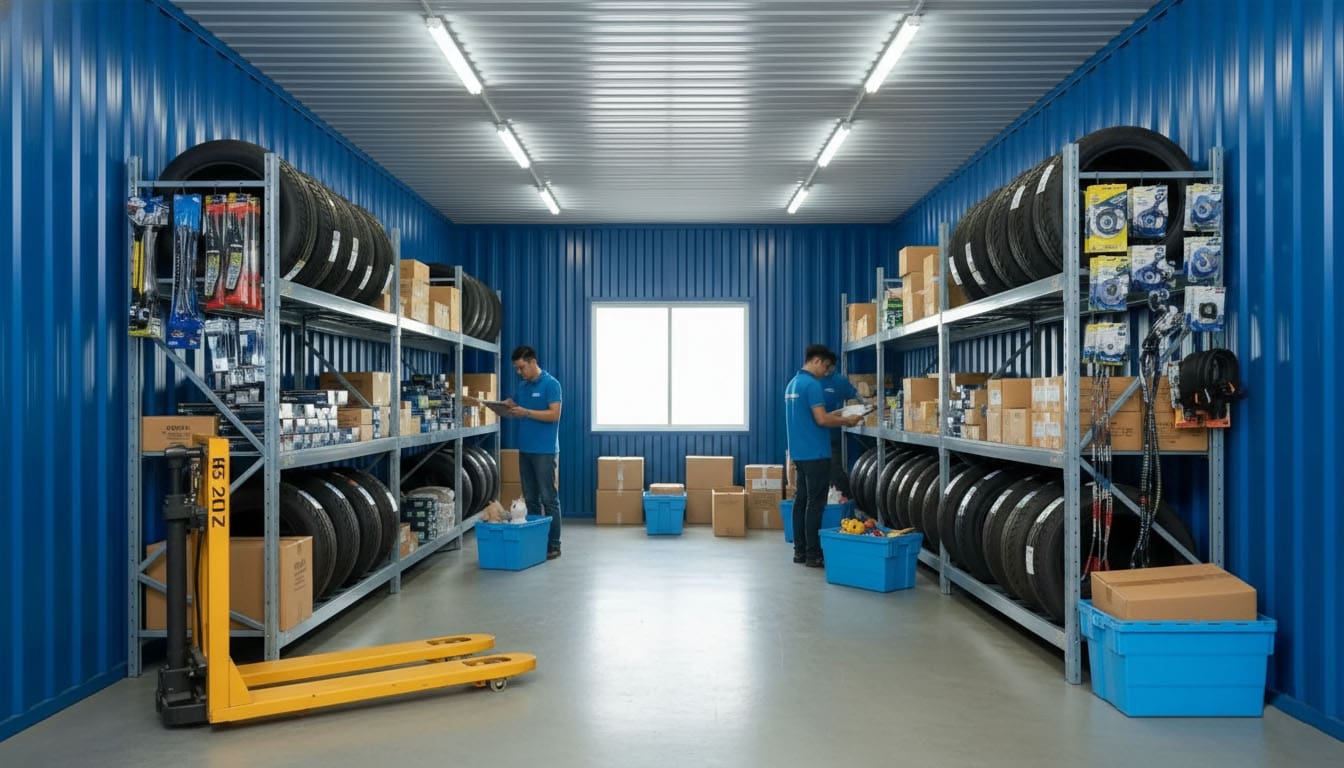
Automotive and motorcycle spare parts come in various types, sizes, and require different storage conditions, especially needing humidity control and organization by SKUs to accelerate order fulfillment. Specialized spare parts warehouses can reduce part wear and tear by up to 40% compared to non-standard storage. An EFRA Logistics 2024 study indicates that mechanical equipment suffers losses due to poor storage, ranging from 15–40% of inventory annually.
Unique Characteristics of Automotive & Motorcycle Spare Parts
Unlike consumer goods, spare parts differ due to their vast number of SKUs, variable sizes, and the presence of heavy & easily oxidizable components, thus requiring dedicated warehouse infrastructure (pallet systems, three-phase power bays, humidity control).
1. A Massive and Complex SKU Matrix
A modern car comprises approximately 30,000 large and small components. In the aftermarket industry, a mid-sized dealership might manage between 5,000 and 10,000 stock keeping units (SKUs).
- Absolute Precision: A single incorrect character in the Vehicle Identification Number (VIN) or part code renders the item useless.
- Consumer Goods: Typically have standard packaging sizes (boxes, pallets), making them easy to stack.
- Spare Parts: Exhibit extreme diversity in shape – from tiny screws to bulky front bumpers or lengthy exhaust pipes.
2. Stringent Material Storage Requirements
Unlike consumer goods with clear expiry dates, spare parts have a “technical lifespan” that depends on the storage environment:
- Anti-Oxidation (Rusting): Steel and aluminum components (such as brake discs, crankshafts) are extremely sensitive to humidity. If the warehouse lacks proper humidity control, items will rust even within their packaging.
- Rubber Aging: O-rings, tires, and drive belts will become brittle and crack if stored in excessively hot environments or exposed to direct sunlight.
- Electronic Components: Engine Control Units (ECUs) and sensors demand a dry and strictly anti-static environment.
3. Load Capacity and Warehouse Infrastructure
Consumer goods are typically lightweight and can be stacked high on standard pallet racks. Spare parts, however, are different:
- Extremely High Local Loads: An engine block or gearbox can weigh hundreds of kilograms. Warehouses require heavy-duty racking systems and high load-bearing floors to prevent subsidence.
- Specialized Racking Systems: Cantilever racks are needed for long bars, medium-duty racks for boxed spare parts, and open floor areas for engine blocks.
4. Distinct Goods Flow
In a spare parts warehouse, classifying goods by turnover rate is crucial:
- Fast-moving: Oil filters, brake pads, spark plugs, etc., need to be placed in the most accessible locations.
- Slow-moving: Body panels, rare engine parts, etc., can be stored for several years. If stored like consumer goods (which prioritize quick turnover), these “slow” items would soon be damaged or lost.
Storage Characteristics Comparison
| Feature | Consumer Goods (FMCG) | Automotive & Motorcycle Spare Parts |
|---|---|---|
| Packaging | Uniform (Cardboard boxes) | Diverse, irregular shapes |
| Weight | Light to medium | From ultra-light to ultra-heavy |
| Environment | Ventilation is sufficient | Humidity, temperature control |
| Management | By batch, expiry date (FEFO) | By component code (SKU), vehicle model |
| Risks | Expiry | Rusting, aging, obsolescence |
When storing spare parts, the factor of “Fixed Location” is extremely important. You cannot constantly change the position of items as in a consumer goods warehouse, because finding a washer among 10,000 SKUs without a standard layout is an “impossible mission”.
Analyzing Spare Parts Storage Costs vs. Economic Benefits
The cost of renting a spare parts warehouse, calculated per m³, is often lower than the cost of stockouts due to production interruptions, which can be 20–30% per delayed order – according to the Automotive Aftermarket Report 2025 survey.

1. The Cost of “Stockouts”
According to the Automotive Aftermarket Report 2025, the costs incurred from spare parts supply chain disruptions are often many times higher than inventory holding costs.
- Revenue Loss: When a vehicle is waiting for parts (Vehicle Off Road – VOR), each day of delay can lead to a 15–25% loss of potential revenue for that period as customers switch to competitors.
- Opportunity Cost: For garages, the absence of a small item (like a rubber gasket) can clog the entire repair process, leading to wasted labor and lift bay space.
- Economic Benefits: Scientific inventory management helps reduce the order cancellation rate to below 2%, protecting a stable revenue stream.
2. Specialized Warehouse vs. Standard Warehouse Costs
Many businesses opt for low-cost warehouses to save money, but this often turns into a “cost trap.”
- Standard (Low-cost) Warehouse: Saves 20-30% on rent but carries a risk of damage (rust, mold) up to 5-10% of the goods’ value annually.
- Specialized Warehouse (Heavy-duty racking, humidity control): Although the initial investment cost is higher, it helps to:
- Optimize Space (m³): Utilizing high-rise racking systems allows for storing 3 times the amount of goods in the same floor area.
- Asset Protection: Reduces the rate of environmental damage to goods to nearly 0%.
3. Benefits of Improved Fulfillment
The greatest economic benefit of a well-organized parts warehouse lies in speed.
- FIFO (First In, First Out) Classification: Ensures that components with a technical lifespan (such as batteries, tires) are always in optimal condition.
- Reduced Picking Time: A warehouse arranged with logical SKUs helps staff find the correct item in < 2 minutes instead of 20 minutes.
| Category | Investing in a Standard Warehouse | Cutting Warehouse Costs |
|---|---|---|
| Operating Costs | High (electricity, systems, racking) | Low |
| Goods Damage Rate | < 1% | 5% – 15% (due to humidity, impact) |
| Customer Loyalty | High (always in stock) | Low (frequent rescheduling) |
| Brand Value | Professional, reliable | Less stable |
| Cash Flow Efficiency | Optimized due to fast turnover | Slow due to manual management |
In 2026, leading automotive parts businesses will no longer compete on price; they will compete on “component availability speed.” A self-managed or specialized warehouse system is the “weapon” to achieve that speed without excessively increasing operating costs.
How to Choose the Right Warehouse for Automotive & Motorcycle Parts?
Choosing a parts warehouse should be based on 5 criteria: proximity to roads/dealerships, ISO-standard humidity control, heavy-duty pallet racking, ERP/WMS integration for SKUs, and standard picking/packing processes.
1. Convenient Warehouse Location
The location of the warehouse directly affects transportation costs and customer waiting times.
- Traffic Connectivity: The warehouse should be located near main roads, avoiding routes prone to frequent traffic jams or time-restricted vehicle access.
- Service Radius: An ideal warehouse should be within a 30-45 minute drive to dealerships or areas with a high concentration of repair garages.
- Loading/Unloading Area: Must be spacious enough for trucks or containers to easily enter, exit, and turn around.
2. Environmentally Controlled Warehouse
As analyzed, humidity is the number one enemy of metal and rubber parts.
- ISO-Standard Humidity Control: The warehouse needs to maintain stable humidity (typically below 60%) and have a good ventilation system.
- Fine Dust Protection: Engine parts and electronic components are extremely sensitive to dust. Prioritize warehouses with anti-dust Epoxy coated floors and sealed door systems.
- Separate Storage Regimes: Check if the warehouse has separate areas for chemicals (oils, coolants) to prevent odor contamination or fire hazards to other components.
3. Specialized Technical Infrastructure
Never stack heavy gearboxes weighing hundreds of kilograms on flimsy metal shelves.
- Heavy-duty Racking System: Must ensure floor load capacity and shelf load capacity can accommodate heavy components like engine blocks and axles.
- Lifting Equipment: The warehouse must have readily available forklifts or hand pallet trucks suitable for safely moving bulky parts pallets.
- Lighting System: Sufficient lighting in aisles helps staff accurately read SKU codes, minimizing picking errors.
4. The Management “Brain” – WMS System
In the digital age, managing 10,000 SKUs with a notebook is self-sabotage.
- Barcode/RFID Integration: The warehouse must support barcode scanning for real-time control of inbound, outbound, and inventory.
- Bin Location Management System: The software must precisely indicate which aisle, shelf, and level an item is located on.
- Smart Inventory Reports: Automatically alerts when stock falls below minimum levels or when “dormant” SKUs have been in the warehouse for too long.
5. Standard Operating Procedures (SOPs)
Picking & Packing Procedures: Do warehouse staff have a basic understanding of parts to avoid incorrect packaging or scratching component surfaces?
Fire Safety: The warehouse’s fire protection system must be regularly inspected, as parts warehouses often contain many flammable materials (packaging, oil, rubber tires).
Comparison: Self-Storage Mini Warehouse vs. Large Parts SKU Storage Warehouse
A self-storage mini warehouse is suitable for garages/SMEs with <1,000 SKUs, while a large SKU warehouse requires a racking system, extensive floor space, and complex inventory processes.
| Criteria | Self-Storage Mini Warehouse | Large Parts SKU Storage Warehouse |
|---|---|---|
| Definition | Small, flexible space for individuals/SMEs to access their items | Industrial or high-tech warehouse specializing in managing large quantities of SKUs |
| Suitable for | Small shops, small garages, individuals | Aftermarket businesses, parts dealers, garage chains |
| SKU Scale | Limited (~<1,000 SKUs) | Large (>1,000 SKUs – many thousands of codes) |
| Suitable Item Types | Small parts, few variations | All SKUs: small – medium – large – bulky |
| Environmental Control | Usually basic, no temperature/humidity control | Optional in-depth temperature & humidity control |
| Infrastructure | Low shelving, basic pallets | Heavy-duty pallet racking, sorting areas, conveyor belts |
| Sorting Process | Manual, simple logic | Batch sorting system (ERP/WMS) |
| Inventory Metrics Support | Small inventory, no strict FIFO needed | FIFO, batch traceability, lot number |
| Warehouse Management Software (WMS) | Not mandatory, often Excel | Mandatory (WMS – integrated ERP) |
| Order Processing Speed | Slow – medium | Fast, can process hundreds of orders/day |
| Operational Process | Not standardized, little automation | Standardized according to central warehouse processes, with automation |
| Security & Fire Safety | Basic | Advanced, industrial standard |
| Premises Cost (rental price) | Low | Higher (due to location & technical infrastructure) |
| Monthly Operating Costs | Low – moderate | Moderate – high |
| Initial Investment Cost (setup) | Very low | Moderate to high |
| Software Costs | Not needed | Yes (WMS, scanner, label, automation) |
| Space Optimization Potential | Moderate | Very high (optimized by row, level, zone) |
| Operational Complexity | Low | High |
| Scalability | Limited | High |
| Risk of Operational Errors | High if no SOP | Low if SOP & WMS are in place |
| Return on Investment (ROI) | Short | Longer but with more benefits |
| Suitable for E-commerce? | For few SKUs & small scale | Very suitable for large e-commerce |
| Suitable for Inner-city Distribution? | Possible | Very suitable |
| 3PL/4PL Service Integration Capability | No | Yes |
| Ability to Reduce Shipping Errors | Low – moderate | High (thanks to WMS control) |
| Professionalism for Customers | Moderate | Very high |
Auto & Motorcycle Parts Storage Rental Price List by Size in HCMC
Prices are for market reference only for 2025–2026 (may vary depending on location, accompanying services, rental duration)
| Warehouse Size / Unit | Reference Price (VNĐ/month) | Suitable for | Notes |
|---|---|---|---|
| By Area (m²) | |||
| 1–3 m² | ~600,000 – 1,750,000 | Storing small parts, components | Small self-storage mini warehouse |
| 4–6 m² | ~780,000 – 2,500,000 | Parts boxes, components, loose items | Mini warehouse |
| 7–10 m² | ~1,000,000 – 3,840,000 | Small e-commerce warehouse, few parts | Self-storage mini warehouse |
| 11–20 m² | ~1,250,000 – 5,640,000 | SME warehouse, many parts codes | Large mini warehouse |
| >20 m² | ~2,450,000 – 6,080,000+ | Small/mid-sized business warehouse | Large mini warehouse or shared warehouse |
| By Volume (m³) | |||
| 1 m³ | ~200,000 – 400,000 | Storing small, easily sorted components | Calculated by volume |
| 3–5 m³ (≈ small parts for 1 vehicle) | ~600,000 – 1,200,000 | Storing parts by vehicle unit | Calculated by volume |
| Pallet/Shelf Location Storage | |||
| 1 Pallet Position | ~25,000 – 50,000 / pallet/day | Heavy parts, large pallets | Price per pallet/day |
| Storage by m³ pallet | ~65,000 – 130,000 / m³/month | Shared racking warehouse storing many SKUs | Shared warehouse price calculated by volume |
| Large Warehouse for Businesses | |||
| Large industrial standard warehouse (area rental) | ~100,000 – 160,000 / m²/month | Storing large quantities of parts | Warehouse/large racking facility |
Large industrial standard warehouses (large workshop warehouses) often have lower rental prices per m² but require long-term contracts and are more suitable for larger businesses.
Factors affecting the final price: warehouse location in the city, environmental control (humidity control), security, pallet forklifts, smart WMS inventory management, short or long rental period.
Checklist for Optimizing Parts Storage Implementation
The checklist includes 7 steps: ABC classification of SKUs, calculating area based on ABC, setting up pallet racking, installing WMS, defining picking/packing procedures, checking security, and controlling humidity.

1. Categorize SKUs Using the ABC Model
Before moving any item into your warehouse, you need to identify which products are “hot sellers” and which are “shelf warmers.”
- Group A (Fast-moving): These SKUs represent 20% of your items but account for 80% of outbound movements (e.g., oil filters, brake pads). Store them in low, easily accessible positions near the entrance.
- Group B (Medium-moving): These items have an average outbound frequency. Store them on middle shelves.
- Group C (Slow-moving): While making up the majority of your SKUs, these are rarely used (e.g., car bumpers, rare engine components). Store them on high shelves or at the furthest end of the warehouse.
2. Infrastructure & Shelving System Design
Avoid using a single type of shelving for everything. Auto parts often have “unusual” shapes, so diversify your storage solutions:
- Heavy-duty Pallet Racking: Ideal for engines and gearboxes (Load capacity $>1000kg/pallet).
- Cantilever Racking: Specifically designed for exhaust pipes, bumper bars, or windshields (long and bulky items).
- Medium-duty Shelving with Dividers: Perfect for small parts boxes, screws, and bearings.
- Warehouse Floor: Must be coated with Epoxy paint to resist water, dust, and withstand forklift loads.
3. Environmental & Safety Control
Auto parts are made of metal and rubber, and they “dislike” humidity and dust.
- Humidity Control: Install hygrometers and maintain humidity at 60%. Use industrial dehumidifiers if necessary.
- Fire Safety Planning: Emergency exits must always be clear. CO2 fire extinguishers (suitable for electronic components) should be placed in easily visible locations.
- Rodent & Insect Control: These are the number one “enemies” of electrical wires and plastic parts. Design a sealed warehouse and schedule regular pest control spraying.
4. Digitalization & Operational Procedures
For smooth warehouse operations, you need a robust Warehouse Management System (WMS).
- Bin Location Coding: Each shelf location must have a unique code (e.g., Aisle A – Rack 1 – Level 2 – Bin 3).
- QR/Barcode Integration: 100% of incoming goods must be labeled with barcodes for scanning during inbound/outbound processes.
Are you looking for a flexible & secure auto parts storage solution?
If you need a clean, secure, and easily expandable storage space for car or motorcycle parts, MyStorage’s self-storage units are a worthwhile consideration.
MyStorage self-storage is suitable for garages, auto parts stores, and online shops that require flexible storage areas (1–20m²+) with 24/7 security monitoring and flexible monthly rental terms.
Why consider MyStorage?
- 24/7 security, CCTV surveillance & access control
- Diverse unit sizes from 1-23m³, easily expandable as your SKU count grows
- Air-conditioned units with temperature and humidity control

-
Ideal for storing small parts, components, and e-commerce inventory.
-
Flexible monthly warehouse rental, with no long-term contracts required.
-
Convenient warehouse location, offering easy access to the city center.
-
AI-powered storage size calculator helps customers effortlessly determine the optimal storage unit size and cost.

Following the strong growth trend of the self-storage market in Vietnam (Urban Logistics Report 2024–2025), the self-storage model is increasingly being chosen by small garages and SMEs because it reduces rental costs by 30–40% compared to renting large traditional warehouses (see Urban Storage Industry Report).
If you want to optimize your business space while effectively controlling inventory, consider exploring a self-storage facility that suits your current spare parts inventory.
FAQ
How much does it cost to rent an auto & motorbike parts warehouse per month?
Rental prices range from $25–$120/month for small 3–10m² units, and $4–$7/m²/month for industrial warehouses, depending on location and services.
How much auto parts inventory can a 5m² storage unit hold?
A 5m² unit can typically store 150–300 small parts boxes, or parts inventory for around 15–30 motorbikes with proper shelving.
Should I rent by square meter or cubic meter to save costs?
If parts are stackable, renting by cubic meter (m³) is more cost-efficient. If you need access space, square meter (m²) rental is better.
What storage size is suitable for a small garage?
Small garages with under 1,000 SKUs usually need 3–7m² storage space.
Do auto parts warehouses require humidity control?
Yes. Metal and electronic parts can corrode; improper humidity may reduce product lifespan by 10–30%.
Is self-storage suitable for online auto parts businesses?
Yes, for small-scale operations under 50–100 daily orders. Larger businesses need structured warehouse systems.
Is long-term rental cheaper than monthly rental?
Most providers offer 5–15% discounts for 6–12 month contracts compared to monthly rental.
How much warehouse space does a mid-size parts dealer need?
Dealers with 2,000–5,000 SKUs typically require 15–30m² or pallet-based storage.
Does rental price include electricity, security, and management?
Basic security is usually included; electricity and handling services may be charged separately.
How do I calculate the right warehouse size for my inventory?
Multiply total cartons by average carton volume (m³), then add 20–30% extra space for access and workflow.