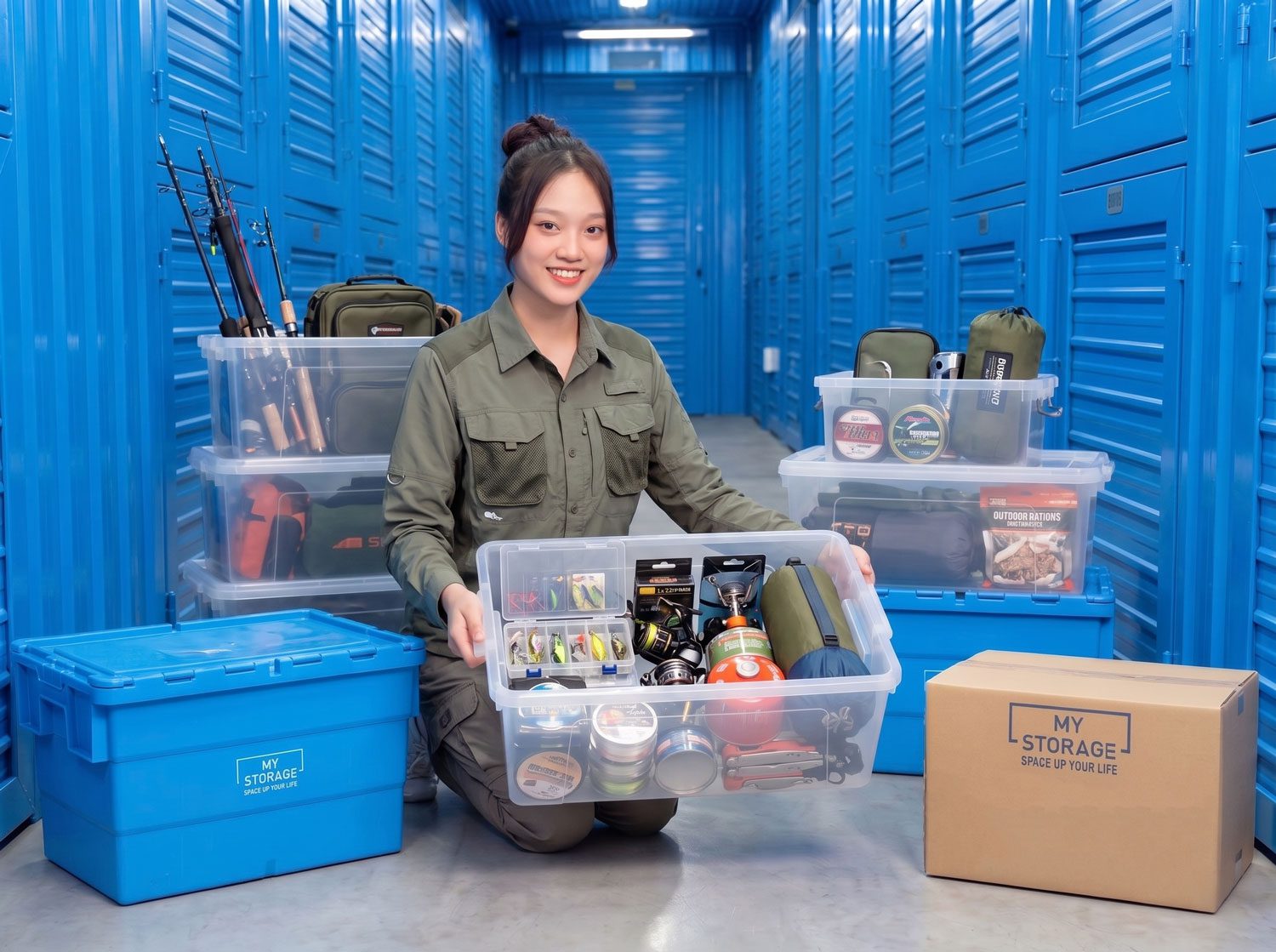
Fishing, camping, and outdoor sports equipment are often bulky and rarely used daily, yet they require proper preservation to prevent mold, warping, or damage. Renting a mini storage unit helps individuals and shops store equipment safely, freeing up living or retail space while ensuring easy access for every trip.
Why Does Outdoor Gear Always Take Up So Much Space?
Outdoor gear combines three characteristics that make home storage difficult: bulky sizes, irregular shapes that are hard to stack, and a low frequency of use compared to the space occupied. A full camping set can take up 2–4 m² of storage space but is only used a few times a year.
| Gear Type | Typical Size | Frequency of Use | Home Storage Issues |
|---|---|---|---|
| Camping tent | 50x30x20 cm bag, 2–4 m² unfolded | A few times per year | Difficult to refold properly; storage bag takes up large cabinet space |
| Folding chairs | 80x15x10 cm each when folded, usually 4–6 units | Weekends or per trip | No fixed spot; often leaned against walls or under beds |
| Folding table | 120x60x8 cm when folded, 5–8 kg | Weekends or per trip | Bulky and difficult to fit in standard cabinets |
| Cooler box | 50–80 liters, large dimensions | Summer and picnics | Occupies kitchen corners or balconies year-round despite rare use |
| Fishing rods | 1.5–3m long including the case | Weekends or seasonally | Hard to store due to length; often leaned against walls, creating clutter |
| Trekking backpack | 40–80 liters, 60–80 cm high | A few times per year | Takes up an entire shelf or sits in the middle of the floor |
| Bicycle | 1.7m x 0.6m x 1m, 8–15 kg | Weekly to a few times per year | Difficult to fit into apartments; often left in hallways or balconies |
| SUP and Kayak | 3–5m long, 70–90 cm wide | Seasonally, a few times per year | Almost impossible to store in a standard apartment |
| Climbing ropes and gear | 60–80m rope coils, many small accessories | Seasonally or weekends | Requires proper preservation; accessories easily get tangled or lost |
- Camping Tents: Tents are the most frustrating items to store because it is nearly impossible to refold them exactly as they were after the first use. Original storage bags often no longer fit after several uses, causing the tent to take up much more space than its initial size. Tents must be completely dry before storage to prevent mold a processing step many people skip after returning home from an exhausting trip.
- Folding Chairs and Tables: Individually, they aren’t large, but a full set for a group of 4–6 people, including chairs, tables, and accessories, can occupy 1–1.5 m² even when folded tightly. The ideal storage location is a warehouse or garage, but most apartment dwellers lack these spaces.
- Cooler Boxes: Cooler boxes are items that cannot be folded or shrunk; they occupy a fixed volume whether in use or not. When not in use, they are often shoved into kitchen corners, under stairs, or on balconies, creating an obstacle that the whole family gets used to but no one wants to deal with.
- SUP and Kayaks: This category of outdoor gear is almost impossible to store in a typical apartment due to dimensions that exceed most indoor spaces. Many SUP or kayak owners must store them at clubs, beaches, or with friends who have yards. Self-storage units with high ceilings and wide doors are the most practical solution for this equipment.
- Trekking Backpacks and Climbing Gear: Large trekking backpacks filled with accessories like sleeping bags, raincoats, and cooking utensils take up as much space as a large suitcase, but their irregular shapes make them difficult to stack in closets. Climbing gear such as ropes, carabiners, and safety equipment must be stored neatly according to safety standards and cannot be mixed with regular household items.
Which Outdoor Equipment Should Be Stored in a Warehouse?
High-value, bulky outdoor equipment used only seasonally or on weekends is perfectly suited for self-storage. Proper preservation in a humidity-controlled environment significantly extends the lifespan of the equipment compared to leaving it in a corner of the house or on a balcony.
Fishing Equipment
Fishing equipment combines many high-value items with different sizes and shapes, making it difficult to store together in a small home space without causing damage.
| Equipment | Typical Value | Storage Requirements | Risks of Improper Storage |
|---|---|---|---|
| Fishing rods | 500,000–10 million VND | Place horizontally or hang vertically; avoid pressure on the tip | Broken sections or warped rod blanks if pressed or leaned at the wrong angle |
| Fishing reels | 500,000–15 million VND | Dry environment; prevent moisture from entering the drivetrain | Gear oxidation, jammed mechanisms, or damaged bearings |
| Bait boxes and accessories | 200,000–3 million VND | Seal tightly to avoid moisture; categorize by bait type | Deformed artificial lures or rusted hooks |
| Bags and tackle boxes | 300,000–2 million VND | Clean and dry before storage; avoid fishy odor buildup | Unpleasant odors spreading to surrounding items in home storage |
Camping Equipment
Camping equipment is the category that occupies the most space in an outdoor kit because none of the items can be significantly miniaturized. Proper storage helps maintain functionality and extends the lifespan for future trips.
| Equipment | Most Important Storage Requirement | Consequences of Improper Storage |
|---|---|---|
| Tent | Dry completely before storing; do not leave moisture in the bag | Fabric mold, damaged waterproof coating, and permanent foul odors |
| Sleeping bag | Store unrolled or in a mesh bag; do not compress long-term | Down or synthetic fibers become permanently compressed, losing insulation capacity |
| Air mattress | Deflate and roll loosely; do not fold tightly along a fixed crease | Cracked valves or damaged waterproof coating at fixed fold points |
| Folding chairs and tables | Clean and dry before storage; prevent moisture in metal joints | Oxidation of joints and jammed folding mechanisms |
| Camping stove | Remove gas canisters and clean food residue before storage | Clogged burners, oxidized gas valves, and food residue attracting insects |
Trekking Equipment
Trekking equipment combines high-tech items like waterproof backpacks and specialized flashlights with consumables like batteries and shoelaces. Proper storage ensures high-tech gear maintains its performance for the next journey.
| Equipment | Storage Requirements | Space Occupied at Home |
|---|---|---|
| Trekking poles | Unlock and fully retract; wipe aluminum tubes dry before storage | 60–70 cm long when retracted; difficult to fit in standard cabinets |
| Trekking backpack | Remove frames if possible; hang or lay flat in a ventilated environment | 40–80 liters; occupies a large shelf even when folded |
| Flashlights and electronics | Remove batteries before long-term storage to prevent leakage | Small but needs to be stored with accessories to avoid loss |
| Trekking shoes | Clean soles, stuff with newspaper to maintain shape, keep in a ventilated area | Bulky; unpleasant odors if not stored correctly |
Outdoor Sports
The outdoor sports group includes the largest equipment of all outdoor gear, making it nearly impossible to store reasonably in a standard apartment without severely impacting living space.
| Equipment | Storage Dimensions | Special Requirements | Suitable Storage Solution |
|---|---|---|---|
| Bicycle | 1.7m x 0.6m x 1m | Periodically pump tires, cover to avoid dust, hang or stand upright | Units with ceilings 2.5m+ high, flat floors for stands or hooks |
| Paddle Board (SUP) | 3–3.5m long, 75–90 cm wide | Avoid direct sunlight to prevent board blistering; store horizontally or vertically | Units with at least 3.5m length; avoid outdoor storage |
| Kayak | 3–5m long, 60–80 cm wide | Avoid sunlight which makes plastic brittle; do not stack heavy objects on top | Large units or warehouses with specialized hanging racks |
| Skateboard | 80–120 cm, relatively compact | Avoid moisture which warps wooden boards; protect wheels from dust | Small units are sufficient; can be wall-mounted within the storage space |

Who Should Rent Outdoor Storage?
The demand for outdoor equipment storage comes not only from individual enthusiasts but also from equipment businesses, rental units, and tour operators. Each group has its own characteristics, yet they all face a common challenge: bulky gear that is used intermittently and is difficult to store at home or in small shops.
Individuals
Individual outdoor enthusiasts often own multiple sets of gear for various activities, with the total storage area far exceeding what a typical apartment can accommodate without compromising living space.
| Target Group | Common Equipment | Main Storage Issues | Suitable Storage Area |
|---|---|---|---|
| Campers | Tents, sleeping bags, camping stoves, folding tables and chairs, coolers | A full set occupies 2–4 m², with no dedicated storage in the apartment | 2–4 m² |
| Trekkers | Large backpacks, lightweight tents, poles, boots, lights, and accessories | 60–80L backpacks take up an entire closet shelf; small accessories are easily lost | 1–3 m² |
| Anglers | Multiple fishing rod sets, reels, tackle boxes, inflatable boats | Long rods are hard to store; expensive gear requires a well-maintained environment | 2–4 m² |
| Cyclists | Bicycles, accessories, pumps, repair tools | Bikes take up 1–1.5 m² of floor space, which is unsuitable for small apartments | 2–3 m² |
| SUP Enthusiasts | SUP boards or kayaks, paddles, life jackets, pumps | 3–3.5m long SUPs are nearly impossible to store in a standard apartment | 4–8 m² |
Businesses
Businesses in the outdoor sector have larger and more diverse storage needs than individuals, requiring clear zoning and frequent access to serve customers and manage operations.
| Target Group | Assets to Store | Operational Characteristics | Suitable Area |
|---|---|---|---|
| Outdoor Shops | Seasonal inventory, excess display equipment, bulk shipments | Need extra storage before peak summer and holiday seasons, downsizing afterward | 10–30 m² |
| Bicycle Dealers | Various types of bikes, spare parts, accessories, repair equipment | Bikes take up significant space; require high-ceiling storage for easy stacking and retrieval | 15–40 m² |
| Fishing Shops | Rods, reels, bait, inflatable boats, diverse accessories | High SKU count requires clear zoning; moisture-sensitive items need proper preservation | 5–20 m² |
| Equipment Rental Units | Tents, kayaks, SUPs, bikes, climbing gear for daily rental | High equipment turnover; requires cleaning and inspection after each rental before storage | 10–30 m² |
| Tour Operators | Group tents, communal stoves, large quantities of tables and chairs, safety gear | Gear is only used for tours; needs storage between trips for maintenance and periodic checks | 15–50 m² |
Different Benefits for Individuals and Businesses
| Criteria | Individuals | Businesses |
|---|---|---|
| Primary Goal | Free up living space, preserve equipment properly | Optimize storage costs, ensure equipment is ready for customers |
| Access Frequency | Weekends or before each trip | Frequently, daily or weekly |
| Preservation Requirements | Dry and secure environment | Standard environment with enough space to inspect and prepare gear |
| Area | 1–8 m² depending on the gear set | 5–50 m² depending on business scale |
| Rental Duration | Continuous long-term or seasonal | Usually long-term with adjustments for peak seasons |
Renting Mini Storage vs. Storing at Home?
Storing outdoor gear at home is suitable when quantities are small and items are compact. As your gear collection grows or begins to impact your living space, mini storage offers better preservation and completely frees up your apartment.
| Criteria | Storing at Home | Mini Storage |
|---|---|---|
| Living Space Savings | No, equipment occupies balconies and room corners | Yes, all outdoor gear is moved out of the apartment |
| Quality Preservation | Average, uncontrolled humidity and temperature | High, stable 50–65% RH humidity and 20–26°C temperature |
| Suitability for Bulky Items | No, SUPs and kayaks are nearly impossible to store at home | Yes, high ceilings and wide doors for large equipment |
| Security | General apartment security | 24/7 cameras, individual PIN locks for each unit |
| Scalability | No, limited by apartment size | Yes, increase area monthly as the gear set grows |
| Cost | No direct cost, but loses valuable living space | From 300,000–800,000 VND per month |
| Best Suited For | Fewer than 3 compact items, apartment has private storage | 3 or more items, bulky equipment, or living in an apartment without storage |

Case Study: Camping-Loving Family Reclaims 6m² of Apartment Space Thanks to Mini Storage
A family of four in Ho Chi Minh City, who frequently go camping and paddleboarding (SUP) on weekends, moved all their outdoor gear into a MyStorage mini storage unit, freeing up their balcony and bedroom and restoring them to their intended living functions.
Background
Living in a 62m² two-bedroom apartment, the family is passionate about the outdoors, camping 2–3 times a month and paddleboarding almost every weekend morning. Over time, they accumulated gear including two 4-person tents, six folding chairs, two folding tables, two 3.2m SUP boards with paddles, a 60-liter cooler, two 65L trekking backpacks, and various camping accessories.
The Problem Before Renting Storage
| Area | Status |
|---|---|
| Balcony | Two SUP boards occupied the entire space, leaving no room for drying clothes or relaxing |
| Second bedroom | Folding chairs, tables, and backpacks lined the walls, taking up 40% of the room’s area |
| Hallway | The cooler was permanently placed here as there was nowhere else for it |
| Total area occupied | Approximately 6m² in a 62m² apartment, equivalent to nearly 10% of the living space |
The Solution
Renting a 5m² storage unit or locker at MyStorage for approximately 900,000 VND per month. All outdoor equipment was moved into storage in a single afternoon. The SUP boards were stored vertically against the wall, camping gear was neatly organized on shelves by trip type, and cooking sets were boxed and clearly labeled.
Results After Renting Storage
| Area | Changes |
|---|---|
| Balcony | Fully reclaimed, now featuring a coffee table and chairs for morning relaxation |
| Second bedroom | Converted into a study room for the children, no longer cluttered with outdoor gear |
| Hallway | Clear and spacious, with no cooler blocking the path |
| Trip preparation | Faster, as equipment is clearly categorized in the unit, allowing the right items to be picked up in minutes |
| Preservation quality | Improved due to the climate-controlled environment; SUP boards no longer risk blistering from balcony sunlight |
A monthly cost of 900,000 VND resulted in 6m² of reclaimed living space and a truly functional balcony. Given average apartment rental prices in HCMC, that 6m² of space is worth between 1.5–3 million VND per month in terms of rental value. Mini storage is not an extra expense but an investment that creates living space value far exceeding its cost.
MyStorage – Storage Solutions for the Outdoor Community and Businesses
MyStorage provides flexible mini storage for both individuals who love the outdoors and businesses selling outdoor equipment. A clean, climate-controlled environment with 24/7 security ensures equipment is preserved to high standards, while flexible monthly sizing accommodates seasonal needs.
Reference Sizes and Costs
| Size | Suitable for | Reference capacity | Estimated cost |
|---|---|---|---|
| 1–2 m² | Individual trekkers, anglers | Large backpacks, fishing rods, tackle boxes, small accessories | 300,000–600,000 VND per month |
| 3–5 m² | Family campers, cyclists | Full camping set, 1–2 bicycles, cooler | 700,000–1,200,000 VND per month |
| 6–10 m² | SUP enthusiasts, small shops | 2 SUP boards, kayak, full camping set | 1,300,000–2,500,000 VND per month |
| 10–20 m² | Bicycle dealers, fishing shops | Seasonal inventory, rental equipment | 2,500,000–5,000,000 VND per month |
| 20 m² or more | Tour companies, equipment rentals | Large group equipment, group tents, multiple kayaks | Contact for a quote |
Preservation Standards Suitable for Outdoor Gear
| Standard | MyStorage meets | Benefits for outdoor gear |
|---|---|---|
| Humidity control | 50–65% RH maintained continuously | Prevents metal oxidation, mold on tent fabric and sleeping bags |
| Stable temperature | 20–26°C year-round | SUP boards and kayaks won’t blister; plastics won’t become brittle |
| Clean environment | Epoxy floors, regular pest control | No termites or pests attacking wood and fabric |
| Security | 24/7 cameras, individual PIN locks for each unit | High-value equipment is protected when you’re away |
| 24/7 Access | Personal PIN code, no appointment needed | Pick up gear early before a trip, return it late after coming back |
Suitable for Each User Group
| Group | Why MyStorage is suitable |
|---|---|
| Individual campers and trekkers | Reclaim balconies and bedrooms; properly preserve tents and sleeping bags in a controlled environment |
| Cyclists | Units have wide entrances and flat floors for easy bike access; no worries about moisture damage |
| SUP and kayak enthusiasts | Units are long enough to store boards vertically; environment avoids direct sunlight that damages board surfaces |
| Outdoor shops and dealers | Flexible storage to expand space before summer and downsize after the season, avoiding fixed warehouse investment |
| Tour companies and equipment rentals | Large areas, frequent access, and enough space to inspect and prepare gear between trips |
Good outdoor gear deserves proper preservation between trips. MyStorage helps you avoid having to choose between your outdoor passion and a comfortable living space.
FAQ
Do outdoor equipment require special storage conditions?
Yes. Most outdoor gear is sensitive to high humidity and sudden temperature changes. Humidity above 70% causes metal oxidation, tent fabric mould, and sleeping bag deterioration. Temperatures above 35°C can warp SUP boards and make kayak plastic brittle. Storage maintaining 50–65% RH and 20–26°C preserves all these items significantly better than balconies or home corners.
Can a 3-metre SUP board fit in a mini storage unit?
Yes, if the unit is at least 3.2–3.5m long with a wide enough entrance to bring the board in. Standing the board upright against the wall saves more floor space than laying it flat. Units with ceiling height of 2.5m or above allow comfortable vertical storage without risk of hitting the ceiling.
Can bicycles be stored in a self-storage unit?
Yes. A 2–3 m² unit fits 1–2 bicycles comfortably. Inflate tyres before storing, clean the chain and drivetrain to prevent oxidation, and place a protective mat under the wheels to keep the unit floor clean. Units with wide entrances and flat floors make wheeling bikes in and out straightforward.
What preparation does a tent need before going into storage?
Dry completely before folding and storing, including both inner and outer layers. Never store a damp tent in a sealed bag as mould develops within days. Fold loosely rather than compressing tightly to prevent the waterproof coating from cracking along fixed fold lines. Place silica gel in the stuff sack to absorb any remaining moisture.
Can down sleeping bags be stored in a storage unit?
Yes, if the unit stays dry and cool. The critical point is never storing a down sleeping bag tightly compressed for extended periods as the down clusters permanently flatten and lose insulating ability. Store in a large mesh bag or hang loosely in the unit rather than stuffed tightly in the original compression sack.
Should outdoor shops rent seasonal or long-term storage?
A combination is ideal. Maintain a base unit on a long-term lease for regular inventory and expand with additional monthly space before summer and Tết when demand peaks. This approach optimises storage costs to match actual business cycles without paying for unused space during low seasons.
Do climbing equipment like ropes and hardware require special storage conditions?
Yes. Climbing ropes must be kept away from UV light, chemicals, and high temperatures as these degrade fibre strength over time even when the rope looks fine externally. Coil loosely without tight bends and store in a breathable bag in a cool, dark unit to maintain the manufacturer’s safety rating.
How much storage space does a tour company typically need?
Usually 15–50 m² depending on group size and monthly tour frequency. More important than total area are a wide entrance for small truck unloading, flat flooring for moving heavy equipment, and sufficient ceiling height for long items like group tents and kayaks. 24/7 access is essential as tour departure schedules often begin very early in the morning.
Will plastic kayaks deteriorate in long-term storage?
No, if the unit has no direct sunlight and maintains stable temperatures below 30°C. UV light and high heat are the primary causes of plastic brittleness and colour fading over time. Avoid placing heavy objects on the hull and use racks or wall mounts rather than leaving the kayak in direct floor contact for extended periods.
What preparation is needed before storing outdoor gear at MyStorage?
List all equipment to be stored and estimate total volume to select the right unit size. Clean and dry all gear before bringing it in, especially fabric and metal items. Bring small shelving or hanging racks to maximise space within the unit and label every bag and box for quick retrieval before each trip.