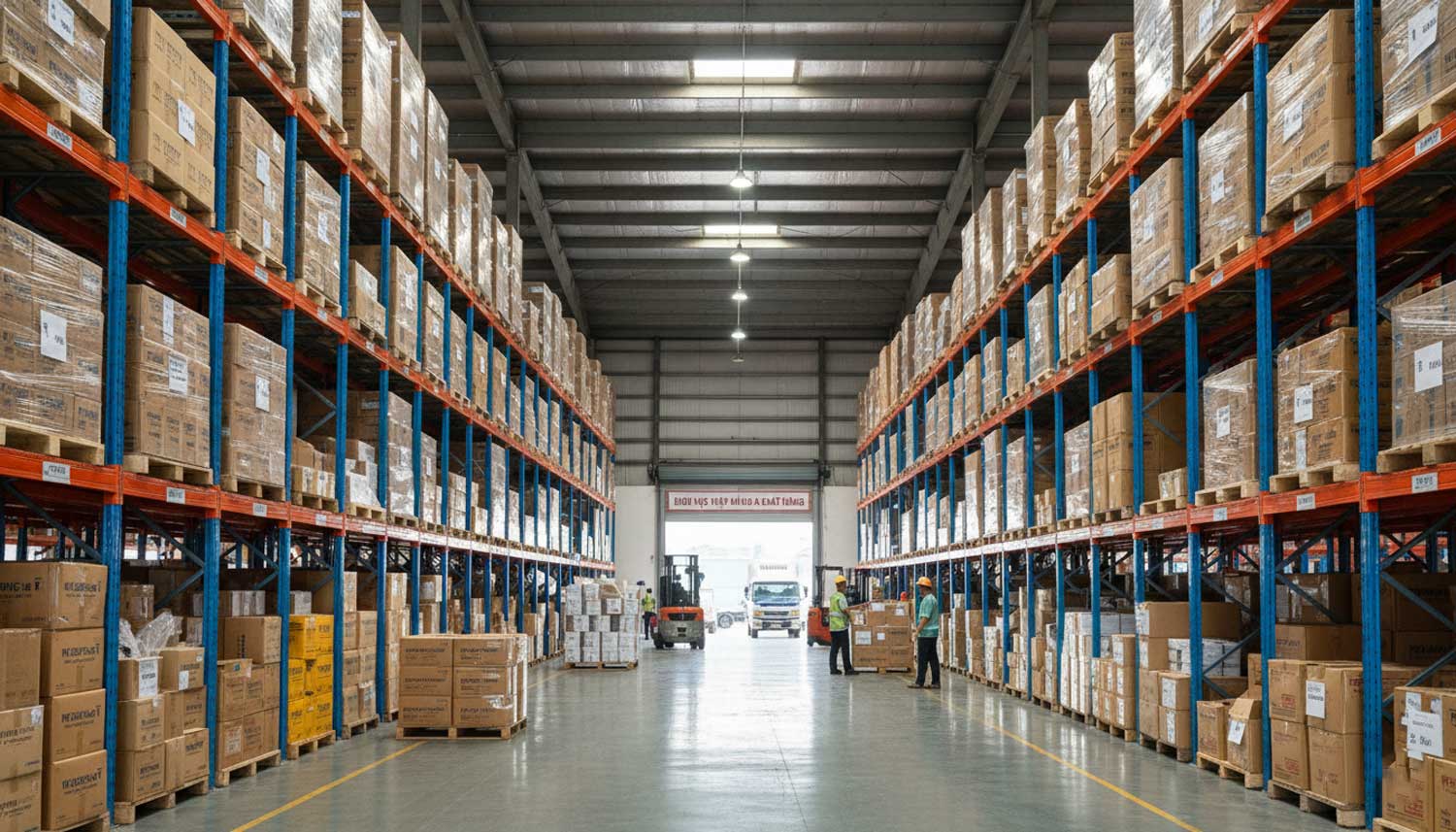
Ready-built warehouses are fully constructed facilities available for immediate lease, ideal for businesses needing to store goods or operate logistics without the initial investment in construction. Rental prices depend on area, location, amenities, and lease duration, typically suiting medium to long-term needs with more optimized costs compared to building your own warehouse.
What is a Ready-Built Warehouse?
A ready-built warehouse is a facility fully constructed by an investor or developer, ready for immediate use without the tenant needing to undertake construction or design for purposes such as goods storage, light manufacturing, or distribution. Unlike the build-to-suit model, ready-built warehouses are developed in advance based on common design standards, then leased or sold to businesses with suitable needs.
This model is experiencing rapid growth in Vietnam, driven by the FDI wave and the demand for modernizing logistics. The occupancy rate for Grade A ready-built warehouses in key Southern provinces reached 88–93% in Q1 2024 (CBRE Vietnam), reflecting demand that currently outstrips supply.
Key Characteristics of Ready-Built Warehouses
A ready-built warehouse is a pre-constructed facility with a complete structure, ready for immediate use for storage, manufacturing, or goods distribution.
Not every available warehouse is a “ready-built warehouse” in the true sense. A standard ready-built warehouse typically possesses the following characteristics:
- Complete pre-engineered steel or reinforced concrete structure, with a clear height of 9–12 m, sufficient for multi-level stacking using reach stackers and installing automated racking systems. This height is one of the criteria for classifying warehouses as Grade A (over 10 m), Grade B (7–10 m), and Grade C (under 7 m) according to JLL standards.
- High-load bearing concrete floor, typically 5–10 tons/m², laser-screed flattened to achieve FM2 flatness or higher – a mandatory condition for safe forklift operation and precise automated racking system functionality.
- Integrated warehouse fire protection and fighting (FPF) system including automatic sprinklers, fire hydrants, emergency lights, and exit signs, already approved by the Fire Police before handover. Tenants do not have to invest in this system themselves, which is one of the biggest advantages in terms of initial cost compared to self-building.
- Dock levelers and loading doors designed for large trucks, typically 4–8 loading dock doors per 10,000 m² of warehouse floor, with hydraulic dock levelers allowing trucks of various sizes to dock closely and unload goods directly into the warehouse without an intermediate ramp.
- Complete auxiliary infrastructure: 3-phase electricity, water, internet, LED lighting system, security cameras, and tractor-trailer parking – all ready when the business takes over the premises.
Comparison: Ready-Built Warehouse vs. Self-Built Warehouse vs. Mini Warehouse
These three models serve entirely different sets of needs; understanding the distinctions helps businesses avoid costly wrong choices.
| Criteria | Ready-Built Warehouse | Self-Built Warehouse | Mini Warehouse |
|---|---|---|---|
| Availability Time | Immediate | 12–24 months for construction | Immediate |
| Initial Investment Capital | Low (rental payments) | Very high (ownership) | Very low |
| Area | 1,000–100,000 m² | Customizable | 1–50 m² |
| Customization Level | Limited | Full control | None |
| Commitment Period | 3–10 years | Permanent (ownership) | Monthly |
| Suitable For | Large-scale manufacturing, logistics, distribution | Businesses seeking long-term asset ownership | Personal storage, small SMEs |
| Operating Costs | Shared infrastructure with investor | Entirely borne by the business | Minimal |
| Land Legal Risks | Borne by the investor | Borne by the business | Borne by the warehouse owner |
Ready-built warehouses are the optimal choice when a business requires large, high-quality technical space, does not want to tie up capital in real estate, and needs to commence operations quickly.
This model is particularly suitable for FDI businesses, logistics companies, and international distributors expanding in Vietnam – entities that need warehouses meeting international standards but lack the time and resources for self-development.
Self-built warehouses are suitable when a business has specific requirements that cannot be met by standard warehouses, such as integrated production lines, clean rooms, deep-freeze storage, or specialized automation systems.
The investment cost is much higher, but the asset is owned by the business, creating long-term asset value. The biggest challenges in Vietnam are complex land legal procedures and extended implementation times (18–36 months).
Mini warehouses serve an entirely different purpose: individuals, household businesses, and SMEs with small, flexible storage needs. They are not a substitute for ready-built warehouses but rather a complementary solution for different requirements.
In Vietnam in 2024, the rental price for Grade A ready-built warehouses ranges from 4.5–6.5 USD/m²/month in the South (Binh Duong, Long An) and 4.0–5.5 USD/m²/month in the North (Hanoi, Hung Yen, Hai Phong) — an increase of 10–15% compared to 2022 due to demand exceeding supply (Savills Vietnam, 2024).
Which Businesses Are Ready-Built Warehouses Suitable For?
Not every business needs or qualifies for a Grade A ready-built warehouse. This model is best suited for:
- Manufacturing and export processing businesses requiring large spaces, high load-bearing floors, and convenient logistics connections to seaports or airports. Requirements for FPF, high-capacity 3-phase electricity, and internal roads for container trucks are conditions that self-developed or older warehouses often cannot meet.
- Logistics and distribution businesses needing multiple loading docks, spacious truck yards, and locations near major transport arteries. Ready-built warehouses in planned industrial parks typically meet all these requirements in one package.
- New FDI businesses entering the Vietnamese market that need to start operations quickly without going through complex construction permit processes. Ready-built warehouses allow contract signing and handover within 30–60 days, instead of 18–24 months for self-construction.
- Large-scale e-commerce businesses operating fulfillment centers that require areas of 5,000–50,000 m², FPF systems meeting international insurance standards, and the ability to install conveyor systems and automated racking without needing structural renovation permits.

Why Should Businesses Rent Ready-Built Warehouses?
Renting ready-built warehouses helps businesses save initial investment costs, achieve quick deployment, and flexibly scale up when needed, rather than tying up capital in real estate while market conditions and demand are still evolving. This is not just a financial advantage but also a strategic one: businesses maintain the flexibility to react quickly to market opportunities instead of being constrained by fixed assets.
In Vietnam, the trend of renting ready-built warehouses is accelerating rapidly, with occupancy rates for Grade A warehouses in key provinces reaching 88–93% in Q1 2024 (CBRE Vietnam). Meanwhile, the average absorption time for a new warehouse entering the market has shortened from 12 months (2019) to 3–5 months (2025), a clear signal that demand is far outstripping supply.
No Construction Investment Needed — Capital Stays in the Business
Building a Grade A industrial warehouse in Vietnam costs between 400–800 USD/m² for construction alone, not including land purchase or lease costs, site leveling, technical infrastructure systems (electricity, water, internal roads), and legal procedures. For a 10,000 m² warehouse, the total investment could reach 5–8 million USD – a capital sum that most small and medium-sized enterprises (SMEs) do not possess, and even for large corporations, it represents a significant capital tie-up.
Renting a ready-built warehouse converts this entire fixed investment into variable operating costs, paying monthly rent based on actual space used, without the burden of asset depreciation, worries about real estate market risks, or the need to manage property assets.
Where can the money saved from not building be reinvested?
- For manufacturing businesses: Purchase additional machinery and equipment, expand production lines, or invest in R&D.
- For commercial businesses: Open new distribution channels, increase inventory, or boost marketing efforts.
This is precisely why most multinational corporations in Vietnam, even large names with ample capital to build their own, choose to rent ready-built warehouses: capital generates the best returns when invested in core business operations, not in real estate.
Actual Cost Comparison: Renting a Grade A ready-built warehouse in Binh Duong at 5 USD/m²/month for an area of 10,000 m² = 50,000 USD/month = 600,000 USD/year. The cost of building an equivalent warehouse: 5–8 million USD in initial capital. A business would need 8–13 years of rent to equal the self-build cost, and within those 8–13 years, the market, technology, and business needs could change entirely.
Quick Deployment — From Decision to Operation in 30–60 Days
Building a warehouse independently in Vietnam is a lengthy journey: obtaining investment policy approval, planning approval, site clearance, construction permits, construction, fire safety acceptance, environmental registration. The total actual time ranges from 18 to 36 months, or even longer if there are legal issues or land disputes.
In today’s competitive market, 18–36 months is enough time to lose a major contract, miss a business season, or allow competitors to gain market share.
Renting a ready-built warehouse shortens this entire process to just 30–60 days, from the contract signing date to the handover of the premises and the start of goods storage. The actual process involves only 4 steps:
- Step 1 — Survey and Negotiation (1–2 weeks): View the actual warehouse, negotiate area, rent price, contract duration, and specific terms such as the right to install equipment and designate usage zones.
- Step 2 — Contract Signing and Deposit (3–5 working days): Ready-built warehouse lease agreements are standardized by the developer — often much shorter and clearer than real estate purchase agreements.
- Step 3 — Premises Handover (immediately after signing): With a vacant and ready warehouse, actual handover takes 1–2 days after completing procedures.
- Step 4 — Interior and Equipment Installation (2–4 weeks): Racking systems, in-warehouse offices, goods zoning — this part depends on the complexity of the business’s operational setup.
Deployment speed is particularly crucial for three groups: FDI businesses newly entering the market with production commitments to partners; logistics companies expanding their warehouse networks before peak seasons; and e-commerce businesses needing to increase fulfillment capacity before major sales events (11/11, Lunar New Year).
Real-world scenario: A fast-moving consumer goods (FMCG) distributor secured an exclusive distribution contract for a new brand in the Southern market, requiring a warehouse ready for operation within 45 days. Self-building was impossible. Renting a ready-built warehouse was the only viable solution and is also why many large contracts can only be executed by businesses that are already prepared with warehouse infrastructure.

Flexible Expansion — Increase Space When Needed, Downsize When Markets Shift
Business doesn’t follow a straight line, and neither do warehouse needs. Companies that build their own fixed-size warehouses are betting that their demands won’t change significantly over the next 20–30 years – an assumption that is increasingly difficult to uphold in today’s dynamic business environment.
Leasing ready-built warehouses offers three levels of flexibility that self-building cannot:
- On-site Space Flexibility: Many developers allow tenants to expand into adjacent warehouse units when needed, often prioritizing existing tenants before offering to the wider market. Businesses can increase their footprint from 5,000 m² to 10,000 m² without relocating or disrupting operations.
- Term Flexibility: Ready-built warehouse leases typically feature flexible negotiation points, such as a 3-year contract with 2+2 year renewal options, or a 5-year contract with a paid exit clause. This enables businesses to plan for the mid-term without being permanently tied down.
- Location Flexibility: As markets evolve – distribution centers shift, customers relocate, or new infrastructure creates opportunities – businesses leasing warehouses can change locations after their contract expires. Companies that build their own warehouses are bound to a single location, which may become suboptimal after 10–15 years.
Flexibility is especially crucial in the current climate: Global supply chains are continuously restructuring in the wake of COVID-19, trade tensions, and the shift in manufacturing driven by the China+1 strategy. Businesses that maintain infrastructure flexibility will adapt faster, providing a competitive advantage that cannot be quantified by mere cost figures.
| Criteria | Self-built Warehouse | Ready-built Warehouse Lease |
|---|---|---|
| Initial Investment Capital | 5–8 million USD (for 10,000 m² warehouse) | None (monthly rent) |
| Deployment Time | 18–36 months | 30–60 days |
| Scalability | Requires additional construction (time, capital intensive) | Lease additional adjacent space |
| Location Flexibility | No — permanently tied | Yes — after contract expiry |
| Real Estate Market Risk | High — borne by the business | Low — borne by the developer |
| Suitable for | Businesses seeking long-term asset ownership, high specific requirements | Most businesses needing high-quality, quick-to-deploy warehouses |
Popular Types of Ready-Built Warehouses
Ready-built warehouses are not a homogeneous product; the market offers various types with different designs, technical standards, and price points depending on their intended use: standard warehouses, cold storage, industrial warehouses, and integrated logistics warehouses.
Choosing the right type of warehouse from the outset helps businesses avoid costly renovations later and, more importantly, mitigates the risk of leasing a warehouse that fails to meet actual operational requirements.

Standard Warehouse
Standard warehouses are the most common type in the ready-built warehouse category, designed for storing and distributing a wide variety of goods that do not require special storage conditions. This is a suitable choice for most commercial, retail, and consumer goods distribution businesses.
Typical specifications: Clear height of 9–12 m, floor load capacity of 5–7 tons/m², automatic LED lighting system, 4–8 loading dock doors per 10,000 m² of floor space, standard fire protection sprinkler system, and internal aisles wide enough for reach stacker forklifts to operate simultaneously.
Suitable for: FMCG distribution, storage of consumer electronics, apparel, household goods, and containerized import/export goods. Large-scale e-commerce businesses operating fulfillment centers also fall into this segment, requiring large areas, precisely flat floors for automated racking systems, and numerous loading/unloading doors.
Reference warehouse rental prices in Vietnam: Class A standard warehouses are priced at 4.5–6.0 USD/m²/month in the South (Binh Duong, Long An) and 4.0–5.5 USD/m²/month in the North (Hanoi, Hung Yen) according to Savills Vietnam Q2 2024. Class B warehouses in the same areas are 20–30% lower.
Note when renting a standard warehouse: Carefully check the classification standards, as many warehouses claim to be “Class A” but only have a clear height of 7–8 m, which is insufficient for 4–5 tier racking systems and VNA (Very Narrow Aisle) forklifts. JLL/CBRE classification standards stipulate that Class A warehouses must have a minimum clear height of 10 m.
Cold Storage
Cold storage facilities are the type of ready-built warehouse with the highest investment cost and most stringent technical requirements, but for businesses dealing with temperature-sensitive goods, there is no alternative.
Ready-built cold storage in Vietnam is typically divided into three temperature segments with completely different structural designs:
- Frozen Storage: Maintains -18°C to -25°C for frozen seafood, meat, ice cream, and processed foods. The structure requires a 150–200 mm thick polyurethane (PU) insulation layer, floor heating to prevent foundation freezing, and a mandatory backup refrigeration system, as a 2–4 hour power outage in a frozen warehouse can destroy an entire batch of goods.
- Chilled Storage: Maintains 0°C to 8°C for fresh vegetables, fruits, milk, common pharmaceuticals, and vaccines. Power consumption is lower than frozen storage, but it requires continuous temperature monitoring and automatic logging, which are mandatory conditions under GDP (Good Distribution Practice) standards for pharmaceuticals.
- Controlled Atmosphere Storage: Maintains 15°C to 25°C with strict humidity control for high-end pharmaceuticals, cosmetics, wine, and some special agricultural products.
Reference rental prices: Ready-built cold storage in Vietnam is currently leasing at 7–15 USD/m²/month, 2–3 times higher than standard warehouses, reflecting the cost of refrigeration equipment investment, operational electricity costs, and specialized maintenance requirements. The supply of international-standard ready-built cold storage in Vietnam is still very limited, mainly concentrated in Ho Chi Minh City, Hanoi, and key seafood export provinces.
Suitable for: Supermarket and food retail chains (AEON, Lotte, Co.opmart), seafood and agricultural export businesses, pharmaceutical and vaccine distributors, and large-scale restaurant and catering chains.
Important question when renting cold storage: “In the past 12 months, have there been any power outages or refrigeration equipment failures? What was the maximum temperature reached in the warehouse, and how long did it take to recover?” — this question distinguishes seriously operated warehouses from those that only meet standards on paper.
Industrial Warehouse
Ready-built industrial warehouses are designed for activities beyond pure storage, combining light manufacturing, assembly, processing, or packaging space with a warehousing area. This type of warehouse is most favored by FDI manufacturing enterprises in their initial phase of market entry into Vietnam.
Key technical differences compared to standard warehouses:
- Significantly higher floor load capacity, ranging from 8–15 tons/m², to withstand production machinery, processing equipment, and heavy semi-finished goods.
- High-capacity 3-phase electrical systems (often from 500 kVA to several MVA) are pre-designed to connect industrial machinery without needing electrical infrastructure upgrades.
- Overhead cranes or crane runways are integrated into the roof structure and cannot be added to an already built standard warehouse.
- Stronger industrial ventilation systems to handle heat and exhaust gases from the production process.
“Ready-built factory” model — a growing trend in Vietnam: Some developers like BW Industrial, KTG Industrial, and SLP Vietnam are developing ready-built factory models, a premium variant of industrial warehouses with full production standards, allowing FDI businesses to start production just 30–60 days after signing a contract. This is a direct solution for the “want to enter Vietnam quickly but don’t want to build a factory” need that many Japanese, Korean, and Taiwanese corporations currently have.
Reference rental prices: 5.0–8.0 USD/m²/month depending on technical standards and location. Industrial warehouses near ports or in industrial parks with high technical infrastructure have rental prices 15–25% higher than in regular areas.
Suitable for: Electronics manufacturing, components, apparel, footwear, processed foods, and any industry requiring a combination of production and storage in the same facility.
Integrated Logistics Warehouse
Integrated logistics warehouses are the most complex and expensive type in the ready-built warehouse category, designed not just for storage but to serve as a central hub for coordinating the entire flow of goods for a region or a supply chain.
Design characteristics:
- Cross-docking capability: Goods enter from one side, are sorted, and immediately dispatched from the opposite side, minimizing the time goods spend in storage and maximizing turnover speed. This requires a special layout design with multiple loading/unloading doors on both sides of the building.
- Automated conveyor & sortation system: Integrated into the structural design and cannot be added to a conventional warehouse without modifying the foundation and structure. This type of warehouse is used by Amazon, DHL, Lazada, and Shopee Express as distribution hubs.
- Large area and strategic location: Integrated logistics warehouses typically range from 20,000–200,000 m², located at major transportation intersections or near container ports to optimize multimodal transportation costs.
- Integrated WMS (Warehouse Management System): Warehouse management software integrated with conveyor systems, automatic scanners, and carrier portals — allowing real-time tracking of each package from inbound to delivery to the recipient.
Reference rental prices: 6.0–10.0 USD/m²/month and higher depending on configuration. While the cost is high, the operational cost per order is often significantly lower than conventional warehouses due to automation.
Suitable for: Logistics and express delivery companies (sorting and distribution hubs), e-commerce platforms (national fulfillment hubs), large-scale omnichannel distributors, and multinational corporations seeking to control their entire supply chain from a central point.
Summary Table of 4 Types of Ready-Built Warehouses
| Criteria | Standard Warehouse | Cold Storage | Industrial Warehouse | Integrated Logistics Warehouse |
|---|---|---|---|---|
| Clear Height | 9–12 m | 8–12 m | 8–15 m | 10–15 m |
| Floor Load Capacity | 5–7 tons/m² | 5–8 tons/m² | 8–15 tons/m² | 5–8 tons/m² |
| Specific Conditions | Standard | Temperature controlled | High-capacity 3-phase power | Cross-dock, WMS, conveyor belts |
| Minimum Area | 1,000 m² | 500 m² | 2,000 m² | 20,000 m² |
| Rental Price (USD/m²/month) | 4.0–6.0 | 7.0–15.0 | 5.0–8.0 | 6.0–10.0+ |
| Availability | Immediate | Immediate | Immediate | By agreement |
| Best Suited For | Trade, FMCG, E-commerce | F&B, pharmaceuticals, agricultural products | FDI manufacturing, processing | Large-scale logistics, E-commerce |
Choosing the right type of warehouse is not just a cost decision but also a decision about operational capability. A warehouse with insufficient load capacity, inadequate clear height, or unsuitable temperature standards will limit what a business can do inside, no matter how attractive the rental agreement might seem.
How Much Does It Cost to Rent a Ready-Built Warehouse?
The rental price for ready-built warehouses in Vietnam depends on three main factors: warehouse class (A, B, C), geographical location, and warehouse type (standard, cold, industrial). Across the market, prices range from 3.0–15.0 USD/m²/month, a wide disparity reflecting significant differences between Class A warehouses near ports and Class B warehouses in tier-2 provinces. Rental prices for Class A ready-built warehouses in Vietnam have increased by 10–15% compared to 2022 due to demand outstripping supply in key areas (Savills Vietnam, Q2 2024).
The real question isn’t just “how much?” but “what is the actual total cost?” because the listed rental price and the actual cost after adding all auxiliary charges often differ by 20–35%.
Rental Prices by Region — 2024 Reference Table
The ready-built warehouse market in Vietnam is clearly segmented by region. Provinces near major seaports, key expressways, and FDI-concentrated areas always have prices 20–40% higher than tier-2 provinces, but compensate with shorter transportation times and better access to a plentiful labor force.
Southern Region:
| Province/City | Class A Warehouse (USD/m²/month) | Class B Warehouse (USD/m²/month) |
|---|---|---|
| Ho Chi Minh City (outskirts) | 5.5–7.0 | 3.5–5.0 |
| Binh Duong | 4.5–6.0 | 3.0–4.5 |
| Long An | 4.0–5.5 | 2.8–4.0 |
| Dong Nai | 4.0–5.5 | 3.0–4.2 |
| Ba Ria – Vung Tau | 4.0–5.5 | 2.8–4.0 |
Northern Region:
| Province/City | Class A Warehouse (USD/m²/month) | Class B Warehouse (USD/m²/month) |
|---|---|---|
| Hanoi (outskirts) | 5.0–6.5 | 3.5–4.8 |
| Hung Yen | 4.0–5.5 | 3.0–4.2 |
| Bac Ninh | 4.2–5.5 | 3.2–4.5 |
| Hai Phong | 4.0–5.2 | 2.8–4.0 |
| Bac Giang | 3.5–4.8 | 2.5–3.5 |
Central Region:
| Province/City | Class A Warehouse (USD/m²/month) | Class B Warehouse (USD/m²/month) |
|---|---|---|
| Da Nang | 3.5–5.0 | 2.5–3.8 |
| Quang Nam, Quang Ngai | 3.0–4.2 | 2.2–3.2 |
Compiled sources: CBRE Vietnam Q1 2024, Savills Vietnam Q2 2024, JLL Industrial Outlook 2024.
Note on reading the table: The prices above are for pure warehouse floor rent (base rent) and do not include service fees, electricity, insurance, and other auxiliary charges. Actual costs are higher; see the hidden fees section below.
Rental Prices by Warehouse Type — Significant Differences
Besides location, warehouse type is the second strongest factor influencing rental prices. Cold storage and integrated logistics warehouses have significantly higher operating costs, leading to correspondingly higher rental prices.
| Warehouse Type | Rental Price (USD/m²/month) | Reason for Difference |
|---|---|---|
| Class A Standard Warehouse | 4.0–6.5 | Market baseline |
| Class B Standard Warehouse | 2.5–4.5 | Lower technical standards |
| Industrial Warehouse (ready-built factory) | 5.0–8.0 | High-capacity 3-phase power, high floor load |
| Cold Storage (chilled, 0–8°C) | 7.0–12.0 | Cost of refrigeration equipment + operating electricity |
| Freezer Storage (-18°C to -25°C) | 10.0–15.0 | Cost of equipment + electricity + special maintenance |
| Integrated Logistics Warehouse | 6.0–10.0+ | Automation systems, WMS, cross-dock |
Hidden Fees to Clarify Before Signing a Contract
This is the most crucial part that most businesses discover after signing and often cannot renegotiate. The listed rental price is just the tip of the iceberg; the actual total monthly cost includes:
- Management / Service Charge: Typically 0.5–1.5 USD/m²/month added to the base rent, covering common area cleaning, infrastructure maintenance, gate security, and common area lighting. Some developers include it in an all-in price, while others charge separately – clarify this from the outset.
- Electricity Costs: Industrial warehouses consume significant electricity, and electricity costs can account for 15–30% of the total warehouse rental cost. Clarify: Is electricity calculated by individual meter or shared by area? Is the applicable electricity price for production or commercial use? Who bears the cost of upgrades if increased capacity is needed?
- Cargo and Property Insurance Fees: Some contracts require the tenant to purchase property insurance for all interior fittings and equipment installed in the warehouse; this cost is usually 0.1–0.3% of the asset value per year.
- Security Deposit: Commonly 2–3 months’ rent paid upfront upon handover – this is tied-up capital that doesn’t generate returns throughout the lease term. For a 10,000 m² warehouse at 5 USD/m²/month, a 3-month deposit is 150,000 USD, enough to purchase an additional batch of production equipment.
- Annual Price Adjustment Fee: Most long-term warehouse lease agreements include a clause for a 3–8% annual increase or an increase based on CPI. For a 5-year contract, the total increase can be up to 15–40% compared to the initial price, which needs to be factored into long-term financial planning from the start.
- Renovation and Handover Costs: If a business installs shelving systems, offices within the warehouse, or conveyor belts, the contract often stipulates that the premises must be returned to their original condition at the end of the lease. Dismantling and restoration costs can range from 50,000–200,000 USD for large-scale warehouses.
Can Warehouse Rental Prices Be Negotiated?
The short answer: yes, but not everything is equally negotiable.
Easiest to negotiate:
- Rent-free period: Developers are often willing to offer 1–3 months of rent-free period when signing long-term contracts (5 years or more) to offset the tenant’s initial equipment installation costs. This is usually the easiest concession to achieve as it doesn’t affect the listed rental price on the contract.
- Tenant improvement allowance: The developer contributes a portion of the cost for installing shelving systems, offices, or renovations requested by the tenant, in exchange for a longer contract or a slightly higher rental price.
- Break clause: In the current market, large tenants (over 10,000 m²) can negotiate a clause allowing them to terminate the contract after the third year with a reasonable penalty fee, rather than being fully bound until the end of a 5-year contract.
Harder to negotiate:
The base rental price in markets with an occupancy rate above 90% is very difficult to reduce; developers know that if you don’t rent, the next tenant is already waiting. Annual price increases and service fees are often fixed terms in the contract templates of major developers.
Instead of negotiating for a lower rental price – which is the hardest to achieve – focus on negotiating the rent-free period, tenant improvement contributions, and break clauses. These three combined can save the equivalent of 6–12 months’ rent over a 5-year contract lifecycle, a value far greater than a 5–10% reduction in monthly rent.
FAQ
What is a ready-built warehouse and how does it differ from self-built?
A ready-built warehouse is a fully constructed facility developed by an investor or developer to standard specifications, available for immediate lease or purchase without the tenant needing to design or build. The core difference from self-built: businesses avoid construction capital costs (USD 400–800/m²), skip the 18–36 month approval and construction process, and bear no land legal risk. Self-built suits businesses with highly specific requirements wanting long-term asset ownership; ready-built suits those needing rapid deployment while maintaining financial flexibility.
Do businesses need significant upfront capital to rent a ready-built warehouse?
When renting a ready-built warehouse, businesses require no construction capital — all infrastructure costs (steel structure, fire suppression, three-phase power, loading docks, truck yards) are borne by the developer. The only initial payments required are a security deposit of 2–3 months’ rent and the cost of installing internal fittings, racking systems, and operational equipment. For a 10,000 m² warehouse at USD 5/m²/month, total upfront costs are approximately USD 150,000–200,000 — many times lower than self-building an equivalent facility (USD 5–8 million). The capital saved can be reinvested in machinery, inventory, or business expansion.
How quickly can a business start using a ready-built warehouse after signing the contract?
Businesses can begin moving goods into a ready-built warehouse within just 30–60 days of signing the rental contract — comprising 1–2 weeks of negotiation and contract signing, 3–5 days for handover procedures, and 2–4 weeks for installing racking systems, partitioning storage zones, and setting up internal operations. Compared to self-building, which requires 18–36 months (permits, construction, inspections), ready-built warehouses reduce deployment time by up to 95% — a decisive advantage for FDI businesses entering the market or logistics operators urgently expanding before peak season.
What hidden fees are commonly encountered when renting a ready-built warehouse?
The six most common hidden fees when renting a ready-built warehouse: (1) Service charges of USD 0.5–1.5/m²/month for maintenance, security, and common area cleaning; (2) Electricity billed via separate meters — can represent 15–30% of total costs for industrial warehouses; (3) Annual rent escalation of 3–8% or indexed to CPI; (4) Reinstatement costs at lease end — dismantling racking, internal offices can cost USD 50,000–200,000; (5) Property insurance at 0.1–0.3% of asset value per year; (6) After-hours access fees for night shifts or weekend operations. Always request a fully itemized all-in written quotation before negotiating.
What is the current rental price for Grade-A ready-built warehouses in Vietnam?
Grade-A ready-built warehouse rental rates in Vietnam in 2024 range from USD 4.0–6.5/m²/month depending on location: southern provinces (Binh Duong, Long An) at USD 4.5–6.0; Hanoi and surrounding areas at USD 5.0–6.5; Hung Yen and Hai Phong from USD 4.0–5.5. Grade-B warehouses are 20–30% lower than Grade-A in the same area. Rents have increased 10–15% since 2022 as demand outpaces supply — Grade-A occupancy rates in key provinces reached 88–93% in Q1 2024 (CBRE Vietnam, Savills Vietnam 2024). Note: listed prices exclude service charges (USD 0.5–1.5/m²/month), electricity, and other ancillary costs.
Is it possible to negotiate the rent on a ready-built warehouse?
Negotiation is possible, but not all terms are equally flexible. Easiest to negotiate: (1) Rent-free periods of 1–3 months when signing long-term leases of 5 years or more; (2) Tenant improvement allowances — the developer shares fit-out costs (racking, internal offices) in exchange for a longer commitment; (3) Break clauses after year 3 with reasonable penalty terms. Harder to negotiate: Base rental rates in markets with over 90% occupancy, and service charges fixed in major developers’ standard contract templates. The three negotiable items combined can generate savings equivalent to 6–12 months of rent over a 5-year lease lifecycle.
How does a ready-built factory differ from a standard warehouse?
A ready-built factory is designed for combined manufacturing and storage operations — differing from standard warehouses in four key technical aspects: (1) Higher floor load capacity — 8–15 tons/m² versus 5–7 tons/m² for standard warehouses, capable of supporting heavy production machinery; (2) High-capacity three-phase power from 500 kVA to several MVA to connect production lines without infrastructure upgrades; (3) Integrated overhead cranes built into the roof structure — impossible to retrofit into an existing standard warehouse; (4) Industrial-grade ventilation to handle heat and production emissions. Rental rates are 20–40% higher than standard warehouses: USD 5.0–8.0/m²/month.
How much does ready-built cold storage cost in Vietnam and which industries does it suit?
Ready-built cold storage in Vietnam currently rents at USD 7.0–15.0/m²/month — 2–3 times higher than standard warehouses — depending on temperature segment: chilled (0–8°C) from USD 7–10; frozen (-18°C to -25°C) from USD 10–15. Supply of internationally certified cold storage in Vietnam remains limited, concentrated in Ho Chi Minh City, Hanoi, and seafood-exporting provinces. Best suited for: supermarket and food retail chains (AEON, Lotte, Co.opmart), seafood and agricultural exporters, pharmaceutical distributors (GDP compliance required), and large-scale F&B and restaurant chains. Before signing, always ask about the history of equipment failures and power-loss recovery time — a more reliable indicator than any specification in a brochure.
What technical standards distinguish Grade-A from Grade-B ready-built warehouses in Vietnam?
According to JLL and CBRE classification standards applied in the Vietnamese market, Grade-A warehouses must meet: clear height of at least 10 m (Grade-B: 7–10 m); floor load capacity ≥ 5 tons/m² with FM2 flatness achieved by laser screed technology; ≥ 4 loading docks per 10,000 m² with hydraulic dock levelers; ESFR sprinkler systems (Early Suppression Fast Response) — the highest fire suppression standard for warehousing; truck yards wide enough for 40-foot container semi-trailers to turn around; and automatic LED lighting at ≥ 100 lux. Warehouses claiming “Grade-A” status with only 7–8 m clear height cannot accommodate VNA forklifts or 4–5-tier racking — always ask for the specific technical specifications, not just the classification label.
What trends are shaping the ready-built warehouse market in Vietnam through 2030?
Four major trends are reshaping Vietnam’s ready-built warehouse market through 2030: (1) Green warehousing — LEED/EDGE requirements from FDI tenants increasing rapidly; green warehouses currently represent 8% of total supply and are projected to reach 25% by 2030; (2) Ready-built factory boom — the China+1 strategy is driving demand for ready-built manufacturing facilities, particularly from Japanese, Korean, and Taiwanese companies; (3) Warehouse automation — WMS systems, AS/RS automated racking, and robot picking are increasingly integrated into new warehouse designs; (4) Geographic decentralization — demand is shifting from Tier-1 provinces (Binh Duong, Hung Yen) to Tier-2 (Bac Giang, Long An, Vinh Phuc) as land availability and rental rates in Tier-1 areas continue to rise.