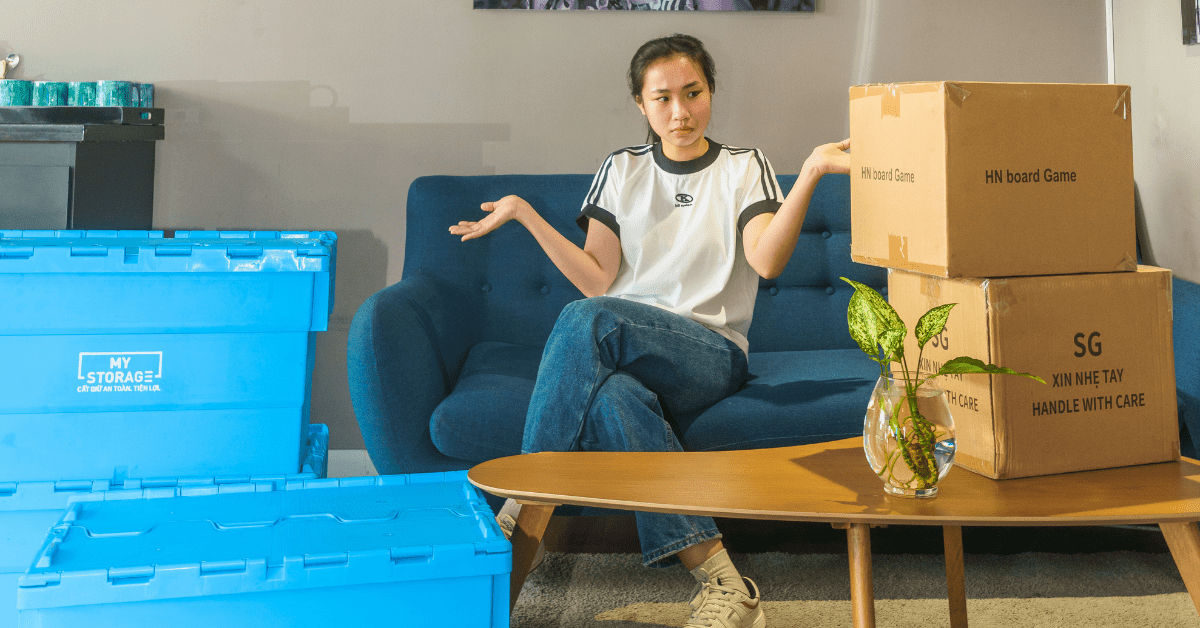
To optimize small apartment space, it is essential to combine scientific organization, utilize multi-functional furniture, and declutter unnecessary items. Additionally, external storage solutions such as renting family self-storage help free up area, keeping the home tidy while ensuring belongings are safely preserved.
Why Do Small Apartments Easily Become Cramped?
Small apartments quickly become cramped not because the area is insufficient, but because belongings accumulated over time exceed the existing storage capacity. A lack of systematic storage solutions causes every empty surface to be filled, shrinking living space and diminishing the quality of life even in apartments with reasonable square footage.
“It is not that the house is small, but that the storage is improper” is a statement reflecting the reality of most urban apartments in Vietnam. A well-organized 50 m² apartment can be much more comfortable than an 80 m² apartment lacking a proper storage system. The issue lies not in the dimensions of the area but in how that space is utilized.
Limited Area Is Not the Root Problem
When people say an apartment is “too small,” what they are actually describing is often the sensation of having no place to store items and no room to move comfortably. These two factors are not necessarily dictated by floor area but by how space is allocated.
Urban apartments in Ho Chi Minh City and Hanoi are becoming increasingly smaller following market trends, with common areas ranging from 30–65 m² for 1–2 bedroom units. However, the problem is not the absolute figure but the ratio between floor area and storage capacity. An apartment without enough storage space forces every item to be constantly present in the living area, creating a sense of clutter even though the floor area is sufficient for daily activities.
- A 45 m² apartment designed with built-in wardrobes and under-stair storage can feel more spacious than a 60 m² apartment lacking good storage solutions.
- Countries with high urban density like Japan and Singapore live comfortably in smaller-than-average spaces thanks to a culture of optimized storage systems, rather than larger square footage.
Belongings Increase Over Time While Space Remains Constant
This is the true and systematic cause. The apartment area is fixed from the day of purchase or lease, while belongings continuously accumulate over time through completely natural mechanisms.
The typical family life cycle: moving into a new apartment with few items, then accumulating through daily shopping, gifts from family and friends, items for each life stage (infants, students, the elderly), and most importantly, no one actively discards old items at a rate equivalent to the arrival of new ones.
- On average, an urban household in Vietnam accumulates an additional 15–20% of belongings each year, according to estimates from household consumption surveys.
- Belongings tend to “fill the space” according to an extended Parkinson’s Law: the volume of items expands to occupy all available storage area.
- Many items are not used frequently but still occupy space permanently because the homeowner has not yet decided how to dispose of them.
UCLA research on living spaces in the US shows that the average family owns over 300,000 items, most of which are not used frequently. In Vietnam, the figures are lower, but the accumulation trend is similar, especially with the parental generation’s mindset of “keeping it because it might be useful later.”

Suboptimal Space Layout for Storage
Many apartments become cramped not because of a lack of absolute storage space, but because potential storage space remains untapped. The most frequently overlooked spots in small apartments actually hold significant storage potential.
Overhead space is often the most wasted. The wall area from the top of cabinets to the ceiling, lofts, and the space above doorways are effective storage locations for rarely used items that most families fail to utilize. Similarly, space under beds, under stairs, and dead corners in bathrooms are often left empty or used inefficiently.
The wall space above kitchen cabinets and wardrobes in a 50 m² apartment can provide an additional 2–4 m² of storage area if extra shelves or cabinets are installed
Under-bed space can sometimes hold the equivalent of 1–2 small wardrobes if flat storage boxes with wheels are used
Many families use balconies to store clutter instead of installing organized shelving systems, wasting both storage space and outdoor living space
When Is Internal Optimization No Longer Enough?
Optimizing the internal layout of an apartment solves many problems but has its limits. When the volume of belongings exceeds the maximum capacity of the space despite full optimization, the solution is no longer rearranging but expanding storage space outside the apartment.
Clear signs that this limit has been reached: no empty space left in cabinets despite removing unnecessary items, inability to buy anything new because there is nowhere to put it, or certain rooms starting to function as storage instead of their original living purpose.
This is the time when external storage, especially flexible monthly self-storage models, becomes the most practical solution to reclaim living space in the apartment without moving or expensive renovations.
| Symptom | Meaning | Solution |
|---|---|---|
| Full cabinets, items still outside | Insufficient storage | Optimize shelves, add cabinets |
| Items encroaching on living space | Capacity exceeded | External storage unit |
| Cannot find items when needed | Lack of organization | Categorize and label |
| Feeling cramped despite cleaning | Too many items | Discard or store externally |
Golden Rules for Optimizing Small Apartment Space
The three core principles for optimizing small apartment space are minimalism, multi-functionality, and utilizing vertical space. Research from the IKEA Global Living Report (2023) shows that 68% of residents in apartments under 50 m² feel more comfortable after applying all three principles simultaneously, compared to only 31% when applying each principle individually.
These three principles do not work independently; they complement each other. Minimalism creates empty space, multi-functional items fill that space more efficiently, and vertical exploitation doubles storage area without sacrificing living space.
Minimalism
Minimalism does not mean living in deprivation but only keeping things that are actually used. According to the Marie Kondo Institute (2022), households applying systematic minimalism reduce their belongings by an average of 40% after the first decluttering, and the sense of spaciousness increases significantly even when the floor area remains unchanged.
Practical rules:
- 6-month rule: Items not used in the last 6 months can be discarded, donated, sold, or moved to external storage
- 1-in-1-out rule: Every time you buy something new, discard or store externally an equivalent item
- 3-group classification: Frequently used (keep at home), seasonal (external storage), no longer used (discard or donate)
Seasonal items like winter clothes, holiday decorations, and camping gear are the ideal group to move to external storage, freeing up significant space in the apartment while remaining accessible when needed.

Multi-function
Every square meter in a small apartment needs to serve more than one purpose. According to a report by Savills Residential Asia Pacific (2023), micro-apartments under 35 m² in major Asian cities command rental prices 15–20% higher than apartments of the same size with single-function layouts, reflecting the practical value of multi-functional design.
The most effective multi-functional solutions:
- Beds with drawers or lofts: Convert the area under the bed or above into storage space, equivalent to adding 1–2 m² of storage without taking up additional floor space.
- Wall-mounted folding tables (murphy desk/bed): Save 2–4 m² of floor space when not in use, particularly effective for studio and 1-bedroom apartments.
- Flip-top ottomans: Serve as seating, a coffee table, and a storage box in the living room.
- Staircase-integrated storage: Popular in Japanese and Singaporean apartment designs, turning each step into a storage drawer.
Vertical Space — Maximizing Height
This is the most overlooked principle yet has the greatest impact on storage capacity. A typical apartment has a ceiling height of 2.6–3.0 m, but most furniture is stacked below 1.8 m, wasting 30–40% of the room’s vertical volume.
Specific ways to utilize vertical space:
- Floor-to-ceiling shelving: Increases effective storage area by 2–3 times compared to standard shelves, especially effective in living rooms and hallways.
- Full-height built-in wardrobes: According to research by the NHBC Foundation UK (2022), full-height built-in wardrobes optimize storage space by 60% more than freestanding wardrobes with gaps at the top.
- Wall hooks and rails: Low cost, quick installation, freeing up floor space for medium-sized items like helmets, handbags, and musical instruments.
- Shelving above doors and windows: Utilizes space that is usually left completely empty, suitable for books, storage boxes, and infrequently used decorations.
The three principles above address most space issues in small apartments. However, when the volume of belongings exceeds the threshold where interior optimization can no longer solve it, off-site storage is the most logical next step, especially for seasonal items, keepsakes, or equipment not used regularly.
How to Organize Small Homes Neatly and Efficiently
Applying multi-functional furniture, utilizing the space under beds, wall shelves, and smart storage boxes can increase the space efficiency of small apartments by 40–60%. According to IKEA Space10 Research (2023), systematically organized apartments under 40 m² are rated as comfortable as unorganized 55–60 m² apartments.
Effective organization doesn’t require excessive shopping but rather the right mindset regarding every spot in the home. The five solutions below can be applied in order of cost priority from low to high.
Multi-functional Furniture
Multi-functional furniture saves an average of 2–4 m² of floor space compared to equivalent single-function furniture, according to a report by Savills Residential Asia Pacific (2023).
Instead of buying more furniture, choose each piece to have at least two functions. A sofa bed replaces both a seat and an extra bed. A wall-mounted folding table (murphy desk) saves 2–3 m² of floor space when not working. An ottoman with internal storage serves as both a coffee table and a small storage cabinet. Principle: every m² of floor space must serve at least two purposes.
Utilizing Space Under Beds and Sofas
A standard double bed frame (160 × 200 cm) can store the equivalent of 1–2 small wardrobes if flat boxes with wheels are used, according to the Home Organization Institute (2022).
The area under beds and sofas is often left completely empty, despite being the most valuable storage space in a small apartment; a height of 20–30 cm is sufficient for seasonal clothing, blankets, and rarely used items. Prioritize using flat boxes with wheels for easy access when needed, and avoid stacking directly on the floor to prevent mold and mildew.

Wall-Mounted Shelves
Ceiling-high wall shelves utilize 30–40% of room volume that is often left empty, potentially increasing effective storage space by 2–3 times compared to standard shelving (NHBC Foundation, 2022).
Walls are the most wasted real estate in small apartments. Floor-to-ceiling shelving in living rooms or hallways provides significant storage without taking up floor space. Shelves above doors and windows are suitable for books, storage boxes, and infrequently used items. The cost of installing wall shelves is typically 50–70% lower than buying new cabinets with the same storage capacity.
Sorting and Decluttering Unnecessary Items
Households applying the KonMari method discard an average of 40% of their belongings after the first decluttering session and maintain a tidier space 80% better after one year compared to those who do not (Marie Kondo Institute, 2022).
No organization solution is effective when a home has too many items. Apply the 6-month rule: items not used within 6 months fall into one of three categories: discard, donate, or move to storage outside the apartment. Seasonal items like winter clothes, camping gear, and Lunar New Year decorations are ideal candidates for external storage, freeing up significant space without losing possessions.
Smart Storage Boxes and Bags
Using a system of labeled storage boxes and bags reduces the average time spent searching for items by 15 minutes per day and increases the long-term tidiness maintenance rate to 65% (The Container Store Consumer Study, 2023).
Uniformly sized storage boxes utilize cabinet space better than a mix of various sizes. Vacuum bags for clothes and bedding reduce volume by 60–70%, making them ideal for seasonal items stored under the bed or in external storage. Clearly labeling each box is the simplest yet most often overlooked step, largely determining whether the storage system will be maintained.
| Solution | Cost | Storage Increase | Implementation Time |
|---|---|---|---|
| Sorting and decluttering | 0 VND | Large (frees up existing space) | 1–2 days |
| Wall-mounted shelves | 500K–3 million VND | 2–3 times shelf area | A few hours |
| Storage boxes and bags | 200K–1 million VND | Medium | 1–2 hours |
| Utilizing under-bed space | 300K–800K VND | 1–2 small wardrobes | 1 hour |
| Multi-functional furniture | 2–15 million VND | 2–4 m² of floor space | Gradual replacement |
When Should You Look for External Storage Solutions?
External storage solutions are suitable when infrequently used items, seasonal goods, or memorabilia occupy regular living space while being used less than 2–3 times per year. According to the Self Storage Association Asia (2023), 62% of personal storage users in Southeast Asia primarily store seasonal items and memorabilia, saving an average of 8–12 m² of living space.
Optimization within the apartment has its limits. When you have applied enough multi-functional furniture, wall shelves, and sorting solutions but the space is still insufficient, it is a clear signal to expand storage outside the apartment.
Infrequently Used Items
Infrequently used items are the group that consumes the most space while providing the least utility in daily life. According to research by the National Association of Professional Organizers (NAPO, 2022), 80% of household items are used only 20% of the time, yet they occupy 100% of the space 24/7.
Typical items that should be moved to external storage:
- Seasonal sports equipment (bicycles, camping kits, surfboards)
- Repair and gardening tools used a few times a year
- Books and archived documents that do not require frequent access
- Old electronics that are still functional but have been replaced by new devices

Seasonal Items
Winter clothes, Tet decorations, summer cooling equipment, and holiday gear are items that occupy significant space during the 9–10 months they are not in use. A full set of winter clothing can take up 0.3–0.5 m³ of closet volume, equivalent to the storage space of dozens of daily outfits.
Moving seasonal items to external storage and rotating them on a schedule is the most common strategy in Asian urban areas with small apartments. In Tokyo and Singapore, the “seasonal rotation storage” model is adopted by over 35% of households living in apartments under 50 m² (JLL Residential Asia, 2023).
Keepsakes & Memorabilia
This is the most difficult group to handle because they cannot be discarded but are not used frequently. Multi-generational family photos, childhood toys, wedding attire, and legal documents requiring long-term storage all belong to this category.
The characteristic of memorabilia is high emotional value but low access frequency, usually 1–2 times per year or less. This group is best suited for climate-controlled storage for long-term preservation without taking up living space.
Signs it’s time to find external storage:
- A room or corner of the house is gradually turning into a storage area instead of serving a living function
- Unable to find necessary items because they are buried under less-used ones
- Refusing to buy necessary new items because of “not knowing where to put them”
- The cost of renting or buying a larger apartment just for more storage space
Simple calculation: If you transfer 10 m² of area from “storing rarely used items” to “actual living space,” the value of that space in Ho Chi Minh City is equivalent to 3–5 million VND/month based on current apartment rental prices. The cost of renting a small self-storage unit is about 500,000–1,000,000 VND/month—a clear difference in actual value received.
Renting Family Storage – The Optimal Solution for Apartment Space
Renting family storage helps free up 8–12 m² of living space by storing rarely used items, seasonal goods, and memorabilia outside the apartment while still ensuring safety and 24/7 access.
External storage is not a solution only for businesses or people with too many belongings. It is the most practical space optimization tool for families living in urban apartments, especially when the rental cost starts from only 500,000 VND/month while the value of the freed-up space is equivalent to 3–5 million VND/month according to current apartment rental prices.
Practical Benefits of Renting Family Storage
- Flexibility based on actual needs: Rent by the month, no long-term commitment. The area can increase when moving house or adding family members, and decrease when items are decluttered. Space ranges from 2 m² for a few boxes to 20 m²+ for entire bedroom furniture sets.
- Better security and preservation than at home: 24/7 cameras, individual locks for each unit, no pests, and controlled humidity. This is particularly important for high-end clothing, paper documents, and electronics that are easily damaged in unregulated home storage.
- 24/7 access when needed: Freedom to enter at any time using a personal code, independent of working hours. Suitable for retrieving seasonal items or accessing documents when necessary.
Comparison: Home Storage vs. Renting a Storage Unit
| Criteria | At home | Renting storage |
|---|---|---|
| Living space | Occupied by rarely used items | Freed up by 8–12 m² |
| Humidity control | Weather-dependent, hard to control | Actively maintained at 50–65% RH |
| Security | General apartment security | 24/7 cameras, individual unit locks |
| Clothing & document preservation | Risk of mold and pests during rainy season | Controlled environment, lower risk |
| Cost | No direct additional cost | From 500,000 VND/month |
| Flexibility | Fixed by apartment area | Adjusted according to needs |
| Best suited for | Daily essentials | Rarely used, seasonal, memorabilia |
10 m² of apartment space occupied by rarely used items = 1.5–2.5 million VND/month in wasted rental value (based on average HCMC apartment rates in 2024). The cost of renting a 5 m² storage unit to hold all those items is about 600,000–900,000 VND/month. The difference is a real saving, not an extra cost.
How to keep your apartment consistently tidy?
Maintaining a tidy apartment doesn’t require constant cleaning—it just needs three core habits: scheduled periodic cleaning, a minimalist mindset, and strict control over new items brought into the home.
- Clean periodically, don’t wait until it’s “messy to clean”: Instead of cleaning based on inspiration, set a fixed schedule: 5 minutes every evening to reset tabletops and floors, 15–30 minutes on weekends to handle hidden corners like under the bed, closets, or kitchen shelves. Frequent small cleanups are much easier than a major overhaul once a month.
- Maintain minimalist habits; every object needs its place: The simplest principle: every item must have a fixed position. After use, return it to its proper place immediately—don’t leave it “temporarily” on a table or chair. For clothing, apply the “one in, one out” rule: every time you buy a new item, liquidate an old one so the total number of items in the house doesn’t increase.
- Control new items with a filter before bringing them home: Before buying anything, ask yourself: “Where will this go?” If there’s no clear answer, it’s a sign the space isn’t ready for it. For gifts or unused second-hand items, schedule a review every 3 months to decide whether to keep, gift, or liquidate them.
A tidy apartment is not the result of one big cleaning session; it is the achievement of small habits maintained consistently every day. When you clean periodically, live minimally, and control new items, the living space will naturally become airy without too much effort.
However, sometimes apartments still accumulate seasonal items, family belongings, or business goods that you aren’t ready to discard. This is when self-storage becomes a smart solution to help you flexibly store what isn’t needed immediately, freeing up living space without having to give up your assets. Living tidily doesn’t mean throwing everything away; it means knowing how to arrange things in the right place.
FAQ
How often should I clean my apartment?
A quick 5–10 minute tidy each evening keeps things under control. Set aside 30–45 minutes on weekends for a full clean, focusing on hidden spots like under the bed, kitchen cabinets, and bookshelves. With consistent habits, you will never need an exhausting all-day deep clean again.
Where do I start when my apartment is very cluttered?
Pick one small, visible area — usually a desk or bedside table. Complete it fully before moving on. The sense of finishing one zone creates momentum, rather than feeling overwhelmed by the entire apartment at once.
How do I prevent clutter from coming back after cleaning?
The core rule: every item has a fixed home and goes back immediately after use. Never set things down “just for now” — temporary placements almost always become permanent. Label boxes and drawers if needed so everyone in the household follows the same system.
What rule helps keep the amount of stuff from growing?
Follow the “one in, one out” rule: every new item means one old item leaves. For clothes, upgrade to “one in, two out” if your wardrobe is already overflowing. Before any purchase, ask yourself: where exactly will this live in my home?
How should I handle clothes and seasonal items?
Review your wardrobe every 6 months, timed with seasonal changes. Clothes unworn for over a year should be donated or sold. Seasonal items like heavy blankets, holiday decorations, and travel gear should go into clearly labeled boxes. If your apartment lacks storage space, renting a small self-storage unit of 1–2 m² is far more cost-effective than letting seasonal items take over your bedroom or living room.
What storage solutions work best for small apartments?
Maximize vertical space: tall wall shelves, beds with under-bed drawers, over-door organizers, and storage ottomans. For rarely used items like sports equipment, tools, old electronics, or family heirlooms, self-storage is a practical option to fully free up living space without discarding things that still hold value.
Should I keep or discard sentimental items, documents, and family belongings?
Keep only what holds real emotional or legal value. Digitize documents and photos to save physical space. Family items like inherited furniture, antiques, or multi-generational keepsakes are hard to let go of but take up significant room. A practical solution is placing them in a family storage unit — keeping them safe and preserved without cluttering your current home.
Who is self-storage suitable for?
Self-storage suits a wide range of people: households moving or renovating, online sellers needing inventory space, small apartment renters wanting more living room, or families storing seasonal items and belongings from members who have moved out. Unit sizes range flexibly from 1 m² to 20 m², billed monthly with no long-term commitment required.
Is the cost of renting a storage unit worth it?
Renting a 2–3 m² unit in Ho Chi Minh City ranges from 400,000–800,000 VND per month. Compared to the value of living space being taken up by rarely used items, this cost is usually significantly lower. Self-storage also offers better preservation conditions than home storage: humidity control, 24/7 security cameras, and no risk of pests or monsoon-season mould.
What is the simplest habit to keep a home tidy long-term?
Do a 5-minute reset before bed: clear all surfaces, return stray items to their places, and set up for tomorrow. Combined with a quarterly or biannual review to decide what to keep, donate, or move into storage, you will maintain a consistently open living space without significant daily effort.