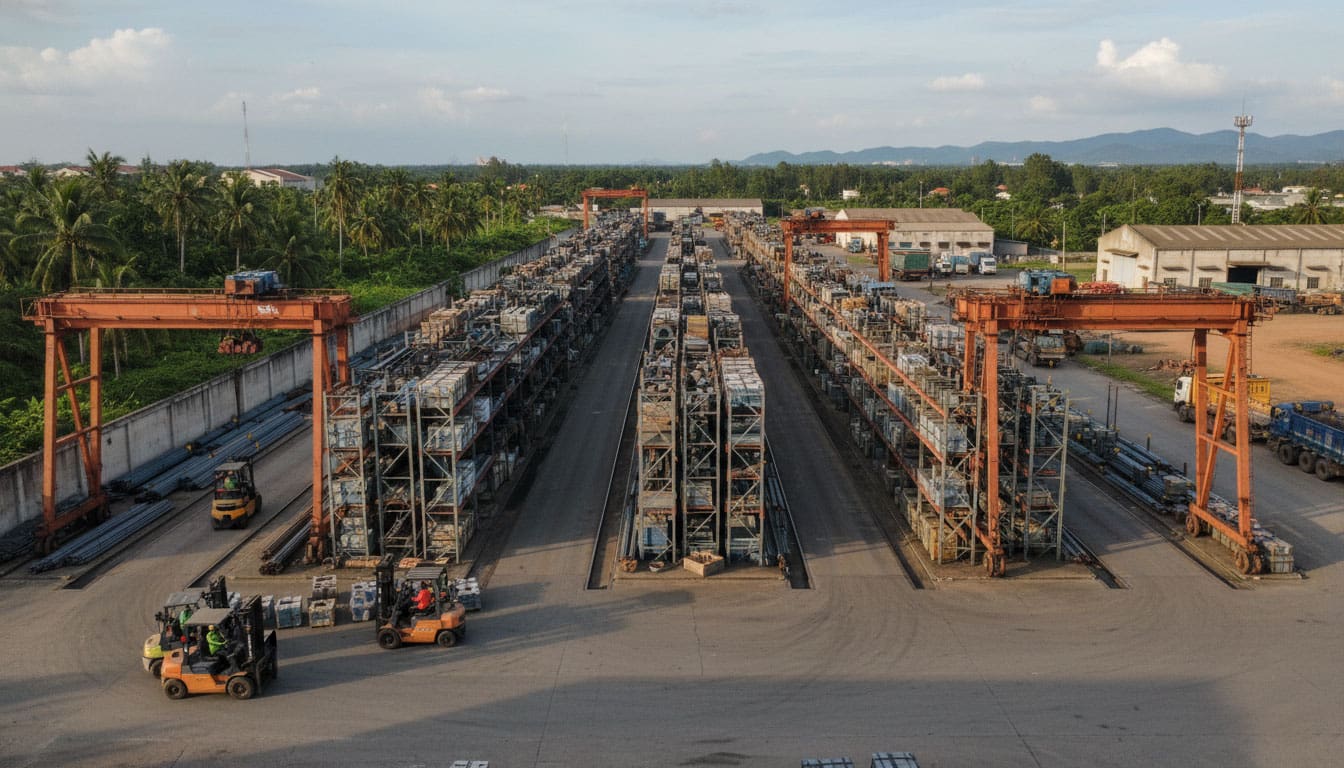
Industrial Outdoor Storage (IOS) is a type of industrial real estate that utilizes outdoor space for storing heavy equipment, containers, machinery, trucks, and construction materials. Unlike traditional warehouses, IOS does not require a roof structure, which helps reduce initial investment costs by 40–60% compared to conventional warehouses.
What is Industrial Outdoor Storage (IOS)?
Industrial Outdoor Storage (IOS) is a type of industrial real estate that uses outdoor space, either uncovered or partially covered, for storing containers, semi-trucks, heavy machinery, and construction materials. IOS offers 40–60% lower investment costs compared to traditional covered warehouses, making it ideal for logistics, transportation, and construction businesses.
Unlike conventional warehouses that demand complex roof structures, fire suppression systems, and temperature control, IOS optimizes land utility by maximizing the use of vacant ground space – a crucial factor many logistics and transportation businesses urgently need but lack flexible, cost-effective solutions for.
How Does IOS Differ from Other Types of Industrial Real Estate?
Many people confuse IOS with ordinary vacant lots or categorize it with warehouses. In reality, IOS holds a distinct position within the industrial real estate sector, boasting clear characteristics.
| Criterion | IOS | Warehouse | Logistics Center | Open Yard |
|---|---|---|---|---|
| Roofing | None or partial | Full | Full | None |
| Storage Items | Vehicles, containers, heavy machinery | Packaged goods, pallets | Diverse goods, cross-dock | Raw materials, scrap |
| Infrastructure Requirements | Medium | High | Very High | Low |
| Investment Cost/m² | Low (5–15 USD/sqft) | Medium (80–130 USD/sqft) | High (130–200 USD/sqft) | Very Low |
| Legal Status & Standardization | Emerging | Mature | Mature | Unclear |
| Cap Rate | 5.5–7.5% (increasing) | 4–6% | 3.5–5% | Low |
Key difference: IOS is not a “vacant lot”; it’s a professionally invested asset featuring load-bearing foundations, security systems, and technical infrastructure designed to meet businesses’ actual operational needs.
What Types of Goods & Assets Are Typically Stored at IOS?
IOS serves a diverse range of industries, from logistics and construction to renewable energy. Below are the most common asset groups:
- Transportation & Logistics Industry: This is the largest global tenant group for IOS. Companies like Amazon, FedEx, and DHL utilize IOS to park semi-trucks, empty containers, and semi-trailers between shipments. According to Savills (2024), IOS demand from this sector increased by 30% in the US market during 2020–2023.
- Construction & Infrastructure Industry: Excavators, cranes, road rollers, scaffolding, and pre-fabricated steel components all require spacious outdoor storage with high ground bearing capacity. IOS is the optimal choice as it avoids wasted roofing costs for assets inherently designed for outdoor operation.
- Renewable Energy Industry: Solar panels, wind turbines, and Battery Energy Storage Systems (BESS) are large-sized assets that cannot be stored in conventional warehouses. IOS demand from this industry is rapidly growing in line with global renewable energy deployment.
- Automotive & Commercial Vehicles Industry: Storage lots for imported vehicles, long-term rental cars, commercial vehicles awaiting maintenance, or storage for automotive and motorcycle spare parts.
All of these represent ideal clients for IOS, requiring large areas and long-term leases.
Identifying a Standard-Compliant IOS Location
Not every vacant plot can be classified as IOS. A professional IOS location typically possesses the following characteristics:
- Scale & Location: IOS operates effectively on areas ranging from 0.5 hectares to 50+ hectares, strategically located within a 15–20 km radius of seaports, cargo airports, or industrial beltways – areas where heavy trucks can easily access without violating urban traffic regulations.
- Technical Infrastructure: The yard surface is paved with concrete or asphalt, ensuring a minimum load capacity of 5–10 tons/m² to withstand fully loaded container trucks. Surface drainage systems are designed to prevent flooding that could affect stored assets.
- Security & Operations: 24/7 CCTV surveillance, robust fencing, access control gates, and full site lighting are minimum requirements. Many modern IOS facilities also integrate IoT sensors for real-time asset tracking.
According to JLL (2023), the US IOS market boasts over 15,000 active locations with a total value of $200 billion, indicating a highly standardized segment in developed markets and an emerging phase in Vietnam.

Why Industrial Outdoor Storage (IOS) is Becoming the Most Attractive Industrial Real Estate Segment
IOS appeals to investors due to its low construction costs, ranging from just 5–15 USD/sqft (compared to 80–200 USD/sqft for covered warehouses). Meanwhile, cap rates reach 5.5–7.5%, and occupancy rates in major markets are as high as 96–98%. Demand for IOS in the US surged by 30% between 2020–2023, driven by the e-commerce boom and the rise of last-mile delivery (Savills, 2024).
While many commercial real estate segments face pressure from high interest rates and weakening demand, IOS is bucking the trend with increasing occupancy rates, escalating rental prices, and a growing influx of institutional capital. What’s truly fueling this upward trajectory?
Scarce Supply Amidst Exploding Demand
The biggest paradox in the IOS market is this: it’s one of the simplest real estate types to operate, yet finding the best locations is incredibly challenging. The reason lies in the fact that IOS properties only realize their full value when situated near ports, major transportation arteries, or large urban peripheries – precisely where land is rapidly depleting due to urbanization.
Consequently, the IOS vacancy rate in the 10 largest US markets is only 3–5% (CBRE, 2023), a figure even cold storage or data centers struggle to achieve. In gateway markets like Los Angeles, New Jersey, and Chicago, this rate drops to below 2%, pushing rental prices up by 15–25% in just two years.
On the demand side, three key drivers are simultaneously boosting the need for IOS:
- E-commerce & last-mile delivery: Giants like Amazon, FedEx, and UPS require hundreds of distributed truck parking lots around urban areas to shorten delivery times to 2–4 hours.
- Growth in international trade: Global container throughput at ports increased by an average of 4.5% annually from 2021–2023 (UNCTAD, 2024), leading to a corresponding rise in demand for temporary container yards.
- Infrastructure construction: Large-scale public investment packages in the US (such as the Infrastructure Investment and Jobs Act – 1.2 trillion USD) are driving demand for construction equipment storage yards to record levels.
Stable Cash Flow — An Advantage Few Segments Possess
One of the reasons institutional investors are increasingly drawn to IOS is its incredibly lean cost structure. Without complex HVAC systems, freight elevators, or elaborate fire suppression systems, operating and maintenance costs for IOS are significantly lower than traditional warehouses.
As a result, professional IOS operators can achieve EBITDA margins of 60–70%, substantially higher than the 35–45% seen in traditional warehouses. Combined with the common 3–7 year long-term leases in the industry, cash flow from IOS is highly predictable and less volatile with economic cycles.
Comparing cap rates: IOS cap rates reached 5.5–7.5% (JLL, Q4 2023), outperforming Class A offices (3.5–5%) and retail centers (5–6.5%), all while boasting significantly lower operational risk.

Institutional Capital Flow – A Confirmation Signal from “Smart Money”
The quickest way to identify a maturing real estate segment is to observe who is allocating capital. For IOS (Industrial Outdoor Storage), that list is growing longer and more impressive by the day.
Blackstone, the world’s largest real estate fund with over $300 billion in assets under management, publicly announced its strategy to expand its IOS portfolio in 2022. Brookfield Asset Management and EQT Exeter have, in turn, established specialized funds for this segment. The total value of IOS M&A transactions in North America in 2023 exceeded $8 billion, doubling from 2021.
This not only reflects confidence in short-term cash flow but also a long-term bet on the irreversible scarcity of suburban industrial land.
China+1 Trend – A Special Opportunity for Southeast Asia
Amidst a complex global geopolitical landscape, numerous multinational corporations are diversifying their supply chains under the China+1 strategy, maintaining manufacturing bases in China while simultaneously expanding into Vietnam, Indonesia, Thailand, and Malaysia.
Each wave of manufacturing relocation brings an immediate demand for container yards, equipment storage, and transshipment areas – precisely the “address” for IOS. Vietnam is embracing this wave with FDI into the manufacturing sector increasing by 8–10% annually, while professional IOS infrastructure is almost non-existent, creating a significant market gap for both domestic and international investors.
JLL’s Perspective: “IOS is following in the footsteps of cold storage a decade ago, evolving from a niche segment that few noticed into a highly sought-after asset with increasingly high valuations.” – Analysis from JLL Industrial Outlook 2024.
The IOS Market in Vietnam: Current State & Opportunities
In Vietnam, IOS is not yet officially classified within the industrial real estate legal framework, but actual demand is rapidly increasing in major port clusters like Cai Mep – Thi Vai and the Hanoi – Hai Phong corridor. Occupancy rates in Southern industrial parks reached ~93%, with industrial land lease prices increasing by 10–15% compared to 2022, averaging 160–200 USD/m²/lease cycle (Savills Vietnam, 2024).
The paradox of Vietnam’s IOS market lies in this: real demand exists, but professional supply is almost non-existent. Thousands of logistics, transportation, and construction businesses are forced to self-manage with spontaneously leased land, unstandardized container yards, or pay significantly higher costs to lease standard industrial park land, even though they only need a well-managed outdoor space. This is precisely the gap that IOS can fill.
3 Key Areas with the Highest IOS Potential
Cai Mep – Thi Vai Port Cluster (Ba Ria – Vung Tau)
Cai Mep – Thi Vai is currently Vietnam’s largest deep-water port cluster, capable of accommodating super-large container vessels with a deadweight tonnage of up to 200,000 DWT – something that Cat Lai Port (Ho Chi Minh City) cannot do. Container throughput through this cluster reached 7.2 million TEU in 2023, an 18% increase compared to 2022 (Vietnam Maritime Administration).
This enormous volume of container movement creates an urgent demand for empty container yards, truck parking, and container cleaning and repair areas – all typical use-cases for IOS. Currently, most of this demand is met by unstandardized, self-managed yards, posing potential legal and safety risks.
Hanoi – Hai Phong Corridor
This is the vital logistics artery of the North with the 105 km Hanoi – Hai Phong expressway, directly connecting the capital with Lach Huyen Port, the largest deep-water port in the North, which is currently in its second phase of expansion.
Along this corridor, provinces like Hung Yen, Hai Duong, and Hai Phong are attracting a strong wave of FDI from Samsung, LG, Foxconn, and numerous Tier 1–2 suppliers in the global electronics supply chain.
Every new factory that comes into operation generates demand for storage yards for equipment, forklifts, bulky components, and export containers awaiting customs clearance – a demand that IOS serves better than any other type of real estate.
Occupancy rates in industrial parks in Hai Phong and Hung Yen reached 85–92% in Q1 2024, with industrial land lease prices increasing by an average of 12% compared to Q1 2023 (CBRE Vietnam, 2024). Pressure on industrial land is pushing businesses to seek IOS solutions as a more cost-effective option.
Da Nang — An Emerging Central Vietnam Gateway
Less noticed than the Northern and Southern regions, Da Nang is quietly becoming a logistics hotspot thanks to its central location on the East-West Economic Corridor (EWEC) – a road connecting Myanmar, Thailand, Laos, and Vietnam to seaports.
Tien Sa Port is being upgraded to accommodate larger vessels, while Da Nang High-Tech Park and Hoa Khanh, Lien Chieu Industrial Parks continue to expand. Demand for commercial vehicle parking, construction equipment, and transit goods is rapidly increasing, but no systematic IOS solutions have been implemented yet.
Growth Drivers: 3 Concurrent Waves
- Wave 1 — Shifting Manufacturing FDI: Vietnam attracted $39.4 billion in registered FDI capital in 2023 (Ministry of Planning and Investment), with the processing and manufacturing sector accounting for over 65%. Each large-scale FDI project that becomes operational brings with it an ecosystem of suppliers, transportation units, and logistics services – all potential customers for IOS.
- Wave 2 — Accelerating China+1: US-China trade tensions and tariff policies are making Vietnam a priority destination in global supply chain diversification strategies. According to Cushman & Wakefield (2024), Vietnam is among the top 3 countries benefiting most from the China+1 trend in Southeast Asia, alongside Indonesia and Thailand.
- Wave 3 — Booming Domestic E-commerce: Vietnam’s e-commerce market reached $20.5 billion in 2023, a 25% increase compared to 2022 (VECOM, 2024), placing Vietnam among the top 3 fastest-growing e-commerce markets in Southeast Asia. Shopee, Lazada, and TikTok Shop are heavily investing in fulfillment infrastructure and last-mile delivery – creating new demand for delivery vehicle parking, transshipment warehouses, and suburban outdoor goods collection points.
Challenges to Overcome Before IOS Breaks Through
Despite its clear potential, the IOS market in Vietnam faces three main barriers that investors need to understand before participating:
- Barrier 1 — Regulatory Gap: The Land Law 2024 and current industrial real estate regulations do not yet have a specific definition or classification for IOS. This makes permitting, valuation, and asset transfer for IOS more complex compared to traditional warehouses or industrial parks. Investors must work on a case-by-case basis with local authorities, leading to lengthy approval times and unpredictable outcomes.
- Barrier 2 — Lack of Uniform Technical Standards: There are no national standards for IOS yard floor load capacity, surface drainage systems, or environmental requirements for outdoor storage activities. Each locality applies different standards, making it difficult to standardize products and compare quality across locations.
- Barrier 3 — Planning Risks: Some areas with high IOS potential (suburban, near ports) are located within zones planned for land use conversion within the next 5–10 years. Investors need to conduct thorough due diligence on local 1/2000 and 1/500 planning before committing to long-term investment.
These barriers do not negate the potential; they actually create an advantage for early movers. Investors with strong legal capabilities and local relationships will be able to establish a dominant position before the Vietnamese IOS market becomes standardized and more competitive – just as happened with the cold storage and logistics segments in Vietnam during 2015–2020.
Criteria for Evaluating a Standard IOS Location
A standard Industrial Outdoor Storage location must meet three groups of criteria:
- Location – within 15 km of a port or national highway, and within a 30-minute radius of a major industrial park;
- Technical specifications – minimum ground bearing capacity of 5–10 tons/m², an environmentally compliant drainage system, and an access road clearance height of ≥ 5.5m;
- Legal compliance – correct industrial land use purpose, and full warehouse fire prevention & fighting and environmental permits for warehousing.
The most common mistake when evaluating an IOS is focusing solely on rental prices while overlooking hidden costs arising from an inconvenient location, insufficient ground bearing capacity, or unresolved legal risks. An IOS location that is 20% cheaper but far from major transport routes could increase transportation costs by up to 40% — completely negating the initial rental price advantage.
Criterion Group 1 — Location & Accessibility
Location is the only factor that cannot be changed after investment, making it the first and most stringent filter in the IOS due diligence process.
| Location Criteria | Minimum Threshold | Ideal Threshold |
|---|---|---|
| Distance to Port/ICD | ≤ 20 km | ≤ 10 km |
| Distance to National Highway/Expressway | ≤ 5 km | ≤ 2 km |
| Radius to Nearest Major Industrial Park | ≤ 30 minutes | ≤ 15 minutes |
| Access Road Clearance Height | ≥ 5.5 m | ≥ 6.0 m |
| Access Road Load Capacity | ≥ 30 tons/axle | ≥ 40 tons/axle |
Beyond distance, it’s crucial to check truck traffic regulations: some routes prohibit heavy vehicles during peak hours or at night, directly impacting the operational efficiency of IOS tenants — especially for logistics businesses operating 24/7 shifts.
Criterion Group 2 — Site Technical Specifications
This group of criteria creates the biggest distinction between a professional IOS and an improvised yard. Technical infrastructure investment costs typically account for 60–70% of the total IOS development capital, but this investment directly determines rental rates, tenant quality, and asset lifespan.
Ground & Site Structure:
Ground bearing capacity is the most critical technical parameter. A fully loaded 40-foot container can weigh up to 30 tons, and when placed by a reach stacker, it exerts immense point pressure on the yard’s surface. The minimum standard for container IOS is 5 tons/m², but IOS facilities serving heavy trucks and machinery need to achieve 8–10 tons/m². A reinforced concrete slab, at least 20–25 cm thick, over a compacted sand layer is the most common solution.
Drainage System:
IOS in Vietnam often falls short in this criterion, yet it’s a weakness that causes the most significant damage during the rainy season. The surface drainage system must be designed to handle extreme rainfall (≥ 100 mm/hour in Ho Chi Minh City and southern provinces), ensuring the site remains flood-free after 30 minutes of heavy rain. Wastewater from car washes and container maintenance areas must be collected and treated according to QCVN 40:2011/BTNMT before discharge.
Security & Operations:
Minimum security checklist for an internationally standard IOS:
- High-resolution surveillance cameras, covering 100% of the area, with a minimum 30-day storage capacity
- Robust fencing ≥ 2.4 m high with intrusion detection systems
- Controlled gate with Automatic License Plate Recognition (ALPR) system
- Minimum 50 lux illumination across the entire premises at night
- 24/7 security guard presence at the main gate
Criterion Group 3 — Legal & Planning
This group of criteria presents the most hidden risks in the Vietnamese market, especially as the legal framework for IOS is not yet standardized.
Land Use Purpose
IOS land must be classified as non-agricultural production and business land (SKC or TMD purpose according to the 2024 Land Law). Absolutely avoid developing IOS on agricultural land that has not completed conversion procedures or on disputed land, as the risk of operational suspension or revocation is very high.
Long-term Planning
Consult the district-level land use plan for the 2021–2030 period and the 1/2000 scale zoning plan for the area to confirm that the land is not designated for conversion to urban, transportation, or public works purposes within the next 10 years.
Operating Permits
List of required permits before operating an IOS in Vietnam:
- Land Use Rights Certificate (red/pink book) with the correct purpose
- Construction permit for auxiliary structures (if there are offices, weighbridges)
- Certificate of completion for environmental protection works (as per Decree 08/2022/NĐ-CP)
- Fire Prevention & Fighting (PCCC) acceptance report from the local Fire Police
Practical note for the Vietnamese market: Prioritize selecting land within the boundaries of industrial parks with Prime Minister-approved planning. Although rental prices may be 15–25% higher than land outside industrial parks, investors benefit from synchronized technical infrastructure, a single legal point of contact (Industrial Park Management Board), and virtually eliminate planning risks throughout the project’s lifespan.

Global IOS Trends & Forecast to 2030
The global Industrial Outdoor Storage (IOS) market is projected to reach 500 billion USD by 2030 (Grand View Research, 2024), with Southeast Asia experiencing a 15–18% CAGR from 2024–2029. Key trends include: integrating solar power on IOS sites, developing commercial electric vehicle (EV) depots, and implementing marketplace platforms for hourly/daily IOS rentals, similar to the Airbnb model.
If the 2010s were the era of smart warehouses with robots and automated conveyor belts, then the 2020–2030 decade is shaping IOS into a next-generation physical infrastructure platform – where green energy, digital technology, and logistics converge on a single outdoor footprint.
Trend 1 — Green IOS: From Parking Lots to Power Plants
The vast outdoor space of IOS, once considered an aesthetic drawback, is rapidly becoming a competitive advantage in the ESG era. The “Solar Canopy IOS” trend – installing solar panels on a framework covering the entire parking area – is booming in Europe and beginning to spread to North America and Southeast Asia.
A 5-hectare IOS site equipped with a solar canopy can generate 4–6 MW of electricity, sufficient to power its entire operations and sell surplus back to the grid, transforming IOS from a mere land rental asset into a multi-revenue generating property. The average investment cost for a solar canopy is 150–200 USD/m², with a payback period of 7–10 years in Vietnam due to preferential rooftop solar electricity prices under Net Metering policies.
Beyond solar power, some advanced IOS sites also integrate:
- Commercial EV charging hubs for tractor-trailers and delivery trucks
- Rainwater harvesting and reuse systems for vehicle washing and landscaping
- LEED or EDGE green certifications to attract multinational tenants committed to ESG goals
Trend 2 — Digitalization of IOS Management
Traditional IOS management relies on security guards, manual ledgers, and phone calls – a model that cannot scale when property areas span tens of hectares with hundreds of vehicles and containers requiring simultaneous tracking.
- IoT & GPS Asset Tracking IoT sensors attached to containers, machinery, and vehicles allow site owners and tenants to monitor real-time location, operational status, and movement history. This technology minimizes asset loss, resolves parking disputes, and optimizes site utilization rates – factors directly impacting an IOS operator’s revenue.
- Drone Inspection Instead of deploying foot patrols, large-scale IOS sites are transitioning to automated drones that fly on a scheduled basis to inspect perimeter security, detect unauthorized intrusions, and record visual evidence. Drone operating costs are 60–70% lower than traditional security models for the same surveillance area.
- Flexible Rental Marketplace Platforms This is the most disruptive trend: startups like Chunker (US) and Stowga (UK) are building platforms that connect IOS owners with businesses needing flexible rentals by the day, week, or month – similar to Airbnb in the accommodation sector. This model helps smaller IOS sites (under 1 hectare), which often struggle to attract long-term tenants, optimize capacity and generate revenue in unprecedented ways.
Trend 3 — Special Opportunities for Vietnam by 2030
Commercial EV Depots VinFast is implementing plans to electrify its truck and bus fleets in Vietnam, while Grab, Be, and other delivery platforms are transitioning to two- and three-wheeled electric vehicles. All these commercial EVs require outdoor charging and maintenance depots – a use case perfectly suited for IOS models integrated with charging stations. This segment has virtually no competitors in Vietnam as of early 2024.
ASEAN Cross-border Logistics The RCEP Agreement, effective from 2022, and bilateral FTAs are boosting cross-border trade in the region. Road transport routes connecting Vietnam – Laos – Thailand and Vietnam – China (Lang Son, Lao Cai, Mong Cai) increasingly need IOS sites to serve as transit points, cargo inspection areas, and parking zones awaiting customs clearance. According to VLA (2023), cross-border logistics turnover through Vietnam is projected to grow by 20–25% annually from 2024–2028.
IOS is no longer a “niche” segment for specialized investors. By 2030, IOS integrated with renewable energy, digital technology, and EV infrastructure will become one of the most multifunctional and sustainable types of industrial real estate, especially given the increasing scarcity of peri-urban land and the rising costs of traditional warehouse construction. Vietnam, with its geostrategic location and top-tier logistics growth rate in the region, stands before a rare opportunity to shape the IOS market before it fully matures.
FAQ
What is Industrial Outdoor Storage (IOS) and how does it differ from a traditional warehouse?
Industrial Outdoor Storage (IOS) is a type of industrial real estate that uses open-air land — fully or partially uncovered — to store containers, semi-trailers, heavy machinery, and construction materials. Unlike traditional warehouses with roofing, fire suppression systems, and climate control, IOS maximizes usable land area at 40–60% lower capital costs, making it ideal for logistics, transportation, and construction companies.
How much does it cost to rent IOS space in Vietnam?
Vietnam’s IOS market is not yet standardized with unified pricing. However, industrial land rental rates in key IOS-potential areas such as Ba Ria – Vung Tau, Hai Phong, and Binh Duong range from USD 160–200/m²/lease term (Savills Vietnam, 2024). Informal yards near seaports may be 30–40% cheaper but carry significant legal risks.
What types of businesses are best suited for IOS?
IOS is most suitable for five business segments: (1) Logistics & transportation companies needing truck and container parking; (2) Construction contractors storing heavy equipment and machinery; (3) Import/export companies requiring temporary container yards; (4) Renewable energy firms storing solar panels and wind turbine components; (5) E-commerce platforms needing suburban staging areas for last-mile delivery operations.
What is the return on investment (ROI) for IOS properties?
IOS cap rates at mature markets reach 5.5–7.5% (JLL, Q4 2023), outperforming Grade-A offices (3.5–5%) and retail centers (5–6.5%). Professional IOS operators achieve EBITDA margins of 60–70% due to low operating costs. In Vietnam, given the nascent market stage, early-mover investors may expect above-average returns compared to global benchmarks during 2024–2028.
Which regions in Vietnam have the highest IOS development potential?
The three highest-potential IOS regions in Vietnam are: (1) Cai Mep – Thi Vai Port Cluster (Ba Ria – Vung Tau) — the largest deep-water port complex in southern Vietnam with 7.2 million TEUs in 2023; (2) Hanoi – Hai Phong Corridor — the North’s leading FDI electronics logistics axis; (3) Da Nang — the eastern gateway of the East-West Economic Corridor connecting mainland ASEAN to the sea.
What technical standards must an IOS site meet?
Minimum technical standards for a qualified IOS site include: concrete/asphalt flooring with 5–10 ton/m² load capacity; minimum 5.5m clearance height at entry roads; drainage system handling rainfall ≥ 100mm/hour; CCTV coverage of 100% of the site with 30-day storage; perimeter fencing ≥ 2.4m high; minimum 50 lux lighting across the entire yard at night; and 24/7 on-site security personnel.
What legal risks should investors be aware of when developing IOS in Vietnam?
Three key legal risks for IOS investment in Vietnam: (1) Regulatory gap — the 2024 Land Law has no specific classification for IOS, complicating permitting and asset valuation; (2) Zoning risk — land near ports and urban fringes may be rezoned for urban, transportation, or public-use purposes within 5–10 years; (3) Environmental compliance — outdoor storage operations must comply with QCVN 40:2011/BTNMT wastewater standards and local fire safety regulations.
What is Green IOS and is it viable in Vietnam?
Green IOS integrates renewable energy and sustainability solutions into outdoor yard operations, most commonly through solar canopy installations covering the entire yard surface. A 5-hectare IOS can generate 4–6 MW of power, enabling self-sufficiency and grid export. Vietnam is well-positioned for this model given its high solar irradiance (4.5–5.5 kWh/m²/day) and rooftop solar incentive policies, with an estimated payback period of 7–10 years.
How is the global IOS market projected to grow through 2030?
The global IOS market is forecast to reach USD 500 billion by 2030 (Grand View Research, 2024), growing at a compound annual growth rate (CAGR) of approximately 10–12%. Southeast Asia is expected to outpace the global average, achieving 15–18% CAGR from 2024–2029, driven by manufacturing FDI inflows, e-commerce expansion, and the modernization of regional logistics infrastructure.
Should SMEs consider renting IOS, or is it only suitable for large corporations?
IOS is suitable for both SMEs and large corporations, depending on the leasing model. SMEs can lease smaller plots from 500 m² to 1 hectare on flexible monthly terms through emerging IOS marketplace platforms — at 50–60% lower cost than traditional industrial park land. Large corporations typically sign long-term leases of 3–7 years for 5–50 hectare sites. The key takeaway: SMEs should prioritize IOS sites with clear legal standing and good location over cheaper informal yards that risk operational disruption.