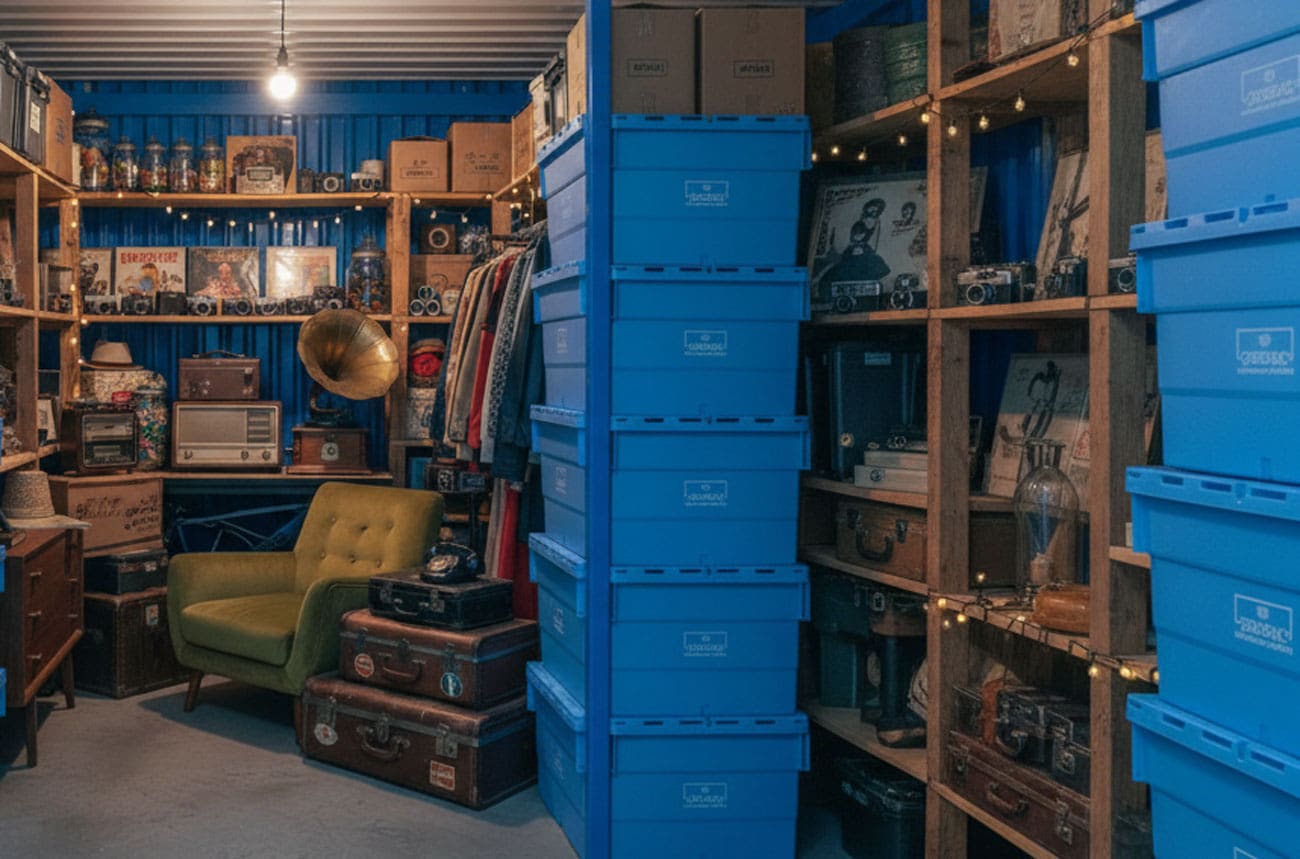
To preserve photos, collections, and vintage items long-term, it’s crucial to avoid humidity, high temperatures, and direct light. Using dehumidifying boxes, acid-free materials, and storing them in a stable environment like a mini-storage unit helps prevent damage, mold, and fading. This offers an effective solution for both individuals and collectors requiring long-term storage.
Why Are Photos, Collectibles, and Vintage Items Prone to Damage?
Photos and vintage items are susceptible to damage due to four environmental factors that accumulate over time: humidity, light, temperature, and oxidation. Unlike regular goods that show clear and rapid deterioration, the degradation process of photos and collectibles is subtle, irreversible, and often only discovered when the damage is too severe to restore.
This holds significant practical importance for anyone storing these collections or items: the storage environment is not merely an “added bonus” but a vital condition that determines the lifespan of the collection.
Humidity — The Number One Enemy of Photos and Stored Items
Humidity attacks organic materials through two parallel mechanisms: biological activation and physical structural breakdown.
Biological Mechanism — Mold and Bacteria:
Mold spores are ubiquitous in the air but remain dormant. When relative humidity (RH) exceeds 65–70%, these spores activate and begin to grow on any organic surface, such as photo paper, fabric, wood, leather, or canvas.
At 80% humidity and 25°C, mold can appear on photo paper in just 48–72 hours. Once fungal hyphae have penetrated the paper surface, there’s no method for complete restoration; only the progression can be slowed.
Physical Mechanism — Cyclical Expansion and Contraction:
Even more dangerous than mold is continuous humidity fluctuation. When humidity increases, cellulose fibers in paper absorb water and expand; when humidity decreases, they contract. This repeated expansion-contraction cycle, day after day, creates accumulated mechanical stress, making the paper brittle, fragile, and causing tiny hairline cracks to appear on the photo surface. This is why old photos often develop “crow’s feet” cracks even without physical impact.
Control Thresholds:
International conservation standards recommend maintaining humidity at 45–55% RH for photos and paper documents, with daily fluctuations not exceeding ±5% RH. In Vietnam, outdoor humidity often ranges from 75–90% RH during the rainy season, which is 20–35 percentage points higher than the safe threshold if not actively controlled.
Light — The Unseen Destruction Process
Light causes damage through photon energy, and this damage accumulates with the total amount of light exposure throughout an item’s lifespan, making it irreversible.
UV Rays and Visible Radiation:
Ultraviolet (UV) rays (wavelengths 10–400 nm) are the most destructive agents; UV photon energy is high enough to break chemical bonds in dye and pigment molecules. The result is uneven color fading, with the most sensitive tones (red, yellow in vintage color photos; blue in wool and silk fabrics) fading faster, creating an uncorrectable color shift.
However, UV rays are not the only concern. Visible light, including LED and fluorescent lighting, also causes fading through a similar mechanism, albeit more slowly. This means no light source is entirely safe for collectibles if exposed long-term.
Photo-oxidation:
Light also catalyzes oxidation reactions on material surfaces: photo paper yellows, glossy coatings on photos become cloudy, and paint on vintage ceramics tarnishes. This process significantly accelerates in the simultaneous presence of high temperature and humidity.
Specific Example:
A color photo printed on RC (resin-coated) paper, hung in a west-facing living room in Ho Chi Minh City, could lose 30–40% of its color saturation in just 5–7 years. In contrast, the same photo, stored in a dark box under controlled conditions, could maintain its quality for over 50 years (Wilhelm Imaging Research, 2019).
Temperature — The Accelerator of All Chemical Reactions
Temperature does not directly destroy materials; rather, it accelerates all ongoing chemical and biological reactions. This is why the conservation industry has a rule of thumb: for every 10°C increase, the rate of degradation doubles.
Thermal Hydrolysis:
At high temperatures, water molecules attack the glycosidic bonds in cellulose—the structural component of paper—breaking down long polymer chains into shorter segments. The result: paper loses mechanical strength, becoming brittle and prone to crumbling. This explains why old newspapers easily disintegrate, while properly stored documents remain intact for centuries.
Physical Deformation:
High temperatures soften plastics and bitumen in vinyl records, cassette tapes, and CD/DVDs—common formats in vintage music and film collections. Vinyl records can warp after just a few hours left in a car under direct sunlight (cabin temperatures can reach 60–70°C). Magnetic tape experiences delamination (the magnetic layer separating from the base) at temperatures above 40°C with prolonged exposure.
Dangerous Temperature Fluctuations in Vietnam:
Uncontrolled storage facilities in Ho Chi Minh City can reach 38–42°C during the day in the dry season, dropping to 28–30°C at night a daily fluctuation of 10–14°C. This continuous thermal expansion cycle causes damage similar to humidity fluctuations: accumulating mechanical stress and accelerating chemical degradation.
Control Thresholds:
NISO (National Information Standards Organization) standards recommend a temperature of 15–20°C for long-term photo preservation. For typical storage spaces that cannot achieve this optimal temperature, the practical goal is to maintain it below 25°C and minimize daily temperature fluctuations.

Oxidation — An Unstoppable Process, Only Slowable
Oxidation is a natural chemical reaction between materials and oxygen in the air that cannot be completely eliminated under normal storage conditions, but its rate can be significantly controlled.
Metals and Alloys: This group is the most visibly and noticeably affected. Silver in silver gelatin prints, the most common type of black-and-white photograph from the late 19th to mid-20th century, reacts with sulfur in the air to form brownish-yellow silver sulfide, a phenomenon known as silver mirroring. This is a typical sign of poorly preserved old black-and-white photographs.
Copper and copper alloys in coins, medals, and vintage decorative items form a green patina (copper carbonate / copper sulfate). In some cases, this patina is stable and intentionally preserved, but under high humidity, the corrosion process continues deep into the metal, causing irreversible loss of surface details.
Plastics and Polymers: Vintage plastic collectibles (Bakelite, cellulose acetate, PVC) undergo off-gassing, releasing volatile chemicals as the polymer degrades. Particularly dangerous is cellulose acetate, the material used for film negatives from the 1950s–1980s, which experiences “vinegar syndrome”: it decomposes to produce acetic acid, not only destroying the film itself but also attacking nearby items stored in the same enclosed space.
Paper and Ink: Lignin, a natural component in wood pulp, oxidizes over time to produce organic acids that yellow and embrittle paper (a process called acid hydrolysis). This is why old newspapers yellow quickly, while acid-free archival paper maintains its white color for decades. Vintage printing inks containing linseed oil oxidize and darken over time, especially noticeable in thick ink areas of old prints, maps, and books.
Why Are These 4 Factors More Dangerous When Acting Simultaneously?
It’s crucial to understand that these four agents do not act independently; they interact and amplify each other in a non-linear fashion.
High humidity accelerates metal oxidation (creating an electrolytic environment). High temperatures amplify the effects of humidity and oxidation. Light catalyzes photo-oxidation reactions and generates localized heat. Oxidation produces acid, which in turn attracts moisture, and moisture then fosters mold – a closed positive feedback loop.
| Agent | Mechanism of Damage | Rate of Impact | Is it Reversible? |
|---|---|---|---|
| High Humidity | Mold, mechanical expansion | Fast (48–72 hours for mold to appear) | No, only stops further progression |
| UV Light | Fading, photo-oxidation | Slow accumulation, not immediately noticeable | Cannot restore lost color |
| High Temperature | Accelerates all other reactions | Accelerates, not directly damaging | Partially with minor physical deformation |
| Oxidation | Chemical degradation of materials | Slow but continuous | No, only slows the rate |
There is no method to restore items already damaged by these agents. The only effective measure is to control the storage environment before damage occurs. This is the most fundamental principle of modern conservation science, and also why specialized storage with controlled temperature, humidity, and light is not a luxury but a minimum requirement for any valuable collection.
Golden Rules for Long-Term Preservation of Memorabilia
Effective preservation of memorabilia requires maintaining a stable, dry, and light-protected environment, using specialized materials to minimize damage over time. The majority of losses to photographs and collectibles do not occur due to accidents – but due to incorrect storage conditions that happen daily and go unnoticed: ordinary paper boxes slowly acidifying the photos inside, room humidity nurturing mold spores, and living room lights silently fading wall art.
The four principles below are not mere recommendations – they are the scientific foundation of conservation applied in the world’s largest museums and libraries, adapted for practical conditions in Vietnam.
Principle 1 — Control Humidity Within 40–60% RH
Relative humidity (RH) is the most critical environmental variable in preservation. Not because it causes damage fastest – but because it amplifies all other damaging agents and can cause irreversible damage in a very short time.
Why is 40–60% RH the golden range? Below 40% RH, organic materials (paper, fabric, leather) lose moisture and become brittle; photo paper easily cracks when rolled or folded, and vintage shoe leather develops surface cracks. Above 65% RH, mold spores activate and begin to grow. The 40–60% RH range maintains a balance, preventing materials from becoming too dry or too damp – this is precisely the range international museums apply for photo and document archives.
Fluctuation is more important than absolute value: The most common mistake is thinking that “not too high humidity” is sufficient. In reality, daily humidity fluctuations are just as damaging – if not more so – than prolonged high humidity levels. Each expansion-contraction cycle of cellulose fibers in paper creates cumulative mechanical stress. An unregulated storage space in Ho Chi Minh City can fluctuate 30–40% RH in a single day between sunny noon and rainy night – equivalent to thousands of stress cycles per year.
Practical solutions by level:
- Basic level — silica gel desiccant packs: Blue indicating silica gel absorbs moisture from the surrounding air and changes color from blue to pink when saturated – signaling the need for re-drying or replacement. Place in airtight boxes containing photos, albums, or collectibles. Recommended ratio: 1 x 50g silica gel pack for every 10–15 liters of box volume. Check and replace/re-dry every 3–6 months.
- Medium level — mini dehumidifier: A mini electric dehumidifier is suitable for storage rooms of 10–20 m², maintaining stable RH without frequent silica gel replacement. Investment cost is 500,000–2,000,000 VND, with low electricity consumption (20–50W).
- Professional level — environmental control storage: Dedicated archival storage with an HVAC system controlling both temperature and humidity 24/7, continuously monitored by data loggers and automatic alerts when thresholds are exceeded – the optimal solution for high-value or large collections.
- Essential tool: Digital temperature and humidity meter (hygrometer): priced from 100,000–300,000 VND at electronics stores. Place it inside the storage space, not outside; humidity inside an airtight box and outside the room can differ by 10–20% RH.

Principle 2 — Avoid Direct Light and Control Light Intensity
The total amount of light an item absorbs throughout its lifespan — known as the light exposure dose — is an irreversible, cumulative factor. Every hour of light exposure is a permanent “withdrawal” from the item’s “lifespan account,” which cannot be replenished.
Hazard classification of light sources:
| Light Source | UV Level | Damage Rate | Notes |
|---|---|---|---|
| Direct Sunlight | Very High | Very Fast | Absolutely Avoid |
| Sunlight through Regular Glass | High | Fast | UV-filtering glass reduces 70–99% |
| Fluorescent Lamps | Medium | Medium | Should use UV sleeves/covers |
| White LED Lamps | Low | Slow | Safer but not harmless |
| Warm LED Lamps (2700–3000K) | Very Low | Very Slow | Best choice if illumination is needed |
| Complete Darkness | None | None | Ideal for long-term storage |
Practical Guidelines:
- For long-term photo and document storage: Store in opaque, sealed boxes where light does not contact the items unless you actively open them for viewing. This is the simplest and most effective measure.
- For display collectibles: If you wish to display them, choose a location without direct sunlight, use low-intensity warm LED lamps, and periodically rotate items into dark storage for “rest.” Museums often apply this rotation principle displaying for a maximum of 3 months, then storing in a dark vault for at least 6 months.
- For wall-hung photos: Use UV-filtering museum glass — this type of glass filters 97–99% of UV rays and harmful light, while still allowing clear viewing of the photo. While 3–5 times more expensive than regular glass, it extends photo lifespan by 5–10 times.
- Simple Home Test: Place a white sheet of paper near your storage location and another sheet in a dark box. After 6 months, compare the two sheets — the color difference indicates the extent of light exposure affecting your stored items.
Principle 3 — Use Acid-Free Archival Materials
This is the least known principle but makes the biggest difference in practice. Most common packaging materials — paper boxes, plastic bags, newspapers, kraft paper — are silently destroying the items within.
Problems with Common Materials:
- Common paper and cardboard boxes: Contain lignin and acids from the pulping process. Over time, acids from the box off-gas into the air and deposit onto the item’s surface, causing paper yellowing, fading, and material degradation. This is the main reason why photos stored in regular hardcover photo albums yellow unevenly.
- Common PVC and polyethylene plastic sleeves: PVC releases hydrochloric acid (HCl) as it ages, which is particularly harmful to metals and photographs. Sealed, non-breathable plastic sleeves also create localized humid environments, promoting mold growth. Regular zip-lock bags may be safe for short-term use but are not suitable for long-term storage.
- Newspaper and kraft paper: Have very high acidity. Never use them to wrap collectibles, even for a short period — acids from printing ink and pulp transfer to the items within just a few weeks of contact.
- Proper Archival Materials: Acid-free boxes and paper (pH ≥ 7.0): Made from de-acidified pulp and contain an alkaline buffer (often calcium carbonate) to neutralize acids from the environment. The PAT (Photographic Activity Test) standard of ISO 18916 is the highest certification confirming that a material is safe for direct contact with photographs.
- Melinex/Mylar polyester or plasticizer-free polyethylene sleeves: Transparent, acid-free, non-off-gassing, allowing content viewing without removal. Suitable for film negatives, slides, individual photos, and important documents. Acid-free clamshell boxes: Designed to open like a book, with a lid that covers all sides — minimizing exposure to air and dust. The gold standard for storing vintage photographs and valuable documents.
- How to Identify Acid-Free Materials: Look for “acid-free,” “archival quality,” or “pH neutral” labels on the packaging. If these labels are absent, the product is almost certainly not archival standard. In Vietnam, specialized archival materials can be ordered through professional photography stores, art supply stores, or imported directly from brands like Gaylord, University Products, or Talas.
Principle 4 — Minimize Hand Contact and Handle Properly
Hands are the primary tool when working with collectibles and also one of the most common yet overlooked sources of damage.
Why Hands Cause Damage:
Skin secretes a mixture of sebum, sweat containing salts, lactic acid, and amino acids — all of which leave invisible fingerprints on sensitive surfaces. On photographic paper, fingerprints create areas with differing pH levels over time, which yellow or mold faster than the surrounding areas. On silver (gelatin silver prints), oils from hands catalyze the sulfidation process, causing fingerprints to appear clearly as dark stains after several years.
On vintage metal items (coins, medals, silverware), fingerprints leave corrosive acids that etch the surface layer, especially noticeable on polished surfaces. On vinyl records, hand oils attract dust into the grooves and accumulate as difficult-to-clean residue.
Proper Handling Procedures:
- Wear powder-free white cotton gloves: The basic standard for handling photos, documents, and paper collectibles. White cotton ensures no dyes transfer to the item, and powder-free ensures no residue is left behind. Replace or wash gloves after each handling session.
- Nitrile gloves (latex-free, powder-free) for metals and glass: Cotton can leave fibers on polished metal and glass surfaces — thin nitrile provides better tactile feel and leaves no lint. Handle photos by the edges, not the surface: When not wearing gloves, hold photos by their two side edges — avoid touching the photo surface or the sensitive coated back.
- Wash hands before wearing gloves, not as a substitute: Dirty gloves or gloves with external oils can still transfer harmful substances. Wash hands thoroughly with mild soap and dry completely before wearing gloves.
- Handling Environment: Never work with collectibles near food, drinks, or in dusty environments. Lay down a clean acid-free paper sheet or white foam board as a working surface before placing items on it. For small photos and film negatives, use soft-tip forceps/tongs instead of direct hand contact when high precision is needed.
| Principle | Objective | Essential Tools | Common Mistakes to Avoid |
|---|---|---|---|
| Humidity Control | Maintain 40–60% RH, fluctuation range ≤ ±5% | Silica gel, hygrometer, dehumidifier | Measuring room humidity instead of inside storage box |
| Light Control | Store in darkness, limit light exposure when displaying | Opaque dark boxes, UV-filtering glass | Displaying photos near sunny windows |
| Acid-Free Materials | Prevent acids from packaging materials attacking items | Acid-free boxes, Mylar polyester sleeves, neutral paper | Using regular cardboard boxes, PVC zip-lock bags |
| Proper Handling | Prevent oils and acids from hands contacting items | White cotton gloves (paper), nitrile gloves (metal) | Handling photos with bare hands, direct contact with photo surface |
The overarching principle of modern conservation science is that no measure can completely halt the aging process. The goal of preservation is to slow down the rate of degradation to the absolute minimum achievable, ensuring that meaningful items can endure for generations. These four principles, when applied simultaneously and consistently, can extend the lifespan of photographs and collectibles from several decades to hundreds of years — this is not an exaggeration, but a documented outcome in conservation practices at major museums worldwide.

Why Store Sentimental Items in Mini Storage?
Mini storage offers a stable, highly secure, and private environment, preserving sentimental items better than storing them at home. For items with emotional or financial value – such as multi-generational family photos, stamp/coin collections, vintage items, or important documents – an unsuitable storage environment isn’t just a risk; it’s a guaranteed loss, merely a matter of time.
The real question isn’t “is mini storage better than home storage?” but rather: can your home truly meet the conditions your sentimental items need?
A Practical Comparison: Home Storage Vs. Dedicated Mini Storage
| Criterion | Home Storage | Dedicated Mini Storage |
|---|---|---|
| Humidity Control | Difficult to control – fluctuates 70–90% RH during rainy season in Vietnam | Maintained stably at 45–60% RH year-round |
| Temperature Control | Depends on weather – can reach 38–42°C in summer | Air-conditioned 20–25°C continuously |
| Light Exposure | Difficult to fully control room light, windows | Dark space, no direct sunlight |
| Security | Standard house locks | 24/7 cameras, individual unit locks, on-site guards |
| Pest Risk | High — cockroaches, termites, rodents in a home environment | Low — regular pest control |
| Fire Risk | General risk to all assets in the house | Sprinkler system, dedicated independent fire protection |
| Space | Limited, often shared with daily necessities | Flexible — rent exact space needed, from 1–50 m² |
| Cost | No direct cost, but hidden damage costs | From 500,000 VND/month for a small unit |
The table above clearly shows the differences, but the most important figure often overlooked is the cost of improper storage. A family photo album ruined by mold, a 20-year coin collection oxidized, or a vintage wedding dress damaged by termites – these losses are irreplaceable, both financially and emotionally.
Reason 1 — Vietnam’s Humidity: A Challenge Most Homes Can’t Solve
Vietnam is located in a tropical monsoon climate zone, with average outdoor humidity ranging from 75–90% RH during the rainy season, especially in Ho Chi Minh City and southern provinces. This humidity penetrates every uncontrolled space in the home: wooden cabinets, cardboard boxes under beds, drawers, and small storage rooms.
The safe threshold for preserving photos and collectibles is 45–60% RH, which is 15–30 points lower than outdoor humidity during the rainy season. To maintain this threshold at home, you’d need air conditioning or a dehumidifier running continuously 24/7 in the storage space – the electricity and equipment costs are not low, and it’s often impractical for a home storage room.
Dedicated mini storage solves this problem with industrial HVAC systems operating continuously, with costs shared among hundreds of tenants. Each person pays only a small fraction of the total environmental control system’s operating cost.
Reason 2 — Multi-Layered Security That Homes Cannot Replicate
High-value sentimental items, both financially and emotionally, are often stored at home with inadequate security: a standard locker, sometimes just a cardboard box in a storage room.
Dedicated mini storage provides a multi-layered security system that typical homes cannot replicate at a reasonable cost:
- Building Access Control: Personal access cards or PINs; every entry/exit is recorded with time and identity. No one can enter the storage area without authentication.
- Individual Unit Locks: Padlocks or combination locks fully controlled by you; storage staff do not have keys to your unit. This principle is similar to a bank safe deposit box: the security infrastructure belongs to the storage facility, but only you can access the contents inside.
- 24/7 HD Cameras: Covering all hallways, entry areas, and blind spots; data stored for a minimum of 30 days. This provides clear legal evidence if any incident occurs.
- On-Site Guards: Physical presence 24/7, responding immediately to alerts from the security system.
Reason 3 — Private Space, Undisturbed, No Accidental Risks
A common reality: sentimental items stored at home are often disturbed during cleaning, reorganizing, or when other family members look for something else. Photos are misplaced, collectible boxes are stacked with heavy items, or albums get damp from being near a window after a house clean-up.
Self-storage mini units completely eliminate this risk: it’s your space, only you can enter, and no one else can accidentally harm what’s inside. This is especially important for collections or archival documents where a single mishandling can cause permanent damage.
Furthermore, mini storage spaces are designed specifically for storage – not living spaces that double as storage. There are no food odors, cigarette smoke, perfumes, or household chemicals that can seep into stored items over time.
Reason 4 — Flexibility According to Actual Needs
Storage needs are not always fixed. Collections grow over time. After inheriting grandparents’ antiques, space needs might suddenly increase. Or you might need to store more items when reorganizing your home.
Mini storage allows you to rent the exact space needed, adjusting to actual circumstances, from small units of 1–2 m² for a few boxes of photos and documents, to large units of 10–20 m² for extensive vintage collections. Monthly contracts mean you’re not tied to long-term commitments when your needs are unstable.
Practical calculation: The cost of renting a small mini storage unit (2–3 m²) in Ho Chi Minh City or Hanoi ranges from 500,000 – 800,000 VND/month, equivalent to approximately 20,000–27,000 VND/day. Compared to the value of the items preserved inside and the priceless cost of losing them permanently, this is a highly cost-effective protective investment.

Who Are Mini Storage Units Best Suited For?
Not everyone needs a mini storage unit, but for the following groups, it’s often a more optimal choice than storing items at home:
- Individuals with multi-generational family photo collections, especially analog film, black and white photos from before 1990, and film negatives – items that are irreplaceable if damaged.
- Collectors of vintage items, coins, stamps, and old books whose growing collections exceed the safe storage space available at home.
- Those preserving mementos of deceased loved ones – items with irreplaceable sentimental value that need to be safeguarded for future generations.
- People who move frequently or rent homes without stable long-term storage space, needing a fixed and secure location regardless of changes in residence.
- Individuals with high-value collections such as vintage watches, wine collections, or art, where preservation conditions directly impact their value when sold or auctioned in the future.
Checklist for Safe Photo & Collectible Preservation
Effective preservation requires a combination of suitable storage environments, specialized materials, and regular inspections to limit cumulative damage over time. The checklist below is divided into three stages – pre-storage, during storage, and periodic checks – because preservation is not a one-time action but a system that needs consistent maintenance.
Stage 1 — Pre-Storage Preparation
This is the most crucial and often overlooked stage. Placing items into storage without proper preparation is like setting a time bomb; damage will occur, just slower and harder to detect.
- Clean before storing: Dust, grease, and organic matter on item surfaces are nutrients for mold and bacteria. Gently wipe surfaces with a clean, lint-free microfiber cloth before placing them in boxes. For photos: do not use a damp cloth; only use a soft brush or blower to remove dust. For vintage metals: wipe with a dry cotton cloth; do not use chemicals unless specifically recommended by an expert.
- Choose proper acid-free boxes and materials: Regular cardboard boxes, PVC plastic bags, and newspaper are silently destroying what’s inside. Replace them with acid-free boxes (pH ≥ 7.0), Melinex/Mylar polyester sleeves, or plasticizer-free polyethylene bags. For photo albums: choose those with acid-free pages; avoid albums with clear PVC plastic sleeves – common stationery store types often contain PVC, which releases HCl over time.
- Avoid poor-quality lamination: Lamination (plastic coating) may seem to protect photos, but it’s actually a trap: the plastic layer traps moisture and heat close to the photo surface, accelerating fading and yellowing, especially for photos over 20 years old. If you want to protect photos for frequent viewing, use clear Mylar sleeves instead – they allow viewing without direct contact and don’t create heat/moisture traps.
- Place silica gel in each storage box: Standard ratio: 1 packet of 50g blue indicating silica gel per 10–15 liters of box volume. Do not place directly on items – wrap in a thin cotton cloth or place in a small mesh bag, positioned in a corner of the box. Mark the date placed in the box to know when to check.
- Wear gloves before handling: Use white, powder-free cotton gloves for paper, photos, and documents. Use thin, powder-free nitrile gloves for metals, glass, and lacquerware. Never touch the surface of photos directly – oils and acids from hands leave invisible fingerprints that yellow after a few years and cannot be removed.
- Label the outside of boxes – do not write on items: Record content information, storage date, and sensitivity level on labels affixed to the outside of the box. Never write directly on the back of photos with regular pens – ballpoint and felt-tip pen ink bleeds through the paper and creates stains on the front over time. If notes are needed on photos, use a light 2B pencil in a corner on the back.
Stage 2 — Storage Environment Standards to Check
Whether storing at home or renting a specialized mini storage unit, the storage environment must meet the following minimum criteria. These are not museum standards; they are practical thresholds to prevent item damage under Vietnamese conditions.
- Check humidity is within 45–60% RH: Use a digital hygrometer (priced from 100,000–300,000 VND) placed inside the storage space, not outside the room. If humidity consistently exceeds 65% RH, a dehumidifier is needed, or move to a climate-controlled storage unit. In Vietnam, uncontrolled storage can reach 80–90% RH during the rainy season – nearly double the mold activation threshold.
- Check temperature is maintained below 25°C: The ideal temperature is 15–20°C according to international conservation standards, but a realistic goal in Vietnam is below 25°C with limited daily fluctuations. Unconditioned storage in HCMC can reach 38–42°C during dry season days – every 10°C increase doubles the rate of degradation according to Arrhenius’s rule.
- Ensure the space is dark, with no direct light: Storage boxes should not be placed near windows, fluorescent lights, or any direct light source. Cumulative light causes irreversible fading; the total amount of light exposure over an item’s lifetime is the determining factor, not just instantaneous intensity.
- Confirm the storage area is free of termites, cockroaches, and rodents: Insects and rodents cause rapid and thorough damage – one night with rats in storage can destroy what 50 years of natural aging might not. Check for signs of insect droppings, gnaw marks, or termite nests in and around the storage area before placing items.
- Confirm the fire protection system is operational: For mini storage: check the validity of the fire safety acceptance certificate and ask if the sprinkler system operates independently of your storage area. For home storage: place a mini fire extinguisher near the storage area and ensure sealed, acid-free boxes provide an additional layer of physical protection.
Stage 3 — Periodic Checks
Preservation is a continuous system, not a one-time action. Regular inspection schedules help detect early signs of degradation before they become irreversible damage.
- Check silica gel every 3–6 months: Blue indicating silica gel turns pink/white when saturated with moisture – it needs to be reactivated by baking at 120°C for 2 hours or replaced. Ineffective silica gel that isn’t replaced is more dangerous than having no silica gel – it creates a false sense of security while no longer providing real protection.
- Visually inspect items every 6–12 months: Open boxes and inspect each item under good light (but not direct light on photo surfaces). Look for signs: white or gray spots on the surface (early stage mold), uneven yellowing, sour or musty smell, rust on metal, cracks on leather or fabric. Early detection at this stage allows for timely intervention – waiting until it’s clearly visible is often too late.
- Scan and back up important photos and documents: Digital copies do not replace the original’s value – but they are the best insurance against natural disasters, fires, or unforeseen sudden damage. Scan at a minimum resolution of 600 DPI for photos and general documents, 1200–2400 DPI for film negatives and small photos. Save original files in TIFF format (uncompressed) and viewing copies in high-quality JPEG. Back up to at least 2 independent storage locations – external hard drive and cloud storage.
- Update labels and storage records: Note any observed changes, inspection dates, and any interventions made. This storage record has dual value: it helps you track the condition of your collection over time and increases the provenance value if financially valuable items are sold or auctioned in the future.
| Stage | Item | Frequency |
|---|---|---|
| Preparation | Clean items before storing | Each new storage instance |
| Preparation | Use acid-free boxes & materials | Each new storage instance |
| Preparation | No lamination – use Mylar sleeves instead | Each new storage instance |
| Preparation | Place silica gel in each box | Each new storage instance |
| Preparation | Wear gloves when handling | Each contact |
| Environment | Check humidity 45–60% RH | Monthly |
| Environment | Check temperature below 25°C | Monthly |
| Environment | Ensure dark, no direct light | Each time entering/exiting storage |
| Periodic | Check & replace silica gel | Every 3–6 months |
| Periodic | Visually inspect all items | Every 6–12 months |
| Periodic | Scan backup important photos & documents | First year, then when new items are added |
| Periodic | Update storage records | After each inspection |
Priority Principle When You Can’t Do Everything At Once: If you have to choose only 3 actions from this entire checklist, prioritize them as follows: (1) acid-free materials – preventing internal damage sources within the box; (2) humidity control – preventing the biggest environmental damage source; (3) scan backup – the ultimate insurance for irreplaceable items. These three actions, applied simultaneously, eliminate most damage risks with minimal cost and effort.
FAQ
How can I preserve old photos to prevent deterioration over time?
Effective photo preservation requires controlling four factors simultaneously: maintain humidity between 45–60% RH using silica gel or a dehumidifier; store in acid-free boxes away from all direct light; avoid laminating photos entirely as the plastic layer traps heat and moisture against the photo surface, accelerating fading; and always handle with lint-free white cotton gloves to prevent oils and acids from fingers leaving invisible fingerprints that yellow over years. Scanning backups at 600 DPI or higher is an essential additional layer of protection.
What humidity level is safe for preserving photos and collectibles?
The safe humidity range for preserving photos and collectibles is 45–60% RH, with daily fluctuations not exceeding ±5%. Below 40% RH, organic materials such as paper and leather become brittle and prone to cracking. Above 65% RH, mold spores activate and can appear on photo paper surfaces within just 48–72 hours. In Vietnam, outdoor humidity during the rainy season regularly reaches 75–90% RH — exceeding the safe threshold by 15–30 points without active control through dehumidifiers or a climate-controlled storage environment.
What is an acid-free box and why is it more important than regular cardboard?
An acid-free box is made from de-acidified wood pulp with an alkaline buffer added (typically calcium carbonate, pH ≥ 7.0) to neutralize acids from the surrounding environment. Regular cardboard contains lignin and acids from the wood pulp manufacturing process — over time, these acids off-gas into the air inside the box and deposit onto photo surfaces, causing uneven yellowing and breaking down paper structure. This is the primary reason photos stored in standard hardcover albums deteriorate even when never exposed to moisture. Archival-quality boxes are labeled “acid-free”, “archival quality” or carry PAT certification per ISO 18916.
Why should photos not be laminated for preservation?
Laminating photos appears protective but causes long-term harm for three reasons: the plastic layer traps heat and moisture against the photo surface, accelerating the chemical reactions that cause fading and yellowing; some laminate plastics contain PVC that releases hydrochloric acid (HCl) as it ages, corroding the silver and dyes within the photo; and most critically — lamination is irreversible, meaning any deterioration occurring beneath the plastic layer cannot be repaired or treated. The best alternative is a clear polyester Mylar sleeve — allowing photos to be viewed without direct contact, without creating a heat-moisture trap, and without off-gassing harmful chemicals.
What resolution should old photos be scanned at for long-term digital preservation?
For long-term digital archiving, scan photos at a minimum of 600 DPI for standard-sized prints (4×6 inches and larger) — sufficient to reprint or enlarge without significant quality loss. For small photos, film negatives, and slides, scan at 1200–2400 DPI to preserve full detail. Save master files in TIFF format (uncompressed, lossless) and working copies as high-quality JPEG. Back up to at least two independent locations — an external hard drive and cloud storage — following the 3-2-1 rule: 3 copies, on 2 different storage formats, with 1 copy stored off-site.
Are cotton or nitrile gloves better for handling collectibles?
The choice depends on the type of item. Lint-free white cotton gloves are the standard for paper, photos, and documents — soft, chemical-free, and containing no dyes that could transfer to items. Thin powder-free nitrile gloves are better suited for metals, glass, and polished surfaces — cotton can leave small fibers on polished surfaces that reduce surface quality. Both types must be powder-free since talc powder leaves white residue on items. Importantly: wash hands thoroughly and dry completely before putting on gloves — dirty or damp gloves still transfer contaminants to the items being handled.
Is a dedicated mini storage unit genuinely better than storing keepsakes at home?
For items with high emotional or financial value, dedicated mini storage outperforms home storage across most critical criteria: maintaining stable humidity at 45–60% RH year-round (while Vietnamese homes can reach 80–90% RH during rainy season); continuously air-conditioned to below 25°C; multi-layer security with 24/7 cameras and individual unit locks; no insects, food odors, or household chemicals penetrating the storage space; and a dedicated area that remains undisturbed. Costs start from VND 500,000 per month for a small unit — approximately VND 20,000 per day to protect items that cannot be recovered or replaced if lost or damaged.
How is silica gel used in photo preservation and when should it be replaced?
Silica gel absorbs moisture from the air inside storage boxes, maintaining stable humidity below the mold activation threshold. Use indicating silica gel — the beads change from blue to pink/white when saturated with moisture, signaling the need for replacement or regeneration. Standard ratio: one 50g packet per 10–15 liters of box volume. Never place directly on items — wrap in a small mesh bag and place in a corner of the box. Check every 3–6 months; regenerate by heating at 120°C for 2 hours or replace entirely. Saturated silica gel that hasn’t been replaced is more dangerous than having none at all — it creates a false sense of security while providing no actual protection.
Are LED lights safe for photos and collectibles?
LED lights are safer than fluorescent lights and direct sunlight, but are not completely harmless for items in long-term storage. The total cumulative light exposure throughout an item’s lifetime — including light from LEDs — is the factor that causes irreversible fading. Warm LED lights (2700–3000K) emit the least UV and are the best choice if lighting is needed in storage areas. However, the optimal solution for long-term storage remains complete darkness — store in opaque closed boxes and only bring items into light when genuinely needed for viewing. For displayed photos, UV-filtering museum glass that blocks 97–99% of UV radiation extends the lifespan of photos by 5–10 times.
How often should stored photos and collectibles be inspected?
A recommended periodic inspection schedule follows three timeframes: check silica gel every 3–6 months — observe the indicator color and replace or regenerate as needed; conduct a full visual inspection of all items every 6–12 months — look for signs of mold (white/gray spots), unusual yellowing, sour or musty odors, rust on metal items; check environmental control equipment (hygrometer, dehumidifier) monthly to confirm the system is functioning correctly. Early detection at the stage of small mold spots allows timely intervention — waiting until mold has spread extensively is typically too late for recovery.