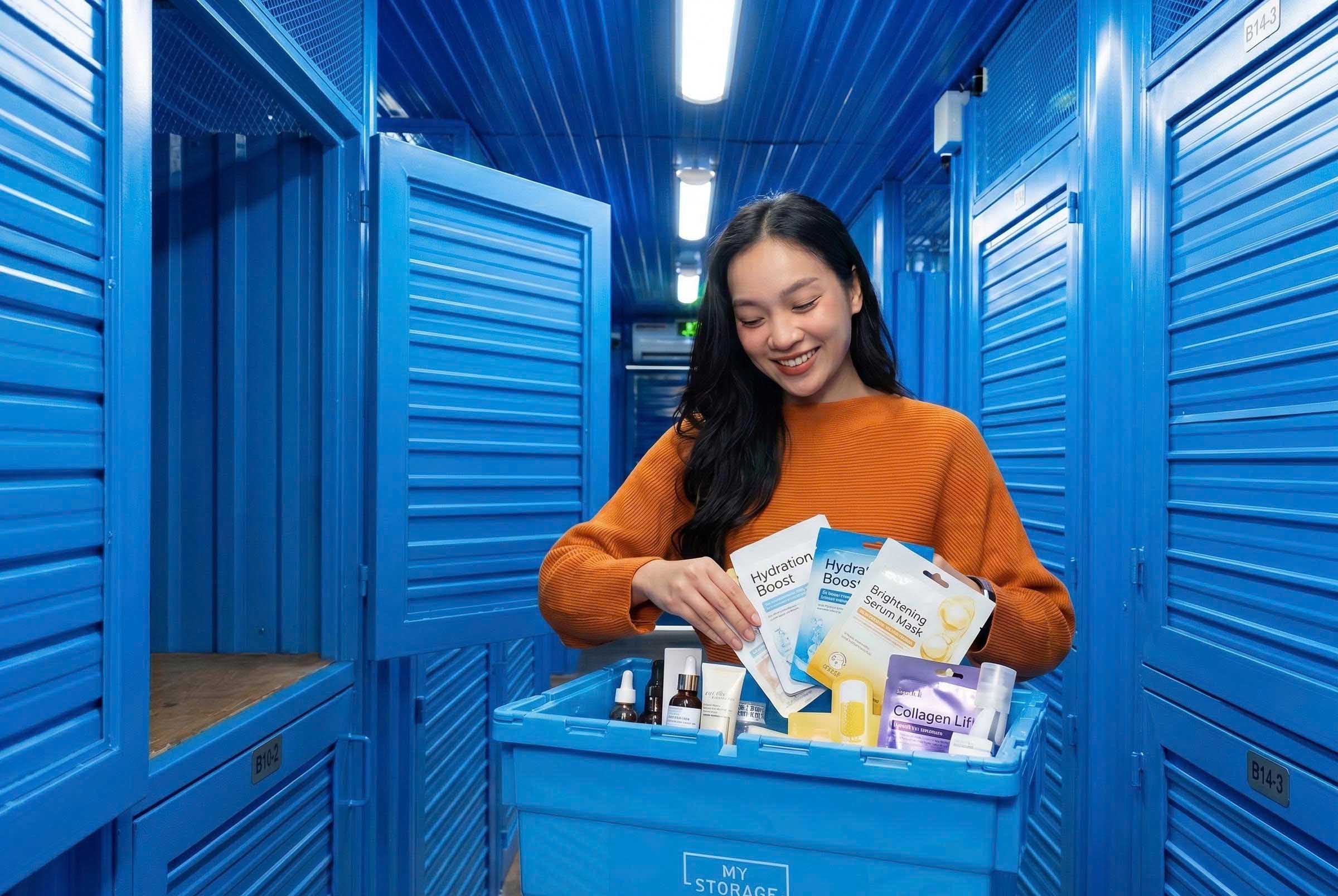
Cosmetic storage helps Shopee, TikTok Shop, and online store sellers store goods safely, cleanly, and more manageably as order volumes increase. Given their sensitivity to temperature and humidity, cosmetics need to be stored in a stable environment to prevent quality degradation. Renting a private warehouse also helps shops optimize living space, manage inventory better, and operate sales more professionally during campaign seasons or livestreams.
Why Do Shopee and TikTok Shop Sellers Need a Dedicated Cosmetic Warehouse?
Most online cosmetic sellers start by storing goods at home, but as orders grow through major sale events, living space is quickly occupied and the quality of cosmetic preservation is no longer guaranteed. A private warehouse is an inevitable transition once a shop surpasses the threshold of several dozen orders per day.
- Goods piling up in bedrooms and living rooms: A few initial boxes are easy to manage, but after each large stock intake before 9.9, 11.11, or Tet sales, inventory levels spike 3–5 times higher than normal. Bedrooms become storage rooms, walkways are blocked by cardboard boxes, and the family’s living space is significantly narrowed. Many sellers report having to sleep next to hundreds of boxes of lipsticks, serums, and creams for several consecutive weeks before and after major sale periods.
- Difficulty controlling inventory when goods are scattered: When goods are scattered in various places around the house without a clear classification system, sellers easily confuse different batches, forget the expiration dates of each lot, or lose track of exactly how many units remain for each SKU. Inventory errors directly lead to overselling and order cancellations, affecting shop ratings and losing loyal customers.
- Living space severely affected: The boundary between living and business space blurs as goods spill out of a single room. The scent of certain cosmetics, cardboard packaging accumulating moisture, and blocked walkways create an uncomfortable living environment for the whole family. For sellers with young children, keeping cosmetics and chemical products in living areas also poses safety risks that need to be addressed early.
- Cosmetics require stricter storage conditions than general goods: Not every item can withstand arbitrary storage conditions. Cosmetics are particularly sensitive to high temperatures, direct sunlight, and fluctuating humidity. Vitamin C serums oxidize and change color when kept in hot places. Sunscreens separate when temperatures consistently exceed 30°C. Lipsticks melt and deform when placed near windows with sunlight. This damage not only causes direct financial loss but also leads to customer complaints and negative reviews that long-term affect the shop’s reputation.
Initially, a few orders a day are manageable, but after major sales, the house practically turns into a warehouse. This is a sign that the shop has grown enough to need a specialized storage space, completely separate from the living area. Self-managed storage not only solves the space issue but also upgrades the entire operational process from receiving goods and storage to packaging and delivery.
Common Issues When Storing Cosmetics at Home
Storing cosmetics at home affects both product quality and operational efficiency. Uncontrolled temperatures damage active ingredients, cramped spaces lead to inventory management errors, and the boundary between personal life and work gradually disappears.
- Hot and humid temperatures degrade cosmetic quality: Average temperatures in Ho Chi Minh City fluctuate between 28–35°C year-round, combined with 75–85% humidity, creating ideal conditions for cosmetics to degrade quickly. Vitamin C and retinol oxidize and lose effectiveness when exposed to prolonged high temperatures. Sunscreens separate and lose SPF efficacy when stored above 30°C. Lipsticks, balms, and waxes melt or deform when placed near windows with sunlight. Damaged products not only cause direct financial loss but also lead to customer complaints, 1-2 star reviews, and long-term impacts on the shop’s reputation score on e-commerce platforms.
- Difficulty managing expiration dates without a system: Cosmetics have much shorter shelf lives than general goods, typically 12–36 months from the date of manufacture. When goods are scattered in various places around the house without a first-in, first-out (FIFO) order, sellers easily sell near-expiry batches after newer ones by mistake. The consequence is expired inventory that must be discarded, with losses potentially reaching tens of millions of VND per stocktake if a clear management system isn’t in place from the start.
- Easy to lose track of inventory amidst living spaces: When goods are in closets, under beds, in kitchen corners, and on balconies all at once, no one can know exactly what the total actual inventory is. Sellers frequently fall into two situations simultaneously: overselling because they think they have stock when they are actually out, or ordering unnecessary extra stock because they can’t find the old batch hidden somewhere in the house. Both cause cash waste and directly affect the shop’s operational cash flow.
- Insufficient space for professional order packaging: Packaging is the stage that directly affects customer experience and 5-star rating ratios. Without a dedicated packaging area, sellers often have to use dining tables or the floor, lacking organized packaging tools and wasting time searching for wrapping materials, mailers, and labels. During peak sales when processing 50–200 orders per day, the lack of specialized packaging space becomes the biggest bottleneck in the entire operational process.
- Imbalance between living and work space: When a home serves simultaneously as a warehouse, office, and packaging area, the boundary between personal life and work almost disappears. Stress accumulates when there is no real space to relax, affecting sleep quality and work morale in the long run. For sellers with families, this situation also creates conflict over shared living spaces, especially during peak periods when goods overflow everywhere. This is the clearest sign that a shop has grown large enough to need a complete separation of business space from the residence.

What Standards Should a Cosmetic Warehouse Meet?
A cosmetic warehouse doesn’t just need to be spacious; it must meet four core standards: stable temperature and humidity control, a clean environment with minimal dust, 24/7 security, and flexible space for sale seasons. Lacking any of these criteria directly impacts product quality and the shop’s reputation.
| # | Description | Required Standards | How MyStorage Meets Them |
|---|---|---|---|
| Temperature & Humidity Control | A stable environment is the most crucial factor when storing cosmetics, especially for active skincare and perfumes that are easily affected by high temperatures and sudden humidity changes. | Temperature 20–26°C, humidity 50–65% RH, with no major fluctuations regardless of the weather | Air conditioning and dehumidifying systems operate continuously, maintaining stable conditions year-round regardless of external weather. Suitable for preserving skincare, makeup, and perfumes |
| Clean Environment & Dust Limitation | Dust on cosmetic packaging not only affects the product’s image upon delivery but also signals an unhygienic warehouse environment, which can easily lead to quality complaints. | Clean warehouse floors, shelves with covers or protective wrapping, no insects, and no mold | The warehouse is cleaned periodically, featuring dust-proof epoxy floors and easy-to-clean stainless steel or plastic shelves. No windows with direct sunlight exposure, minimizing external dust |
| Camera & 24/7 Security | Cosmetics are high-value, compact, and portable items, making them common targets for loss if the warehouse security system is not robust enough. | Full-coverage HD cameras, individual locks for each unit, clear access logs, and permanent security guards | 24/7 cameras with 90-day footage storage; each unit has its own lock with a personal PIN code. Only the owner has access; MyStorage staff do not open customers’ units |
| Flexible Space for Sale Seasons | Inventory needs for cosmetic sellers fluctuate significantly by campaign: increasing 3–5 times before 9.9, 11.11, and Tet, then decreasing rapidly after sales end. Flexible warehousing helps sellers avoid paying for unnecessary space. | Monthly rentals, flexible space expansion or reduction, and no penalties for changes | Sellers can expand to adjacent units before sale seasons and downsize afterward. With 1–2 weeks’ notice, MyStorage assists in arranging suitable units in the shortest time possible |
Real-Life Experiences of Online Cosmetic Sellers When Renting a Warehouse
Many Shopee and TikTok Shop sellers, after moving their goods to mini-warehouses, have solved three problems simultaneously: reclaiming their living space, ensuring cosmetics are stored in proper conditions, and significantly speeding up order processing during sale seasons. This represents a transformation in both quality of life and business efficiency.
Real-World Experience After Renting a Warehouse
| Issues Before Renting a Warehouse | Changes After Having a Private Warehouse |
|---|---|
| Goods piled up in bedrooms and living rooms, constant family complaints, especially before major sales when inventory surges 3–5 times higher than usual | All stock moved to the warehouse; the home returns to its intended living function. No more waking up at night worrying about falling boxes or house cats climbing on cartons |
| Packing on the dining table or floor, lack of space to spread out goods, packing materials scattered everywhere, processing 50–100 orders per day took nearly double the necessary time | Dedicated packing area in the warehouse with long tables, material racks, and goods within arm’s reach. Order processing speed increased by 40–60%, especially effective during flash sales when orders flood in continuously |
| Not knowing the exact inventory of each SKU, frequent overselling or over-ordering because old stock couldn’t be found, near-expiry items mixed with newly imported goods | Goods categorized by product line and batch, clear expiration labels, inventory managed by the First-In-First-Out (FIFO) principle. Almost completely eliminated overselling and expired inventory |
| During 11.11 sales and Lunar New Year, large quantities were imported but there was no storage space, having to store items at relatives’ houses or refuse to restock despite knowing they would sell | Rented adjacent storage units before the sale season and scaled back after the peak. Proactively increased inventory 3–4 times without affecting living space or turning down good orders |
| Serums and active skincare kept in hot rooms discolored, lipsticks melted when placed near windows, customers complained about quality despite products being within their expiry date | Warehouse maintains 20–26°C and 50–65% RH humidity year-round. Product quality complaints dropped significantly, and shop ratings improved after the first 1–2 months |
Comparison: Storing Cosmetics at Home vs. Renting a Mini Warehouse
| Criteria | Storing at Home | Renting a Mini Warehouse |
|---|---|---|
| Living Space | Constantly occupied, worst during stock-ups before major sales | Home and warehouse are completely separate; living space remains unaffected |
| Cosmetic Preservation | Temperatures of 28–35°C, uncontrolled humidity, serums easily oxidize, lipsticks easily melt | Stable 20–26°C and 50–65% RH humidity, preserving product quality until it reaches the customer |
| Inventory Management | Goods scattered in multiple places, hard to audit, easy to mix up batches and expiry dates | Clear zoning, full labeling, fast auditing, First-In-First-Out (FIFO) easily implemented |
| Order Packing | Lack of fixed space, extra time spent finding materials, difficult to handle order surges | Dedicated packing area, materials within reach, processing speed increases by 40–60% |
| Professionalism | Shop image affected when goods are damaged due to poor storage, leading to more complaints | Shop has clear operational processes, lower complaint rates, and more stable ratings |
| Scalability | Limited by home area, cannot import large volumes before sales without affecting daily life | Increase warehouse space according to sale seasons, scale down after peaks, no long-term commitment required |
| Actual Cost | No direct warehouse costs but potential losses from damaged goods, overselling, and inefficient processing time | From 500,000–1,500,000 VND per month depending on size, much lower than losses from damaged goods and negative reviews |
| Best Suited For | New shops, under 10 orders per day, low inventory, and no immediate expansion plans | Shops with over 20 orders per day, growth plans, and a desire to professionalize operations |
Who Is Suitable for Cosmetic Warehousing Services?
Cosmetic warehousing services are suitable for any entity whose inventory growth exceeds home storage capacity or those needing a more stable preservation environment: Shopee sellers, TikTok Shop sellers, skincare brands, import resellers, and e-commerce startups in the expansion phase.
| Target Audience | Need Triggers | Commonly Stored Assets | Main Pain Points | Suitable Area |
|---|---|---|---|---|
| Shopee Sellers | Orders exceed 20–30 per day, no more room at home before flash sales and major campaigns | Skincare, makeup, beauty tools, packing materials | Cramped home, slow packing, difficult to control inventory for many SKUs | 2–8 m² |
| TikTok Shop | Livestreaming creates sudden order surges, needing to process 100–500 orders post-live, home space cannot match required packing speed | Flash sale items, promotional combos, free gifts, gift set materials | Order surges after lives, unable to pack in time, wrong orders due to disorganized stock | 3–10 m² |
| Skincare Brands | Self-produced or OEM brands needing to store finished products in correct conditions before dispatch, especially temperature-sensitive active ingredients | Batch-based finished products, raw packaging materials, samples, certification documents | Preserving active ingredients at the right temperature, strict batch and expiry management | 5–20 m² |
| Imported Cosmetic Resellers | Importing large quantities from Korea, Japan, or the US to optimize costs, needing batch and origin-based sorting before distribution | Bulk imports, multiple batches, goods awaiting inspection or distribution | Managing multiple batches simultaneously, avoiding near-expiry mix-ups, clear inbound/outbound control | 8–25 m² |
| E-commerce Startups | Rapid growth phase, not yet large enough for big warehouses but exceeded home capacity, needing flexible monthly solutions | Various product lines, samples, marketing materials, bundle products | Flexible warehouse costs, no long-term commitment, easy to expand as revenue grows | 3–12 m² |

- Shopee Sellers: The threshold for renting a warehouse usually occurs when a shop consistently processes over 20 orders per day or prepares for major campaigns like 9.9, 11.11, and Tet. A 2–5 m² locker is sufficient for regular inventory and can be expanded to adjacent units before peak sales without needing to change long-term contracts.
- TikTok Shop: The unique nature of TikTok is that orders are concentrated within a few short hours after each livestream, creating immense processing pressure in a short time. A private warehouse with a fixed packing area and goods organized by processing order helps sellers shorten the packing time per order and reduce errors when handling hundreds of orders simultaneously.
- Skincare Brands: These have the strictest storage requirements in this group. Finished products containing vitamin C, retinol, and peptides require temperatures below 25°C and strictly controlled humidity to ensure product efficacy for consumers. Self-managed warehouses with environmental controls meet these standards at a much lower cost than renting specialized cold storage.
- Imported Cosmetics Resellers: Managing multiple batches from various sources requires a clear zoning system and full labeling. A private warehouse allows resellers to organize goods by country of origin, import date, and expiration date, ensuring the first-in-first-out (FIFO) principle and minimizing losses from expired inventory.
- E-commerce Startups: The initial phase from 6 months to 2 years often sees highly volatile and unpredictable storage needs. Monthly rental contracts without long-term commitments allow startups to flexibly adjust warehouse space according to actual growth rates without being tied down by excessive fixed costs during periods of uncertainty.
The transition from storing goods at home to a private warehouse is not just a decision about space but a strategic move for development. Once a shop surpasses the threshold of several dozen orders per day, old operational methods are no longer sufficient to maintain service quality and growth speed simultaneously.
Self-managed storage helps cosmetic sellers solve three problems at once: preserving goods under the right conditions to maintain product quality, separating living space from business space to maintain quality of life, and building professional operating procedures to prepare for the next growth phase. With storage costs starting from 500,000 VND per month, this is an investment that creates real value from the very first month.
FAQ
When should a cosmetics seller start renting storage?
When the shop consistently processes over 20 orders per day, stock begins taking over living space, or customer complaints about product quality start increasing. These are the three clearest signs that home storage no longer suits the shop’s current scale.
Is self-storage suitable for storing serums and active skincare products?
Yes, if the facility maintains 20–26°C and 50–65% RH humidity. These conditions prevent vitamin C discolouration, retinol degradation, and active ingredient breakdown before the expiry date printed on the packaging.
Will lipstick and makeup products deteriorate in storage?
Not if the facility maintains temperatures below 28°C and avoids direct light exposure. Lipstick melting and cushion separation occur mainly when temperatures exceed this threshold for extended periods, common in homes without continuous air conditioning.
Do self-storage facilities support on-site order packing?
Many self-storage providers allow customers to use their unit as a working area including order packing. Sellers should confirm with the facility about bringing folding tables, packing materials, and label printers into the unit.
How do I effectively manage cosmetic expiry dates in storage?
Apply the first-in-first-out principle: older stock placed in front for easy access, newer stock behind. Label every box with the intake date and expiry date, and conduct monthly inventory checks to identify batches approaching expiry before it becomes a problem.
How much does cosmetics storage cost in Ho Chi Minh City?
A 2–5 m² unit suitable for mid-sized sellers ranges from 500,000–1,200,000 VND per month at MyStorage. Compared to losses from a single batch of damaged serums or negative reviews from poor-quality products, this cost is typically recovered within the first few weeks.
Do TikTok Shop sellers have different storage needs compared to Shopee sellers?
TikTok Shop sellers should prioritize units with ample packing space since orders concentrate after each livestream, potentially reaching 100–500 orders within a few hours. Shopee sellers typically have steadier order flow and prioritize SKU-based inventory zoning over packing speed.
Do imported cosmetics require special documentation for self-storage?
Self-storage facilities do not require import documents or product certifications. Sellers only need a rental agreement and personal or business identification. Ensuring the legal compliance of stored goods is the seller’s responsibility, not the storage provider’s.
Is self-storage suitable for skincare brands with their own production?
Suitable if finished products do not require cold storage below 15°C. Self-storage maintaining 20–26°C suits most standard skincare products. For products requiring lower temperatures such as probiotic or live-culture skincare, confirm specific storage conditions with the facility before signing.
What should a cosmetics seller prepare before renting a storage unit?
List all SKUs and estimate total stock volume to choose the right unit size. Prepare clearly labeled boxes, small shelving for tiered storage if needed, and an initial inventory list. Set up a zoning and labeling system from day one so ongoing inventory management requires minimal additional effort.